
This weekend will see the rise of the May 2026 Blue Moon, best seen on 30/31 May in the southeast around sunset.
By the end of May 2026, we will have seen two full Moons rise: one on 1st May and a second on 31st May.
That makes the 31st May 2026 full Moon a blue Moon and means we'll see 13 full Moons in 2026, rather than the usual 12.
Here we'll look at what a blue Moon is, explore the difference between a monthly and a seasonal blue Moon, and all you need to know to see it.

Quick tips for observing the Blue Moon
- Find a southeastern/southern horizon that's flat and clear of tall buildings
- Head out just before sunset
- Look to the southeast and spot the Blue Moon rise as the Sun sets
- Don't use any optical equipment – our advice is to enjoy the spectacle as a naked-eye view
- Once the Sun sets, look to the western sky and see if you can spot bright planets Venus and Jupiter
May 2026 blue Moon rise times
| Region | City | Moonrise (local time) |
|---|---|---|
| North America | New York City | 21:12 |
| Toronto | 21:49 | |
| Los Angeles | 20:51 | |
| UK & Ireland | London | 22:05 |
| Edinburgh | 22:08 | |
| Cardiff | 22:17 | |
| Belfast | 22:55 | |
| Dublin | 22:45 | |
| Europe | Paris | 22:40 |
| Berlin | 22:18 | |
| Madrid | 22:18 | |
| Australia | Sydney | 16:30 |
| Asia/Middle East | Dubai | 19:34 |
| Singapore | 19:08 | |
| New Delhi | 19:31 |
Why blue Moons happen
What makes a blue Moon? We all know the phrase 'once in a blue Moon', meaning something that happens very rarely.
The origins of the term relate to our yearly calendar, which has its roots in astronomy.
As a quick primer on the Sun-Earth-Moon system and how it informs our calendar:
- A day is how long it takes Earth to rotate once on its axis
- A year is the time it takes Earth to orbit the Sun
- A month is based on the length of time it takes the Moon to orbit Earth
It's that last one that gives us the term 'blue Moon'. Normally we see 12 full Moons a year, each one falling into a calendar month.
That's why the full Moons have nicknames that match what's happening in nature during the month in question, such as February's Snow Moon, June's Strawberry Moon and December's Cold Moon.
These nicknames arose because there is reliably one full Moon every month, although not at the same time every month.
But lunar cycle and the calendar months don't precisely match. A calendar year has about 11 days more than the number of days in 12 lunar cycles, so sometimes we get two full Moons in a month, and this is what's happening in May 2026.

Monthly vs seasonal
When there's a second full Moon in a calendar month, it's a monthly blue Moon. However, this is not the true astronomical definition of a blue Moon.
The older, more traditional meaning of a blue Moon relates to an astronomical season.
An astronomical season is the period of time between an equinox and a solstice, from spring equinox to summer solstice, to autumn equinox and winter solstice.
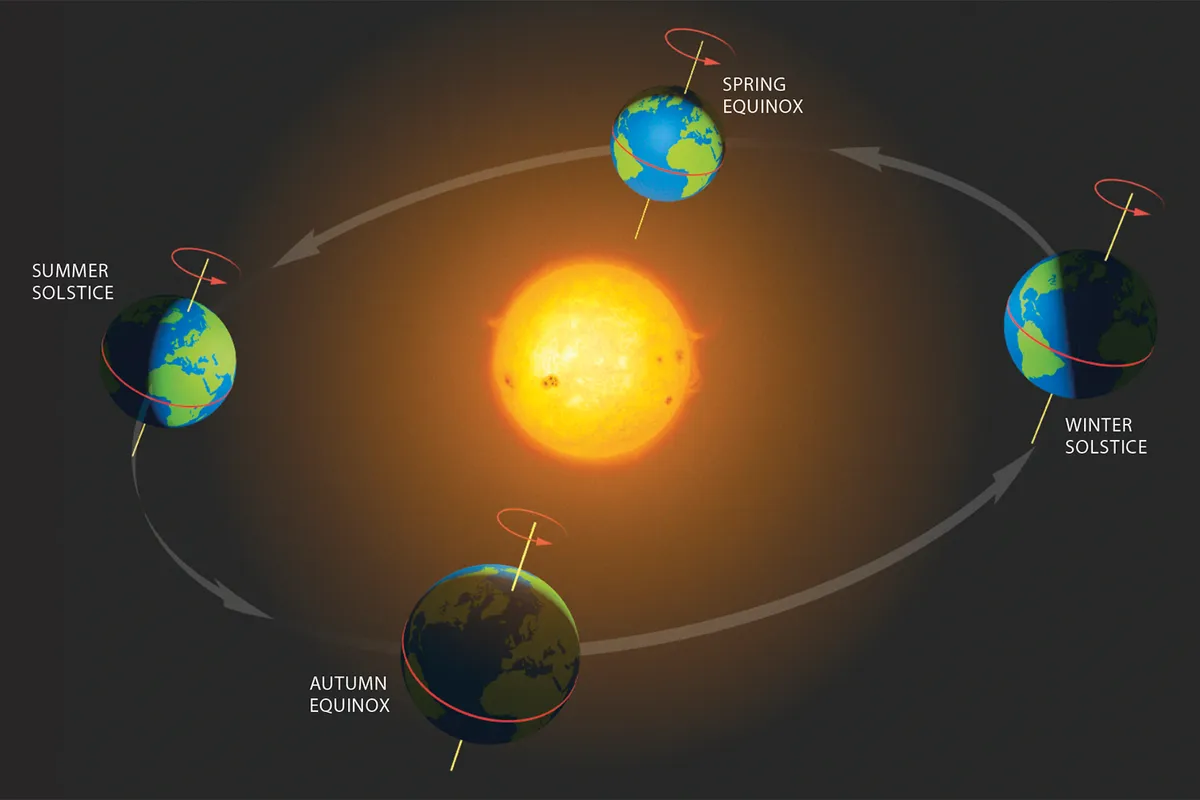
In the northern hemisphere, summer solstice occurs around 20–22 June and pinpoints the beginning of astronomical summer.
The autumn equinox occurs around 21–23 September and is the beginning of astronomical autumn.
Within that time, we usually see three full Moons.
A seasonal blue Moon – and this is the astronomical definition of a blue Moon – is the third full Moon in a quarterly season of four full Moons.
It's a little trickier to wrap your hear around, in comparison to a monthly blue Moon.
A seasonal blue Moon is also slightly rarer than a monthly blue Moon, as a monthly blue Moon has a higher statistical chance of occurring.

Observing the May 2026 blue Moon
The 31st May 2026 full Moon is a monthly blue Moon because it's the second full Moon in that month.
The first full Moon in May 2026 rose on 1st May, and this was the Flower Moon, so-called because May is the time when spring is fully in swing and the flowers are in bloom.
Because that full Moon rose on 1st May, and because there are only about 29.5 days between each full Moon, that means we're getting another full Moon before the month is out.
That makes the 31st May full Moon a monthly blue Moon.
The 1st May full Moon – the Flower Moon - rose in the east around sunset, located between the constellations Leo and Cancer, just to the right of the Sickle star pattern.
Then the 31st May full Moon – the blue Moon – will rise again in the east, but this time lower down and just to the right of the constellation Virgo. It will be best seen around dusk in the southeastern sky.

Why blue Moon?
It's not exactly clear where the term 'blue Moon' comes from, i.e. why a rarity should be described as a 'blue Moon' and not a green Moon or a purple Moon.
Perhaps it's because many of the other colours are already taken, when it comes to describing Moons.
The Moon may naturally appear red, orange or yellow at times, and this occurs when the Moon is low-down, close to the horizon, or when a lunar eclipse is occurring.
And the term 'pink Moon' is used to describe the full Moon in April, as a result of the pink flowers that bloom during that month (and not because the Moon is literally pink).
Needless to say, a blue Moon isn't actually blue. It's just a turn of phrase used to describe the rarity of the extra full Moon.
If you observe or photograph the May 2026 Flower Moon or blue Moon, share your images with us by emailing contactus@skyatnightmagazine.com

