
Comet 3I/ATLAS was one of the biggest talking points of 2025, both scientifically and speculatively.
This interstellar visitor was discovered on 1 July 2025 and was quickly found to be a body that had originated from beyond our Solar System.
Of all the comets human beings have ever discovered, only three are known to have formed beyond our Solar System, and comet 3I/ATLAS is one of them.
This has led some commentators to hypothesise that 3I/ATLAS could in fact be some sort of alien spacecraft visiting our Solar System, while the vast majority of scientists and astronomers maintain it is an interstellar comet.
More on 3I/ATLAS

And those scientists and astronomers have had a lot of visual evidence and data to work with, in order to confirm that it is in fact a comet.
We've seen images of 3I/ATLAS from ground-based observatories like the Gemini South telescope and the Very Large Telescope.
We've seen images captured by the Hubble Space Telescope and the James Webb Space Telescope.
We've even seen images of 3I/ATLAS captured by Mars spacecraft, by solar-observing spacecraft and by a European Space Agency spacecraft on its way to Jupiter.

If anyone is in a good position to test whether 3I/ATLAS does indeed bear the hallmarks of an alien spacecraft – and not a seven-billion-year-old space rock – among the many dedicated scientists are the Breakthrough Listen project and their array of Earth-based radio telescopes.
Breakthrough Listen is a team of scientists focussed on SETI – the Search for Extra-Terrestrial Intelligence – who approach the subject of alien life in a scientific, evidence-based manner.
In 2025, the team and their network of collaborators pointed their telescopes at 3I/ATLAS to look for signs of alien technology, known as 'technosignatures'.
Here's what they found.
Allen Telescope Array
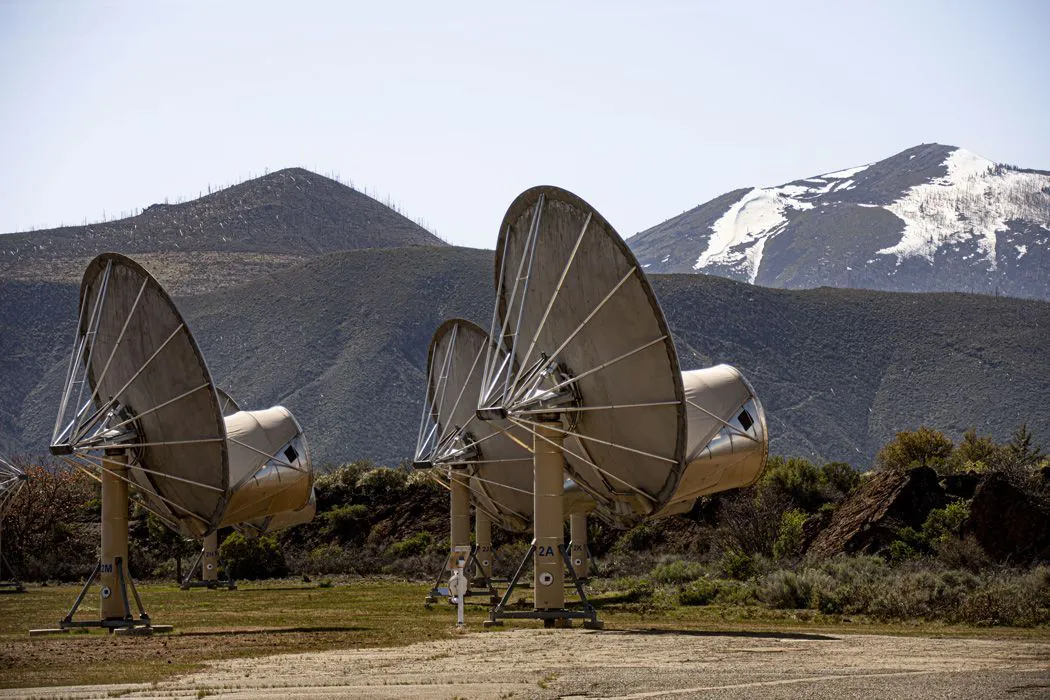
The Allen Telescope Array, located in northern California, USA, is the first radio telescope specifically designed for searching for signs of extra-terrestrial intelligence.
It began scouring the skies in 2007 and has provided scientists with all manner of interesting data and studies, including investigating the famous Wow! signal.
The Allen Telescope Array observed 3I/ATLAS in early July 2025, shortly after the comet was discovered.
On 18 December 2025, the team behind the observations published a paper, yet to be peer-reviewed, that details how they used the telescope to search for signals coming from 3I/ATLAS that might indicate alien technology.
"We did not find any signals worthy of additional follow-up," the paper says, concluding that the team found no evidence of engineered radio signals originating from 3I/ATLAS.
MeerKAT

The MeerKAT radio telescope in South Africa also got a good look at 3I/ATLAS.
MeerKAT is a telescope array consisting of 64 separate radio dishes, each of which interlink to produce a formidable observing machine.
It's a precursor to the Square Kilometre Array, an upcoming international project that will link radio telescopes around the world to explore the cosmos and solve some of the biggest questions in space science.
Breakthrough Listen says MeerKAT detected signatures of hydroxyl in October 2025, which is a sign of water ice in 3I/ATLAS melting and evaporating as the comet approached the Sun.
As well as this, the MeerKAT team used the BLUSE (Breakthrough Listen User Supplied Equipment) computer at the telescope to look for technosignatures.
The team say MeerKAT with BLUSE is able to detect a cell phone at hundreds of millions of kilometres.
"MeerKAT observations confirm that 3I/ATLAS is acting as a comet and do not detect signals from it of technological origin," a statement from the team says.
"We’re happy that we are contributing, alongside colleagues around the world, to a fuller understanding of this remarkable natural phenomenon – a comet likely formed in another stellar system that is briefly passing through our own”, says Fernando Camilo, chief scientist at the South African Radio Astronomy Observatory, one of the leaders of the project.
Vera C. Rubin Observatory

Comet 3I/ATLAS was also observed with the Vera C. Rubin Observatory, one of the newest telescopes on the scene, and one that's expected to help astronomers discover many more interstellar objects over the coming decades.
In a scientific paper, the team behind the Rubin observations of 3I/ATLAS report that their data shows 3I/ATLAS is behaving exactly as they would expect a comet to behave, and that no artificial emissions were detected.
Green Bank Telescope
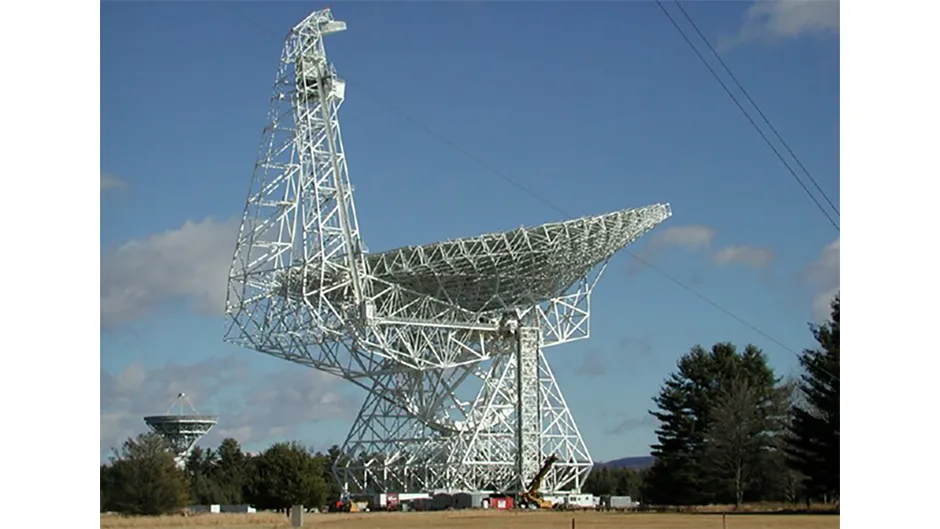
The Green Bank Telescope is one of the most famous radio telescopes in the world, and is known for being the largest fully-steerable radio telescope on Earth.
Green Bank made its observations of 3I/ATLAS on 18 December 2025, one day before the comet made its closest approach to Earth.
The team used four receivers to scan a range of frequencies in search for anything that might be interpreted as an artificial signal.
In summary, Breakthrough Listen says "no artificial radio emission localised to 3I/ATLAS was detected" by the Green Bank Telescope.
Parkes Observatory

The Parkes Observatory, located in New South Wales, Australia, recorded data on 3I/ATLAS with is 64-metre Murriyang radio telescope.
Murriyang observed the interstellar comet on 31 July, 12 September and 5 October in 2025, but the results of the study have not yet been made available.
Summary

Perhaps predictably, and rather disappointingly for those hoping for signs of 3I/ATLAS being an alien spacecraft, Breakthrough Listen concludes: "The Breakthrough Listen Initiative, together with its network of collaborators, has undertaken observations of 3I/ATLAS using a variety of facilities worldwide, starting shortly after its discovery, and continuing through its closest approach to Earth.
"No technosignatures have been detected in any of these searches. 3I/ATLAS continues to behave as expected from natural astrophysical processes. That said, it remains an extremely interesting target for observation given the overall rarity of interstellar objects.
"We will continue to observe 3I/ATLAS as a part of a broader strategy to thoroughly investigate all interstellar objects, consistent with our goal of conducting humanity’s most sensitive, intensive and comprehensive search for technosignatures."

