
The Buck Moon is the name given to the full Moon in July, marking the time of year when male deer – known as 'bucks' – begin to grow their antlers.
From the Northern Hemisphere, the Buck Moon never rises very high above the horizon, making it a tricky full Moon to see, compared to winter full Moons.
But in the Southern Hemisphere the Buck Moon is one of the highest of the year, rising into the sky at the height of Southern Hemisphere winter.
More astrophotography
One photographer who took advantage of this is Taran Sohal, who captured this image of the Buck Moon from Brisbane, Australia on 29 July 2026.
A long exposure reveals the apparent motion of the Moon across Earth's sky, showing how much our natural satellite appears to track across the heavens over a short period of time.
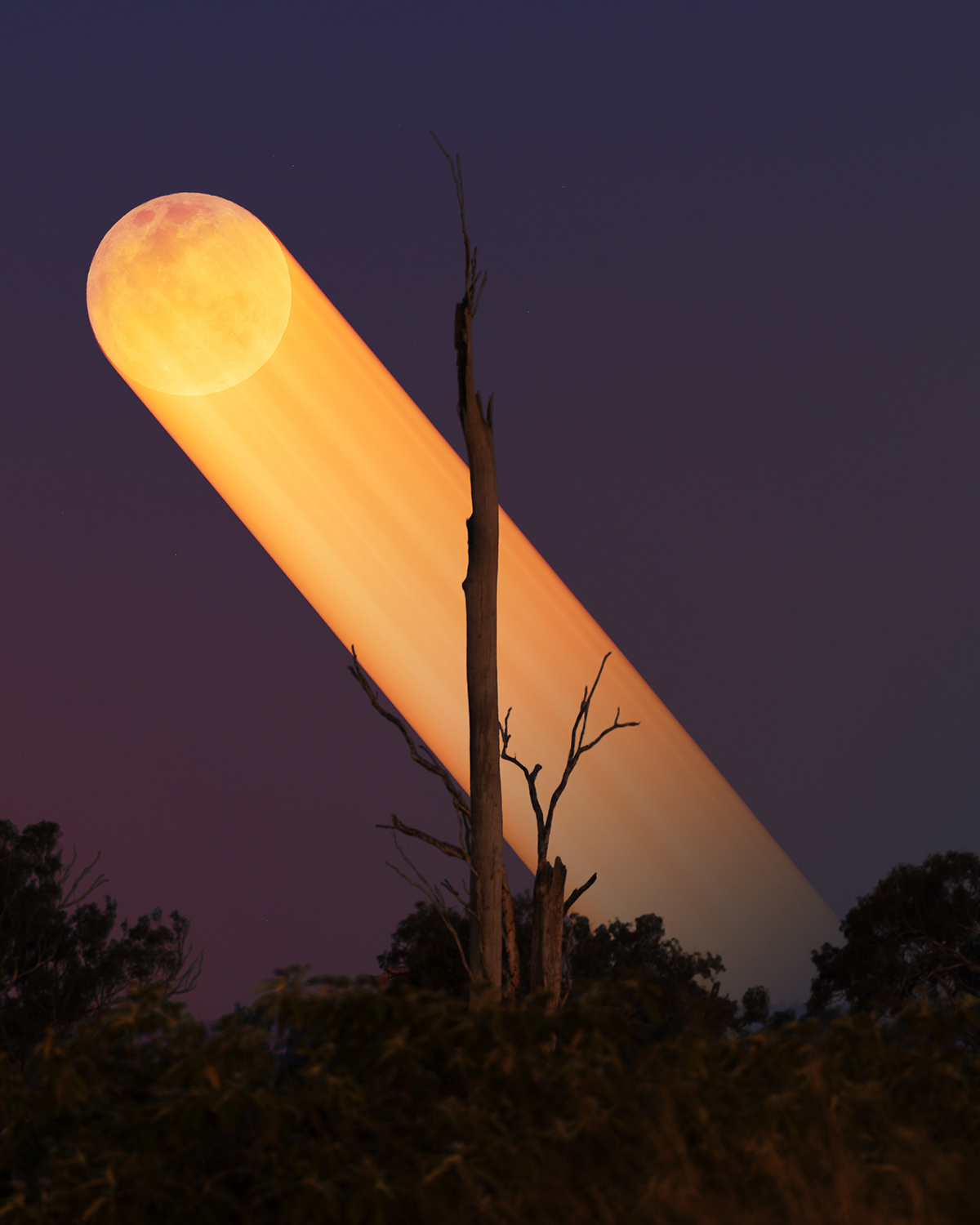
"Rather than freezing the Moon in a single instant, I wanted to portray its journey across the evening sky," says Sohal.
"The photograph combines the stillness of an old dead tree with the relentless motion of the Moon, creating a visual contrast between what appears permanent and what is constantly changing.
"The glowing streak is the result of a single 15-minute exposure, allowing the Moon to naturally trail across the frame as the Earth rotated.
"The exposure was carefully timed so that the Moon remained visible at the beginning of its path while recording its luminous motion through the twilight sky without over-exposing.
"The silhouetted tree serves as a strong foreground anchor, with the Moon appearing to pass behind it, adding depth and a sense of scale.
"What fascinates me about this image is how it transforms a familiar celestial object into something less expected.
"We often photograph the Moon as a perfectly sharp disc, but over 15 minutes it becomes a record of time itself – a reminder that the night sky is never static, even when it appears calm to the naked eye.
"I hope this photograph captures that feeling of movement and encourages viewers to think about Earth's rotation and the passage of time in a more visual and artistic way."
See more of Taran Sohal's work via his Instagram channel @astromaniaaustralia
Capture details
- Camera: Nikon D850 camera
- Lens: Nikkor 200-500mm
- Other equipment: Tripod, stack of 2 NISI ND filters
- Exposure: f/5.6, 15 minutes for Moon, 5 seconds for foreground
- Software: Photoshop
Do you capture images of the night sky? Whether you're a beginner or seasons astro-imager, send us your images and they could appear in a future issue of BBC Sky at Night Magazine

