
A team of scientists say comet 3I/ATLAS probably formed in the outskirts of an old star system, around a star much, much older than our Sun.
The team have published a study that used the European Southern Observatory's Very Large Telescope to study the composition of 3I/ATLAS.
By analysing the chemical fingerprint of the comet, they say they've been able to pinpoint what sort of star it formed around – and where it likely formed in relation to that star.
More on 3I/ATLAS
A relic from across the Galaxy
The vast, vast majority of comets that we know of formed around our Sun.
But comet 3I/ATLAS didn't form around our Sun. It formed beyond the Solar System in a distant corner of the Galaxy, making it an 'interstellar' object.
It's one of only three such interstellar objects ever discovered.
Comet 3I/ATLAS is passing through our Solar System and, once it's gone, will be lost from our view forever.
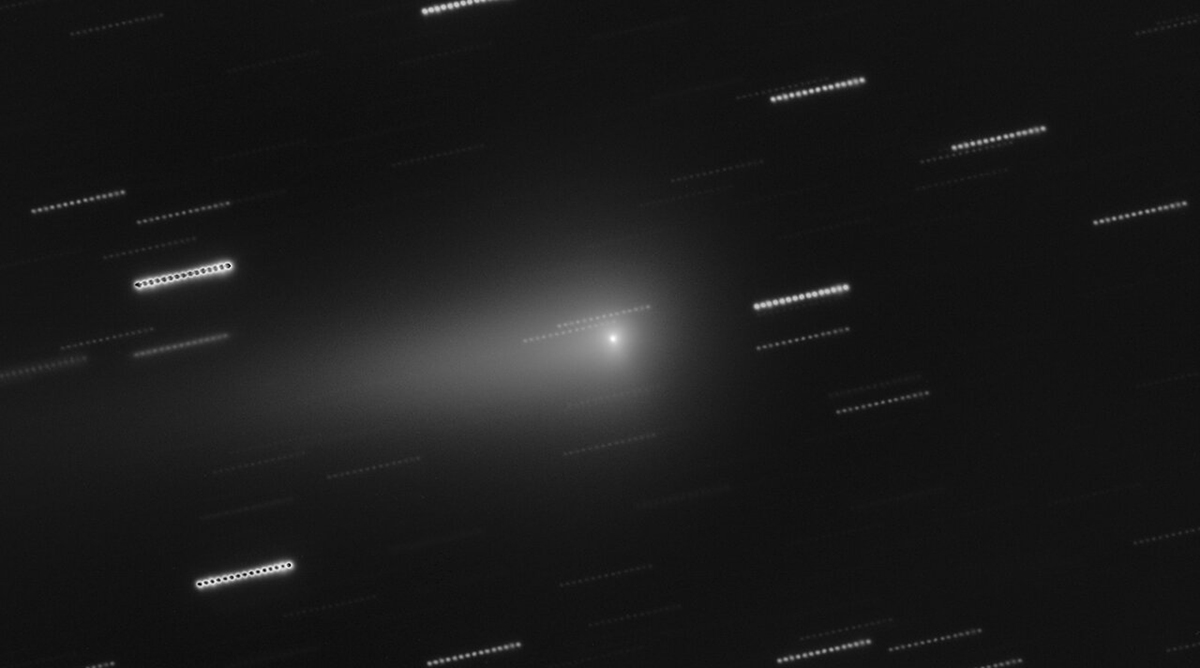
That's why astronomers have been pointing our most powerful telescopes and spacecraft at it, to learn as much as we can about what sort of object it is.
Astronomers have found out that the comet is very, very old. It could even be as old as 12 billions years old – which makes it almost as old as the Universe itself.
And it contains chemical fingerprints that indicate it's like nothing we find in our own Solar System. It truly is an 'alien' object, in terms of its chemistry.
Pinpointing the origins of 3I/ATLAS
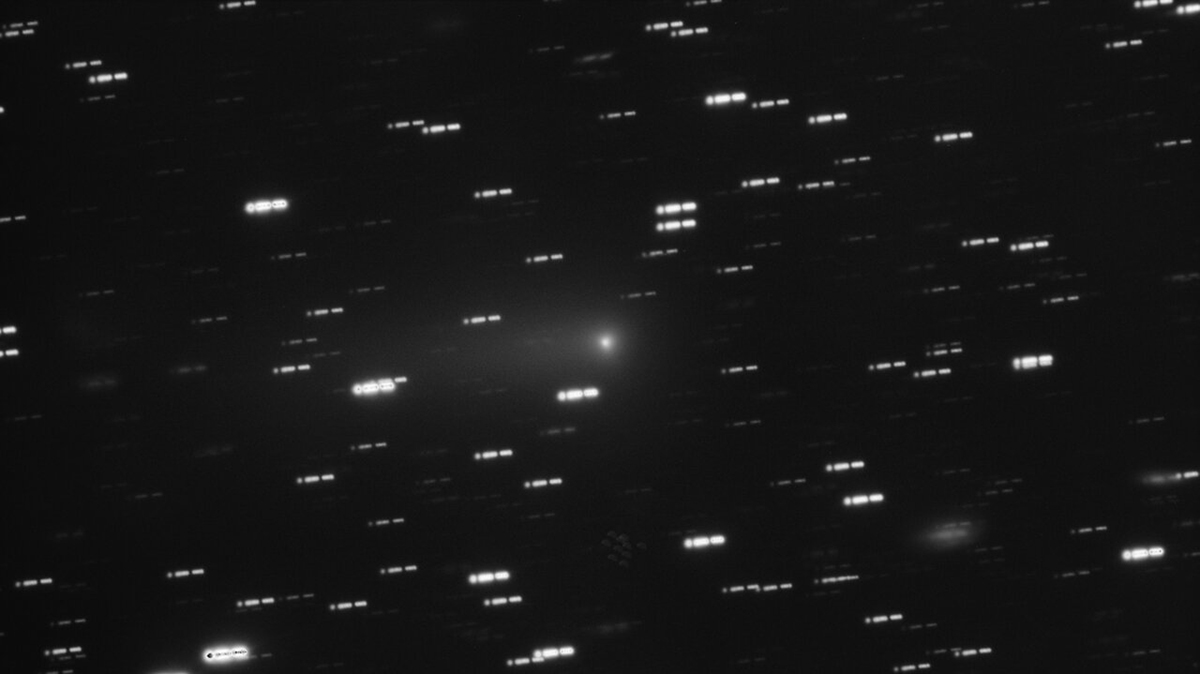
The team used the Very Large Telescope to measure the comet's specific chemical fingerprints.
They say these are the first observations of this kind for a comet that formed outside the Solar System.
The results suggest 3I/ATLAS probably originated in the outskirts of an old star system.
"[Interstellar comets] are sort of fossils from a planetary formation process that happened very far away, but that we get the chance to study from much closer," says astronomer Cyrielle Opitom, a researcher at the University of Edinburgh, United Kingdom.
Opitom led a study of 3I/ATLAS, together with Jean Manfroid and Damien Hutsemékers of the University of Liège, Belgium
The team say that it's thanks to the comet's brightness that they were able to measure its isotopic ratios.
This is a measurement of the relative amounts of different forms of the same element.
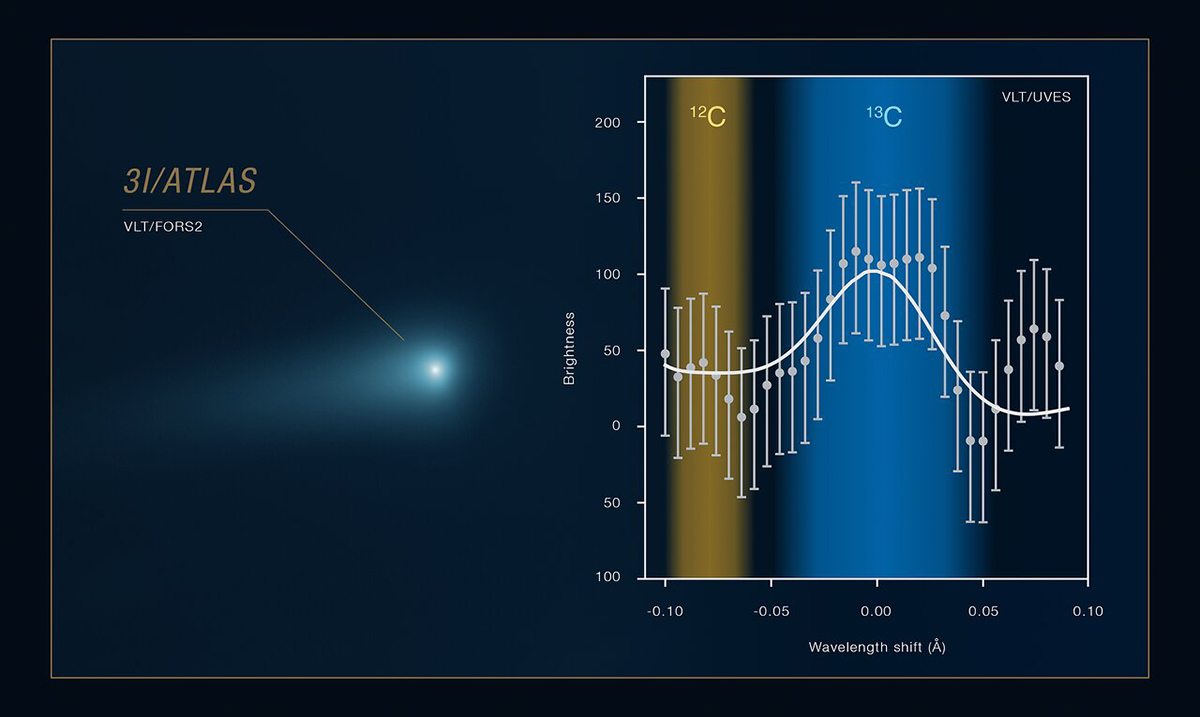
They measured ratios of carbon and nitrogen isotopes in cyanide molecules, which are contained within the gas surrounding the comet's head.
The team say these ratios are sensitive to the specific conditions in which an object formed and probably don't change much as the object travels through space.
That means it's a good indicator as to what sort of region of space the comet was born in.
"Unlike comets from our Solar System, this interstellar visitor carries unusually high carbon and nitrogen isotopic ratios," says Aravind Krishnakumar, researcher at the University of Liège and co-author on the study.
The team point to a similar study led by Martin Cordiner at the NASA Goddard Space Flight Center that found a similar isotopic ratio of carbon and elevated levels of deuterium.
That's the science – here are the results
Opitom’s team say their findings indicate comet 3I/ATLAS likely formed in the outer regions around an old, ‘low-metallicity’ star.
That means the star has few elements heavier than helium in its composition, which indicates 3I/ATLAS formed when the Universe was much younger and less chemically rich than it is now.
In other words, 3I/ATLAS probably originated around a star much older than our Sun. In fact, the evidence suggests the comet is more than twice as old as the Sun.
"3I/ATLAS is a really exciting opportunity to probe the composition of another planetary system, one that formed long before our Sun and Solar System even existed," says co-author Rosemary Dorsey, a researcher at the University of Helsinki, Finland.
The team say that, as 3I/ATLAS moves away from the Sun and gets fainter, the observations with the Very Large Telescope are nearing their end.
But, say scientists, the upcoming Extremely Large Telescope will enable similar studies of future interstellar objects, including those not as bright as 3I/ATLAS.
"The field of interstellar objects is still very new, and we do not really know what to expect," says Opitom.
"Every time a new one is discovered, we have new surprises."
Read the full paper via Nature Astronomy

