
If asteroid 2024 YR4 does hit the Moon, it could produce a bright flash on the lunar surface that would be visible from Earth, and spray debris into our planet's atmosphere.
Such an impact may even produce meteors visible in our night sky, and generate an infrared glow visible hours after the event.
More on asteroids

These are some of the results of a new study looking into what will happen if the large asteroid does hit our Moon in 2032.

The story so far
Asteroid 2024 YR4 became one of the big talking points during the first half of 2025, when it was reported that there was a chance this large space rock could hit Earth in 2032.
The asteroid was discovered in December 2024 and initially sparked concern as scientists calculated there was a 3.1% chance of it striking Earth in 2032.
Asteroid 2024 YR4 was travelling away from Earth during the time of these observations, but is set to return in 2032.

Astronomers were keen to learn as much about the asteroid's orbital trajectory as they could, before it disappeared, so they could calculate the probability of it hitting Earth upon its return.
Further observations and data from the James Webb Space Telescope effectively ruled out a threat to Earth, but instead raised the possibility it could hit our Moon.
By April 2025, refined measurements narrowed the asteroid’s size to about 60 metres across and calculated the probability of it hitting our Moon as 3.8%.
Although the rock will remain unobservable for several years as it orbits the Sun, scientists are still preparing for its return on 22 December 2032.

Asteroid 2024 YR4's bright flash on the Moon
A draft science paper titled 'Observation Timelines for the Potential Lunar Impact of Asteroid 2024 YR4', published in January 2026, reveals what would happen if asteroid 2024 YR4 did hit the Moon in 2032.
It says the asteroid has a 4.3% chance of hitting our Moon.
If this did happen, the paper says, it would produce a roughly 1km-wide (0.6 miles) crater on the lunar surface.
It would be the "most energetic lunar impact event ever recorded in human history," the paper says.
This would be accompanied by a visual flash on the Moon that would likely be seen from Earth.

In fact, the paper says the associated flash of 2024 YR4 smashing into the Moon could be as bright as magnitude –3, which is about as bright as a planet like Mars or Jupiter appears to the naked eye from Earth, when they're at their best.
For context, Sirius, the brightest star in the sky, is about magnitude –1.5.
In the magnitude scale, the brighter an object is, the lower its magnitude is, so that means asteroid 2024 YR4's impact on the Moon would be much brighter than Sirius.
Such a flash would last several minutes after the impact, and a resulting infrared afterglow would last several hours, the paper says.
What's more, the impact would lead to a global Moonquake easily detectable by seismometers.
The resulting debris from the impact would cause about 108kg of lunar rocks and dust to escape the Moon's gravity, hit Earth Earth and cause meteors visible in our sky.
"Despite the associated risk," the paper says, "this scenario offers a rare and valuable scientific opportunity.

International Gemini Observatory/NOIRLab/NSF/AURA/M. Zamani
Observing 2024 YR4's impact on the Moon
The paper points to a window of opportunity to observe asteroid 2024 YR4 as early as 2028, which would help astronomers calculate whether the asteroid will indeed hit our Moon in 2032.
Then, in the months leading up to the potential collision, further observations would be able to determine an impact timeline down to the minute.
Observations could also determine where on the Moon it will impact, and where we should be pointing our telescopes.
"On the Moon, active orbiters and landers should be placed in recording or imaging mode, and seismometers armed for immediate data logging," the paper says.
Spacecraft around the Moon that might observe the aftermath could include NASA's Lunar Reconnaissance Orbiter and India's Chandrayaan3 orbiter.
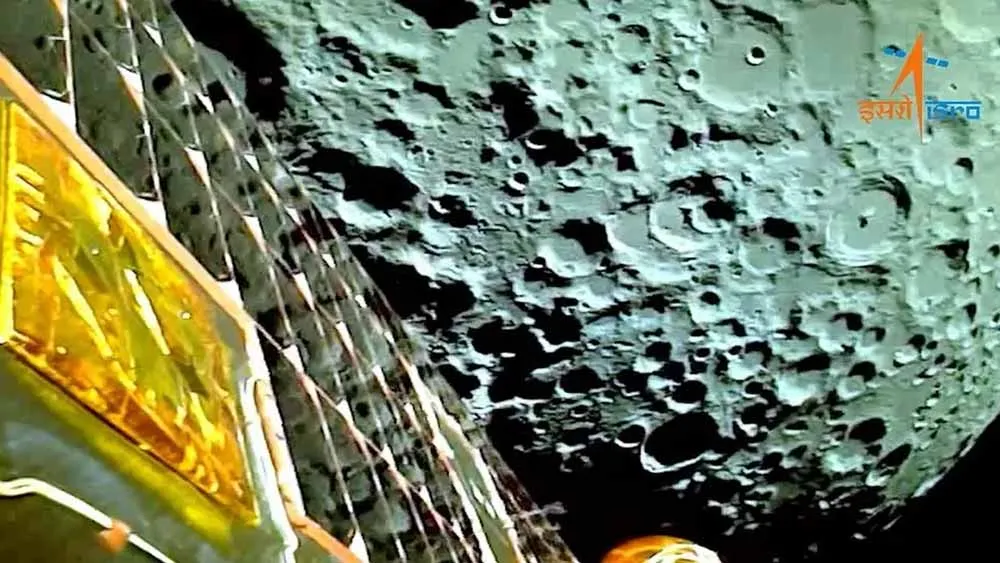
The paper says the predicted impact on 22 December 2032 would occur when the Moon is a waning gibbous, about 70% illuminated.
That means that, at the time of 2024 YR4's impact, the Moon would appear big and bright from Earth, just days after full Moon.
The study says the best places to see the impact will be from the Pacific hemisphere, one of the best ground-based observatories to see it will be Mauna Kea, which incudes the Keck, Subaru and Gemini North telescopes.
Gemini North is notable as being one of the ground-based telescopes that captured amazing views of comet 3I/ATLAS, the interstellar body that appeared in Earth's skies late in 2025/early 2026.
If asteroid 2024 YR4 did hit the Moon, the study says the Moon would be visible in the western part of North America near dawn, while South America, Europe and Asia would have a daylight or low Moon, making observations tricky in those parts of the world.

Timeline of the Moon impact
The paper authors produced a timeline showing what would happen from the moment of impact to the days, weeks months and years after impact.
Moment of Impact
The study says the impact of asteroid 2024 YR4 hitting the Moon would produce a flash with an expected brightness of magnitude –3 to –5, potentially making it visible to the naked eye if it hits the un-lit portion of the Moon.
This would give astronomers using professional telescopes the opportunity to observe the flash in real time, and perhaps even identify the chemical signatures of the lunar material ejected from the surface.
Even if the impact does happen on the lit side of the Moon, just beyond the 'terminator' – the line dividing light and shadow on the lunar surface – it could still be powerful enough to light up the surrounding terrain.
Minutes to hours
Just minutes after the flash, a 1km crater would glow in infrared for several hours, according to the paper, meaning infrared telescopes would be able to observe the glow as it cools.
Enormous Moonquakes could reach seismic stations on the Moon within about 7–15 minutes.
The study authors point to a range of possible studies of the impact, from infrared observations to seismological detections of the quake and observations of the impact crater by lunar orbiters.
Days to years
Between two to eight days after asteroid 2024 YR4's impact with the Moon, the paper says, lunar debris reaching Earth could create a visible meteor shower'.
A small fraction of lunar fragments could even survive plummeting through Earth's atmosphere, land on Earth and be discoverable as lunar meteorites over the coming years.

