
When astronomers peer into space to observe planets orbiting stars beyond our Solar System – known as exoplanets – there are a few rules they might expect a distant world to obey.
For example, rocky planets like Earth and Mars should stay small and compact. Massive worlds like Saturn, Jupiter or Neptune, on the other hand, accrete enormous atmospheres of gas and balloon into gas giants.
GJ 523b is a newly-discovered exoplanet located 87 lightyears from Earth that seems to be breaking the planetary rulebook.
In a study led by researcher Max Kroft at the University of Wisconsin–Madison in the USA, astronomers have used NASA’s Transiting Exoplanet Survey Satellite (TESS) and a ground-based telescope in Arizona, USA to learn more about this extraordinary world.
It’s the first exoplanet discovered and catalogued by researchers for the Wisconsin Center for Origins Research (WiCOR) project.
What they found has left them slightly baffled.
More strange planets
A mega Earth?
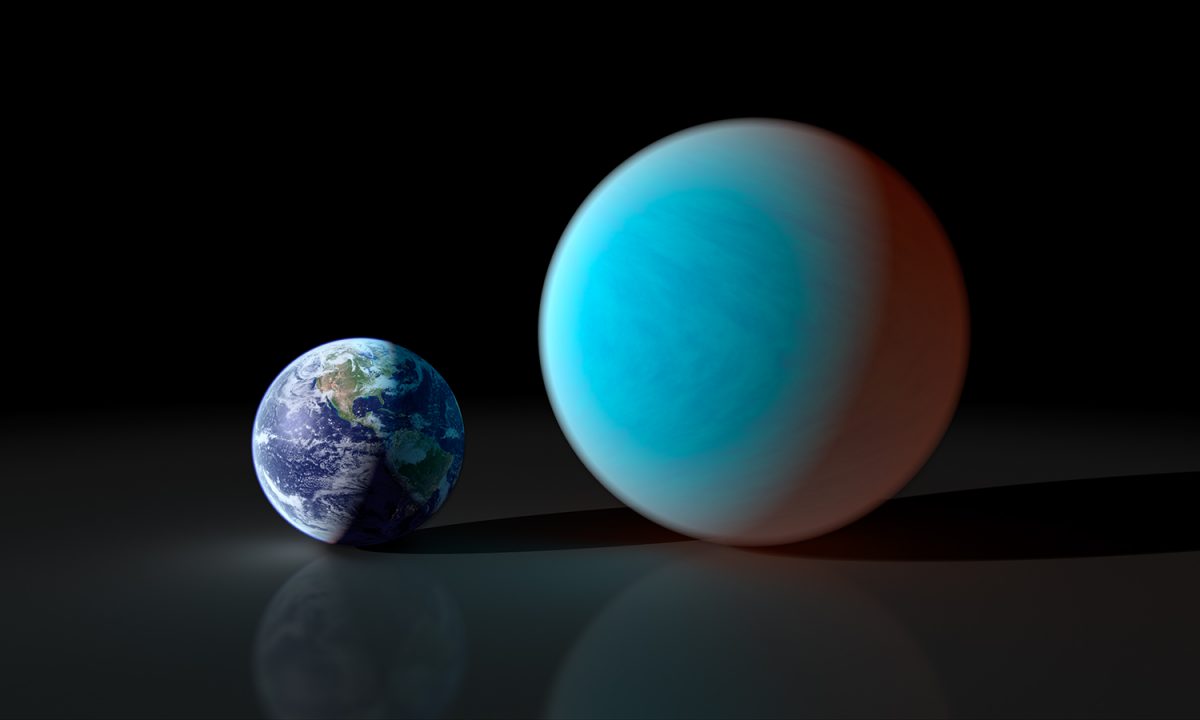
To get a handle of why GJ 523b is such a rule-breaking exoplanet, imagine packing the mass of 23.5 Earths into planet only 2.5 times bigger than our home planet.
Normally, a planet 2.5 times the radius of Earth falls into the 'sub-Neptune' category. These are a type of planet between the size of Earth and the size of Neptune that are wrapped in a thick, gassy atmosphere.
GJ 523b is incredibly massive for its size. Because it packs so much mass into a relatively small space, astronomers call worlds like this 'mega-Earths', a class of ultra-dense, ultra-massive rocky exoplanet.
The discovery follows an effort by WiCOR researchers to find so-called 'Hycean' exoplanets, which are a theorised type of exoplanet with a large ocean and an atmosphere suitable for hosting life.
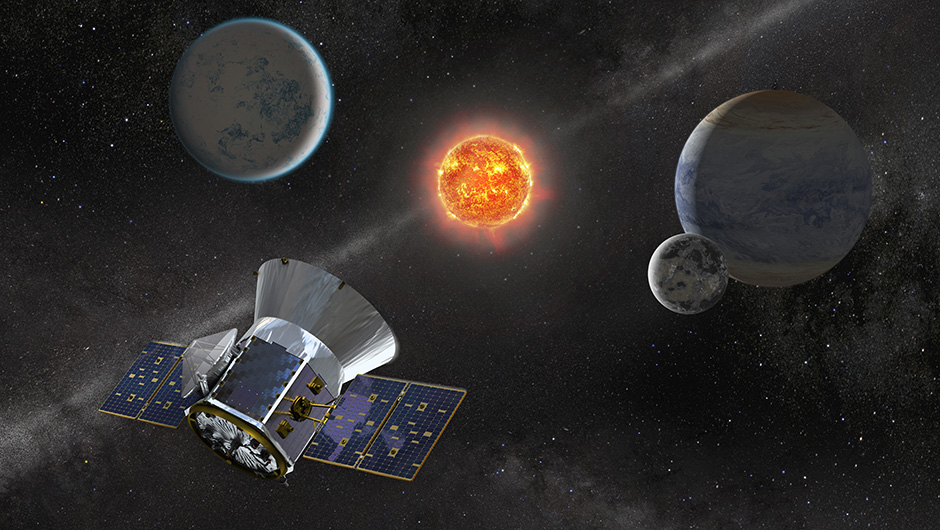
Kroft and the team used the ground-based WIYN Observatory in Southern Arizona to follow up on a planet candidate that had been found by NASA's Transiting Exoplanet Survey Satellite (TESS).
That candidate was what eventually became known as became GJ 523b.
Why GJ 523b is so odd
According to standard theories of planet formation, GJ 523b shouldn't exist in its current state.
That's because, when a newly-forming planet’s rocky core reaches about 10 to 20 times the mass of Earth, its gravitational pull should become a cosmic vacuum cleaner, pulling in huge amounts of gas from the surrounding protoplanetary disk, which is a disk of cosmic gas and dust feeding the planet with the necessary ingredients for it to grow even larger.
Normally, such a planet would grow into a huge a gas giant like Jupiter or Saturn.
But it seems GJ 523b has crossed that threshold, yet has somehow remained almost entirely solid rock and metal, with little to no gaseous atmosphere.
"This isn’t what we expected at all," says Kroft. "Dense planets like this aren’t uncommon, but they’re usually small rocky planets similar to Earth or Mercury. This planet is two and a half times bigger than the Earth."
So what's going on?
At just 170 million years old, GJ 523b is an infant compared to the planets in our 4.5-billion-year-old Solar System.
That means it hasn't been around long enough for a giant atmosphere to have slowly evaporated away.
Measurements show that GJ 523b travels in a highly tilted, near-polar orbit around its host dwarf star, zipping around once every 17.75 days.
So how did it get so dense and grow so enormous, but still remain a rocky planet?
One theory is that it formed when two massive protoplanets smashed into each other. Such a collision could have merged the two heavy iron-and-rock cores together, while blasting away their outer gas layers.
Or, GJ 523b could have formed with a thick gas layer, but powerful radiation or flares from its young, energetic host star have stripped the gas away.
Or perhaps the planet formed in a region of its protoplanetary disk that had plenty of heavy, rocky pebbles but was starved of light gases, stopping it from ballooning into a gas giant.
Astronomers plan to study this mega-Earth further using space telescopes like the James Webb Space Telescope to examine its extreme gravity, search for any remnant traces of atmosphere and figure out how a world like this could become so enormous without turning into a gas giant.
Read the full paper at arxiv.org

