
How did Earth get its oxygen? The more planets that we discover beyond our Solar System, the more it's clear just how special Earth is.
Our planet's temperate climate, its ability to host liquid water on its surface and, of course, its oxygen, all have enabled life to thrive.
But what makes Earth so special? Why did Earth evolve to produce the right amount of oxygen to enable the evolution of complex organisms on its surface?
A discovery by a South Korean science team has found that one of the most destructive processes in our Solar System could be the very thing that fostered early oxygen-producing life on Earth.
More Earth science

Asteroid impacts and early oxygen
South Korean scientists say they've found evidence that could help explain how Earth’s atmosphere became rich in oxygen.
The findings, they say, offer insight into the Great Oxidation Event, when oxygen levels in Earth’s atmosphere rose dramatically about 2.4 billion years ago.
A team from the Korea Institute of Geoscience and Mineral Resources have reported the discovery of stromatolites within the Hapcheon impact crater on the Korean Peninsula.
The crater is about 7km in diameter and formed about 42,000 years ago when a large space rock smashed into our planet.
Stromatolites are layered, sedimentary structures formed by microbial communities, and scientists say they're among the oldest known records of life on Earth.
They're formed by microorganisms like cyanobacteria, that produce oxygen through photosynthesis.

Fossil records date cyanobacteria back to at least 3.5 billion years ago. for reference, Earth is thought to be about 4.5 billion years old.
In this case, the team say they've found evidence the stromatolites formed in a hydrothermal lake created by the asteroid impacting Earth.
The evidence suggests heat from molten rock created during the asteroid impact kept the water warm and rich in minerals for long periods. That produced conditions suitable for microbial growth.
The team found multiple stromatolites in the northwestern part of the Hapcheon crater, each measuring 10-20cm in diameter.

A new view on the Great Oxidation Event?
Could this discovery provide new clues about the Great Oxidation Event?
The team say hydrothermal lakes produced by earlier asteroid impacts could have provided habitats for oxygen-producing microbes to thrive.
Geochemical study of the stromatolites found signatures of extraterrestrial material and surrounding bedrock, as well as evidence that they had been altered by high-temperature water.

The team say the inner layers show stronger hydrothermal signals, which suggests they formed during an earlier, hotter phase.
That means the stromatolites could have formed in a hydrothermal lake created by an asteroid impact, which then gradually cooled over time.
What's more, the team say similar environments may have existed on early Mars, which was much warmer and wetter in its early history than it is today.
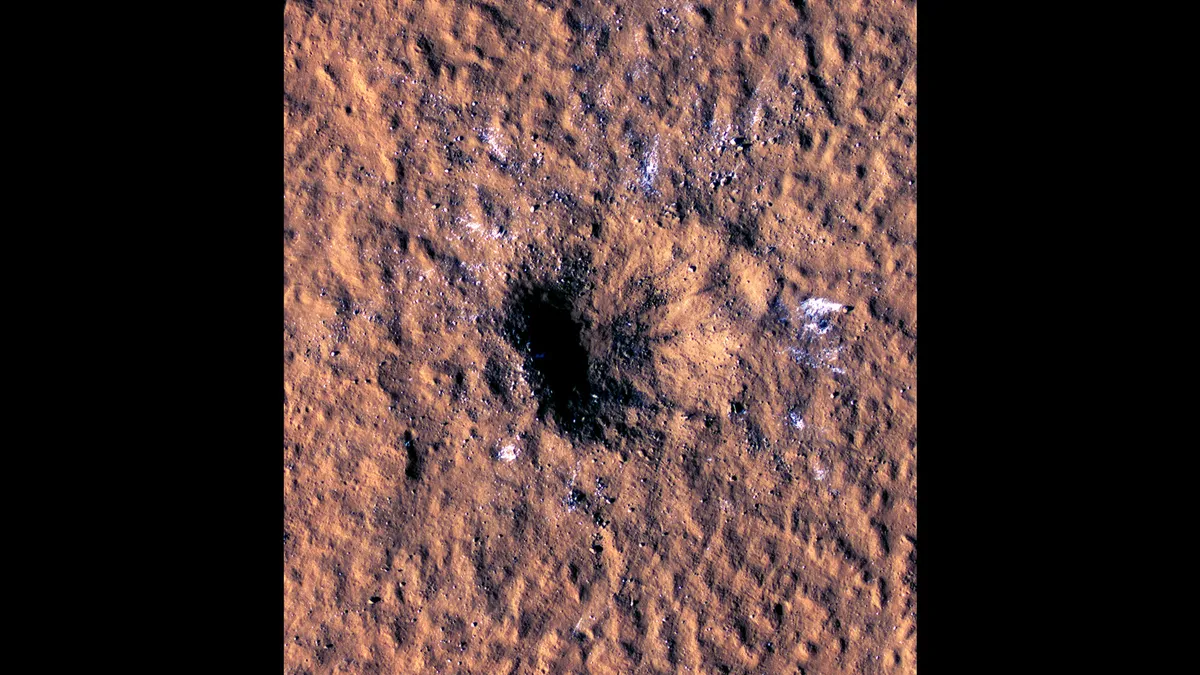
That could mean craters on Mars are key targets for finding evidence of past life on Mars.
"This is the first comprehensive evidence suggesting that stromatolites could form in hydrothermal lakes created by asteroid impacts," says Dr. Jaesoo Lim, lead author of the study.
"Such environments may have provided favorable conditions for early microbial ecosystems."

