An international team of astronomers has finally managed to discover a class of object whose existence has been theorised for decades but never proven: a microblazar within our own Milky Way galaxy.
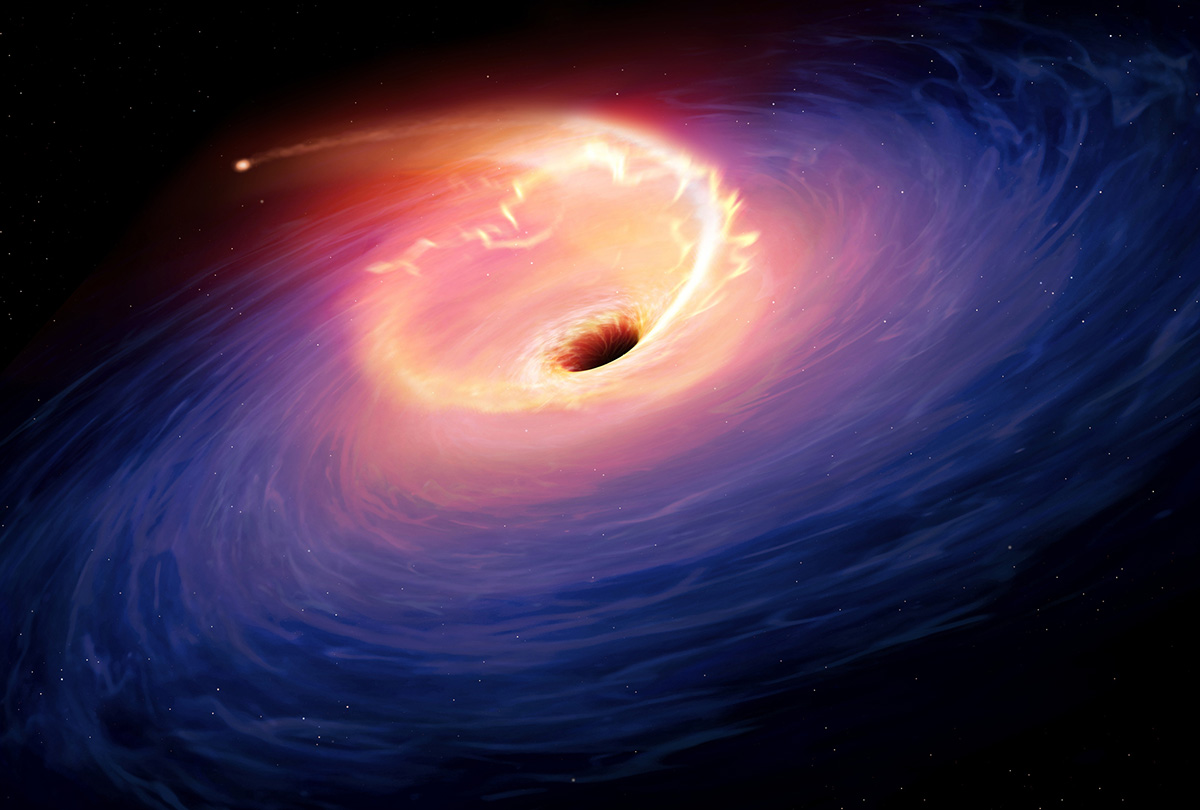
Blazars are, in very concise terms, black holes that emit vast jets of hot plasma travelling at close to the speed of light – these are called relativistic jets.
The supermassive black holes at the hearts of galaxies are often blazars – and the jets of matter they eject can sometimes be pointing towards Earth, albeit from too far away for that to really matter.
But scientists have long suggested that ‘microblazars’ – smaller black holes that also emit jets of plasma at very high speeds – could exist right here in the Milky Way.
Now they’ve found one – and it's pointed right at us.
More on black holes
A strange flash in the Universe – and a closer look
Scientists first became aware of the existence of IRAS 18293-0941 when it showed up in data captured by the Infrared Astronomical Satellite (IRAS) in 1983.
All we knew back then, though, was that there was a lot of infrared light coming from an unidentified point source.
Over time, further study using a number of the world’s largest telescopes – and made more difficult by the object’s position relative to the plane of the Milky Way – led scientists to believe that this abundance of infrared energy could take the form of a relativistic jet coming from a ‘microblazar’.
And now, after years of close, continuous study by multiple observatories worldwide, that hypothesis has been confirmed.
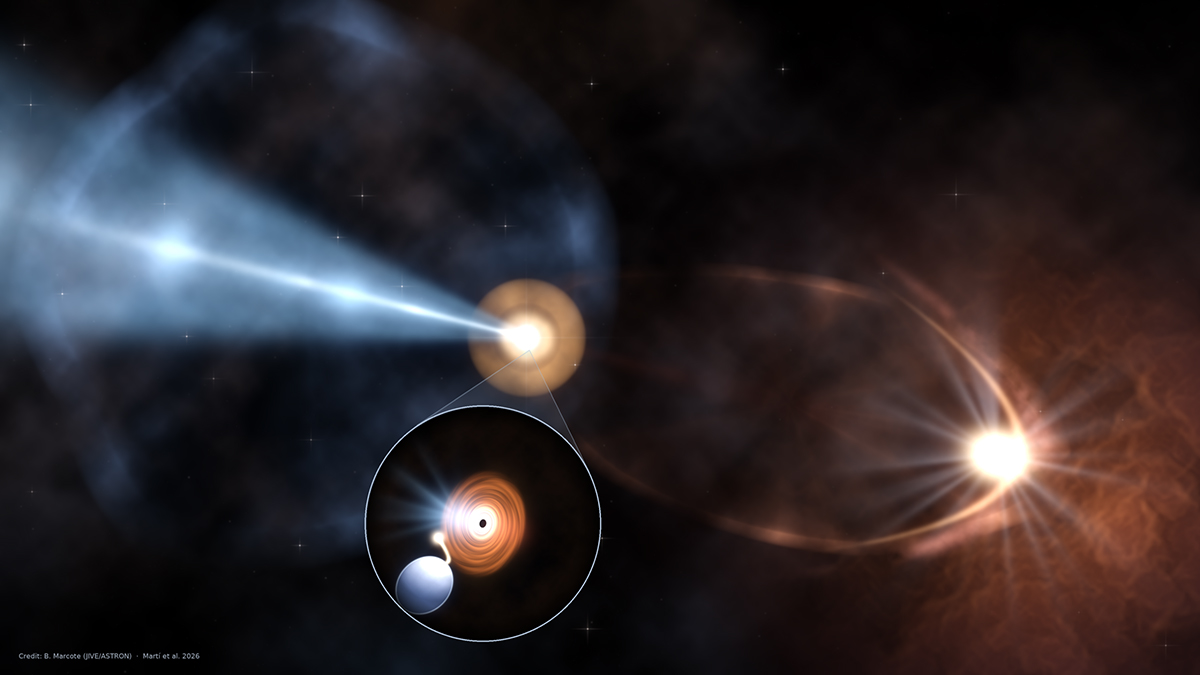
Hidden away (from Earth’s point of view) behind vast clouds of dust, IRAS 18293-0941 turns out, in fact, to be a binary system, with a black hole orbiting a massive, hot star.
As the two objects carry on their cosmic dance, the black hole absorbs matter from its larger companion.
Much of this is simply consumed by the black hole – but some of it is ejected, at right-angles, in two opposing beams.
A new way of studying the cosmos
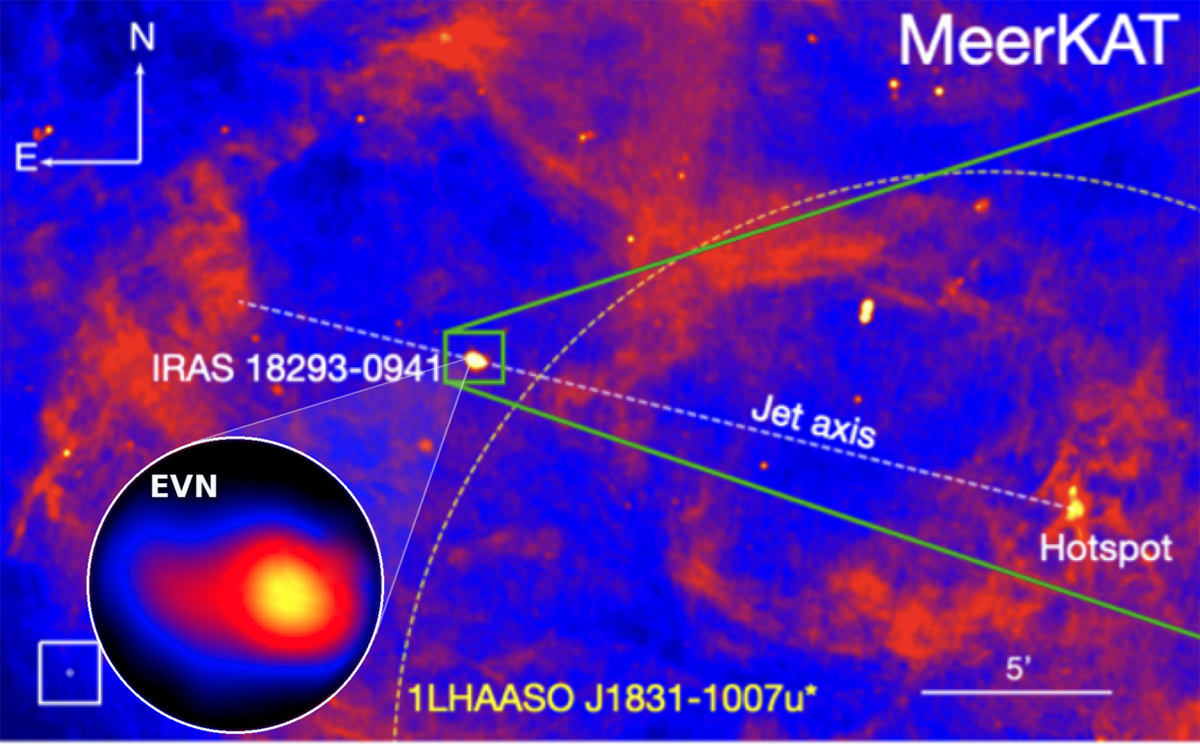
One of those beams is pointed straight at Earth – hence why we see a point source of infrared energy.
The other points 180° in the opposite direction, and while we can’t see the jet itself, the scientists were nevertheless able to prove its existence, because once the plasma jet reaches the interstellar medium, it heats up the gas and dust it finds there – creating a ‘hotspot’ that shows up in astronomical data as a source of high-energy gamma rays.
The scientists hope the new discovery will provide an opportunity to study and explore – on a smaller scale, but much closer to home – exactly how these mysterious objects behave, and what effects they have on other aspects of the formation, structure and evolution of stars, planets and galaxies.