If you've been out stargazing in the early evening and seen a bright star in the eastern sky, the chances are you've been observing the planet Jupiter.
Jupiter reaches opposition on 10 January, when the planet will be at its brightest and largest when viewed through the eyepiece.
Opposition is the date when the ecliptic longitude of Jupiter is 180° offset from the ecliptic longitude of the Sun.
For regular stargazing advice, sign up to receive our e-newsletter and subscribe to our YouTube channel
To put it more simply, opposition is when Jupiter is opposite the Sun in the sky. That's why, when the Sun is setting in the west, Jupiter is rising in the east.
Although it’s often stated that opposition is the best time to view a planet, in reality it’s a longer window of time.
The weeks leading up to and after opposition also give the best views. At opposition, Jupiter will shine at mag. –2.5 (find out what this means in our guide to stellar magnitude).

Observing Jupiter in January 2025
Jupiter has a complex atmosphere that shows lots of details and, of course, the famous persistent storm known as the Great Red Spot.
As Jupiter has no solid surface, features such as the Great Red Spot drift over time.
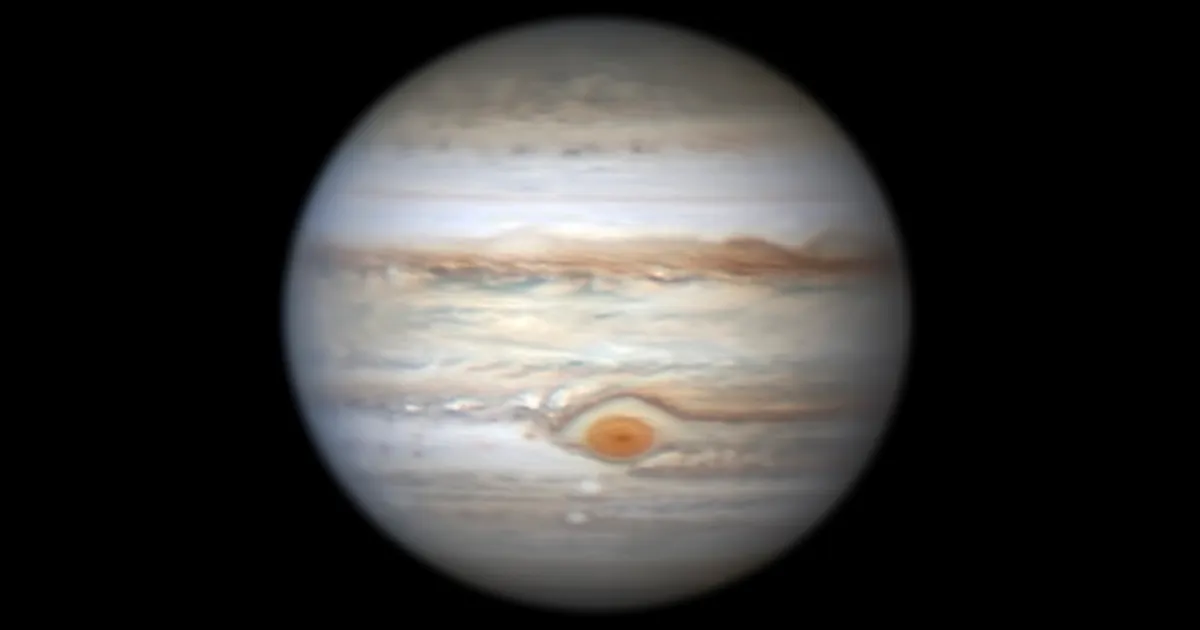
An application such as WinJUPOS can be used to determine the visibility of the Great Red Spot and also the positions of the four bright Galilean moons: Io, Europa, Ganymede and Callisto.
These can be seen interacting with Jupiter. For more info, read out guide on how to observe Jupiter's moons.
Jupiter takes approximately 12 years to move completely around the ecliptic.
Currently we’re enjoying the planet at a high position as it passes through Gemini, which helps to lift it far above the turbulence you find low down near the horizon.
Consequently, this is a fantastic time to enjoy this amazing planet.

For those without a telescope, keep a watch out for when the Moon passes near the planet, as this can be a stunning sight in its own right.
In January 2026, there are two opportunities to see Jupiter close to the Moon, and these are both best seen in the morning skies: 3 January and 31 January.
Jupiter in January 2026 – quick facts
- Best time to see: 10 January, 00:15 UT
- Altitude: 59°
- Location: Gemini
- Direction: South
- Features: Complex atmosphere, moons
- Recommended equipment: 100mm or larger
If you manage to observe or photograph Jupiter, let us know by emailing contactus@skyatnightmagazine.com