You’d be forgiven for thinking all the astronomical action these days is on the cosmic frontier, as new telescopes and instruments peer at the dim and distant Universe.
Yet one of the joys of the subject today is that we can still be surprised by objects closer to home.
Take the galaxy KKR 18. This dwarf system, first identified in 1999, sits around 30 million lightyears from the Milky Way.
While most of our Galaxy’s neighbours lie in a ‘local sheet’, stretching between us and the centre of the neighbouring Virgo Cluster, KKR 18 sits off on its own, above the bulk of nearby galaxies in a nearly empty region known as the Local Void.
That makes it an interesting case study for seeing how galaxies evolve when left to their own devices, without disruption from the normal hurly-burly of mergers and interactions.
More galactic discoveries
A closer look
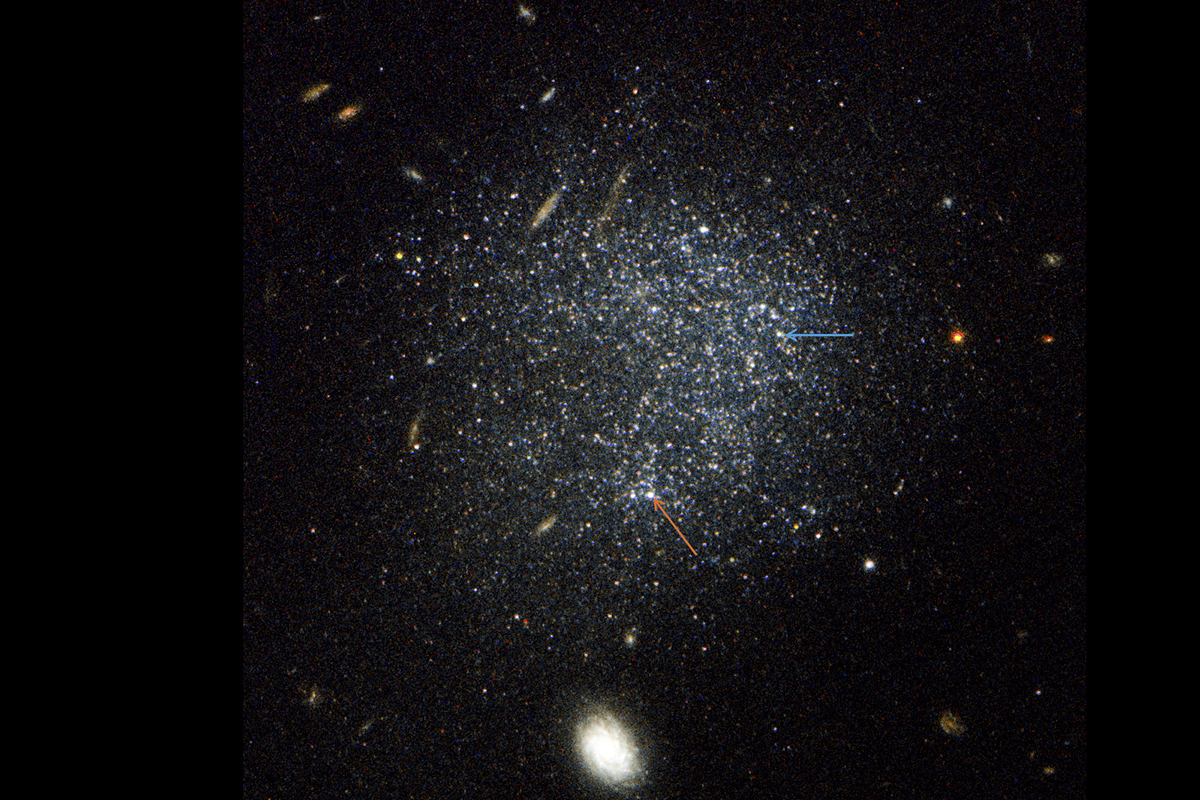
Research by an international team, led by Brent Tully of the University of Hawaii, used the Hubble Space Telescope to take a close look at KKR 18’s stars for the first time, supplemented by spectroscopic observations from a large ground-based telescope.
The Hubble image shows a diffuse cloud of stars looking more like a cluster than a galaxy. Most are blue or white, but a few red stars are scattered across the scene too.
However, compared with similar galaxies, KKR 18 is strikingly devoid of red giant stars, with far fewer than we would expect.
Missing red giants
When the colours of stellar populations in dwarf galaxies are plotted on a graph, we normally see a ‘red giant branch’ – indeed, it’s usually the most obvious feature.
But it’s hard to pick out in KKR 18, despite the substantial number of bright blue stars.
Explaining how these form without also producing a bright set of red giants is the task the researchers set themselves.
Their solution is to assume that this particular dwarf galaxy has a highly unusual history.
They can see in its stellar population plenty of signs of substantial recent star formation taking place between roughly 100 million and 20 million years ago, producing those bright, blue young stars.
There is, though, very little evidence – from either Hubble or ground-based spectroscopy – of older stars.
The team proposes that this is a novel example of a new kind of galaxy: a ‘late arrival’ galaxy – not just young, but left behind as star formation got started everywhere else.
Such galaxies are seen in at least one set of cosmological simulations, where an initially low mass prevents gas clumping and cooling, the first step to forming stars.
As they accrete more matter over time, their gravitational potential grows, and star formation can switch on.
But even these simulations don’t see this happening for systems of the mass of KKR 18.
That discrepancy looks worse if the three other nearby systems the researchers suspect are similar are also members of this newly named class.
Intriguing. But it remains possible that there are more faint red giants hiding among the galaxy’s stars.
If so, deep imaging with JWST or with the forthcoming Extremely Large Telescope will reveal them.
It’s a useful reminder that, as well as staring at the distant Universe, these facilities will do well to take a close look at our nearest neighbours.
Chris Lintott was reading KKR 18: A Late Arrival Galaxy? by R Brent Tully, Valentina E Karachentseva et al. Read it online at: arxiv.org/abs/2609.04437