
If you were out observing the Snow Moon over the past weekend, you likely saw it close to Jupiter, which is currently one of the brightest objects in the night sky.
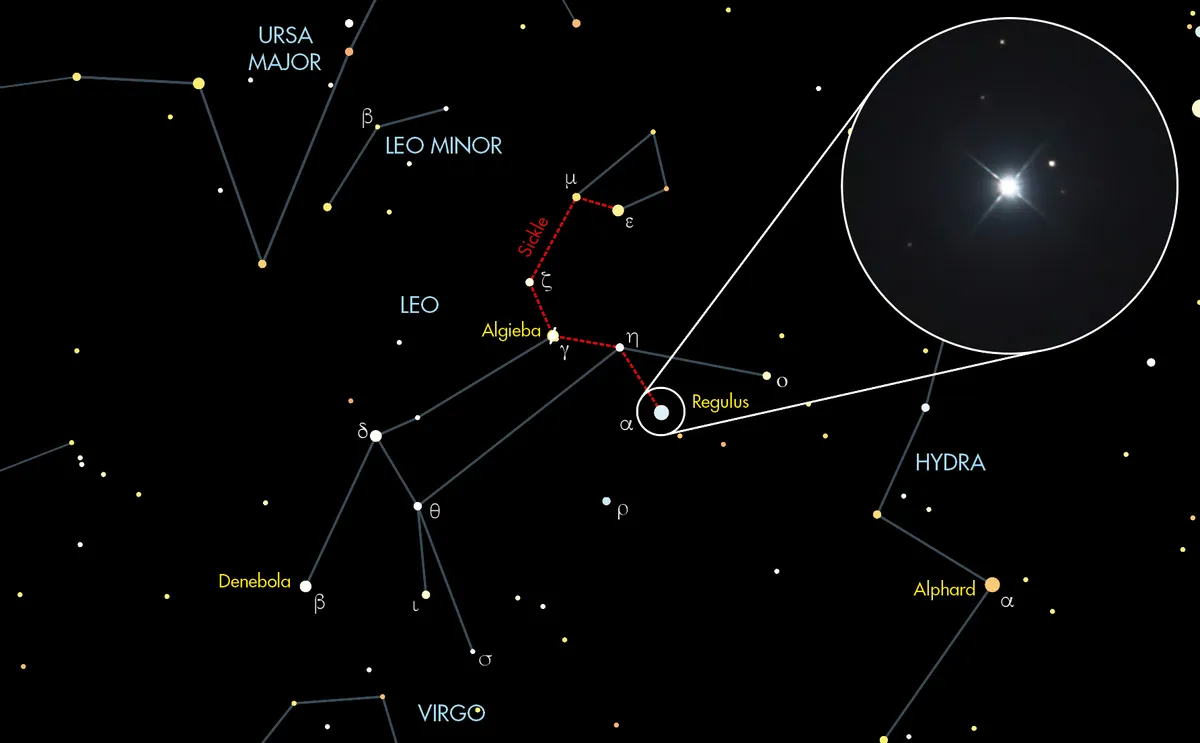
Tonight, 2 February, there's a chance to see the full Moon close to the brightest star in the constellation Leo.
And, if you're in the right part of the world, you'll get to see the Moon pass in front of this bright star, temporarily hiding it from view.
Get weekly stargazing updates and Moon phases delivered directly to your email inbox by signing up to the BBC Sky at Night Magazine e-newsletter

Where to see it
The Snow Moon will appear to pass in front of Regulus, which is the brightest star in the constellation Leo.
This event, known as a 'lunar occultation', will see the full Moon temporarily block some observers' view of Regulus, but what you'll see depends on where you're located in the world.
The lunar occultation will be visible from eastern parts of North America, also in West Africa and the very southern tip of Spain and Portugal.
Other parts of the world like the UK and Europe will still see Regulus pass close to the Snow Moon, but observers there won't see a full lunar occultation of the star.
Dates and times of the lunar occultation for different regions are available via In-The-Sky.org, or you can use a good stargazing app to help you work out exactly what you'll see from your location.

Tips for observing the lunar occultation
A lunar occultation of a star like Regulus will be best seen using binoculars or a telescope.
This enables you to see exactly the moment when the star disappears behind the Moon, then re-emerges out the other side.
Plan ahead. Where are you going to observe from, and where will you need to look in order to see it?
While the exact location will differ depending on where you're observing from, the lunar occultation will be visible in the eastern part of the sky, early on Monday evening, for those observing in North America.
Get set up in good time and start observing Regulus before it's due to disappear behind the Moon. Again, a good stargazing app will help you pinpoint the exact time from your location.
Seeing Regulus's close encounter with the Moon
Much of Europe and the UK will miss out on seeing the lunar occultation of Regulus, but will instead see Regulus pass close to the Moon.
That's because the Moon is so much closer to Earth than background stars, so the Moon's position seems to shift, depending on where in the world you're viewing from.
For observers in the UK and Europe, you'll be able to see Regulus close to the Moon when they rise together in the east after sunset.
At around 03:00-03:30 UTC on the morning of 3 February, Regulus will seem to skim just above the Moon, very nearly resulting in a lunar occultation, but just narrowly missing it!
If you observe or photograph Regulus and its close encounter with the Moon, share your observations and images with us by emailing contactus@skyatnightmagazine.com

