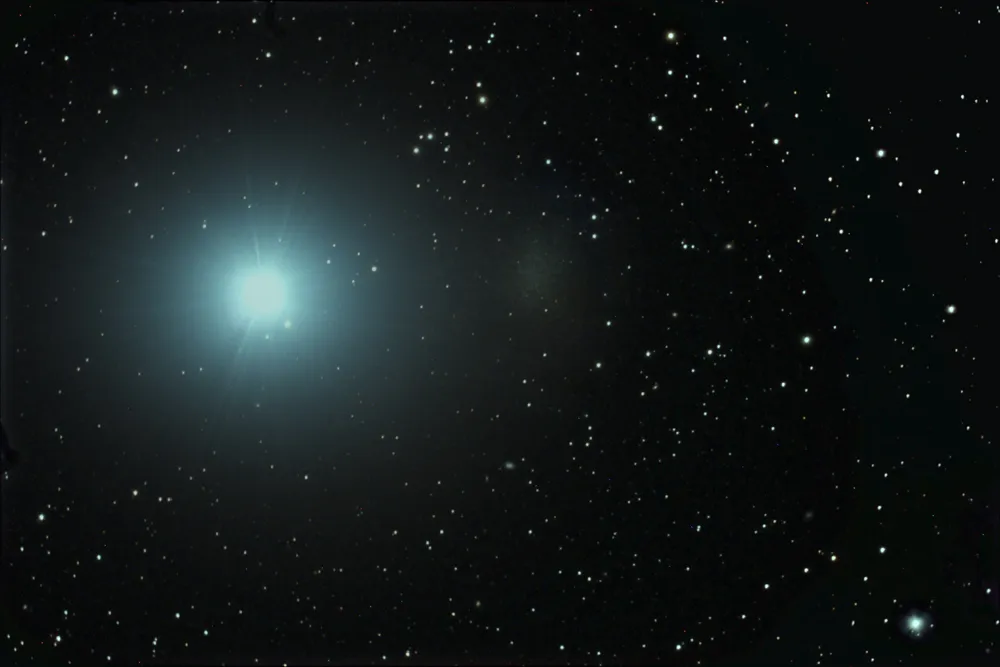
Regulus (Alpha (α) Leonis) is one of the principal stars of the spring sky and can easily be seen with the naked eye.
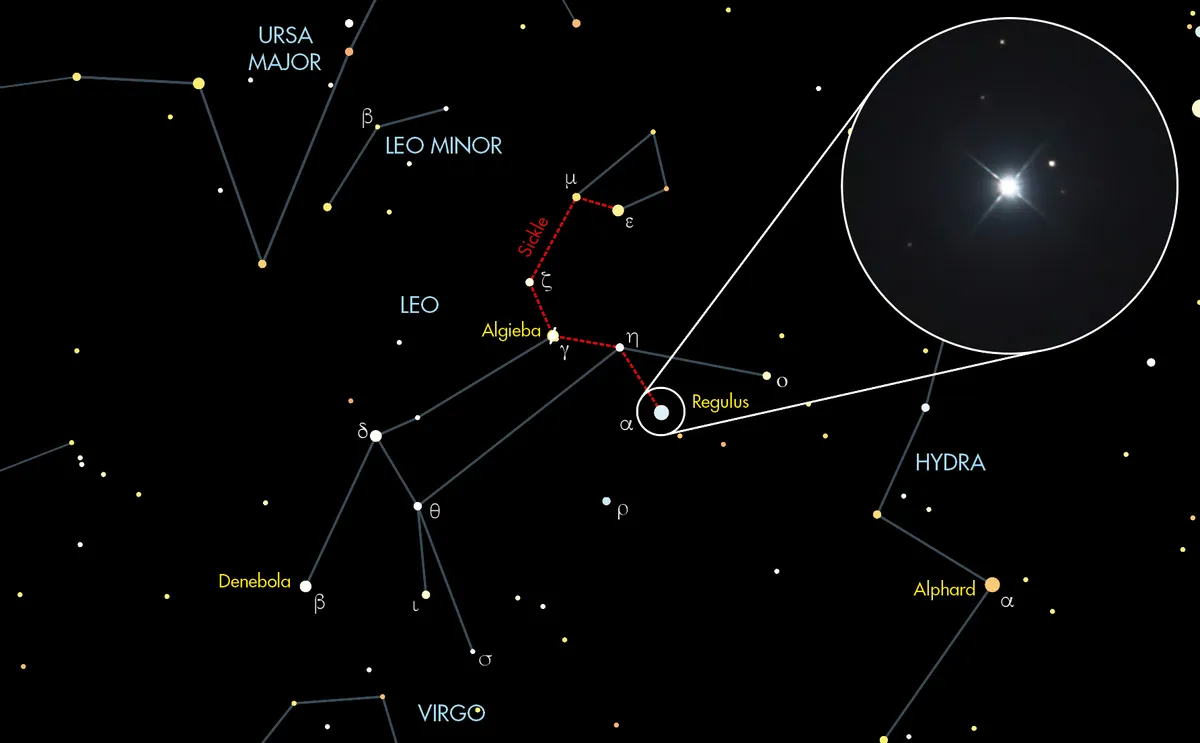
It’s easy to spot at the base of the Sickle asterism, a pattern representing the head of the constellation Leo.
If you need further affirmation, follow the lines of both sides of the Plough’s blade down and away from Polaris, the north star.
With a bit of artistic license, they converge at Regulus.
Regulus quick facts
Regulus is 79 lightyears from the Sun and appears to us at mag. +1.4, located 0.5° from the ecliptic.
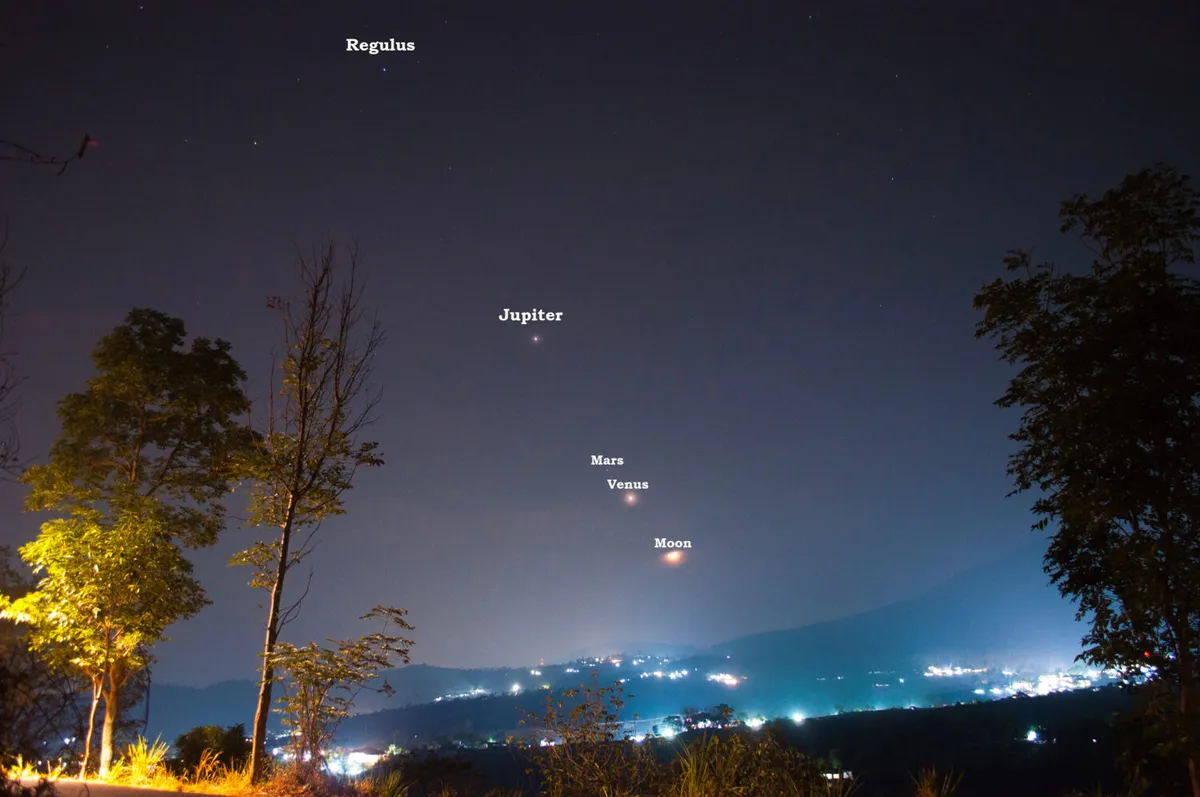
Its location means that Solar System objects appear to interact with Regulus, and it sometimes undergoes lunar occultation.
This is when the Moon appears to pass in front of Regulus from our perspective on Earth.
Planetary conjunctions with Regulus aren’t uncommon but planetary occultations are rare.
Its next planetary occultation will occur on 1 October 2044, when Venus passes in front of the star.
Regulus is a multiple star system. An obvious mag. +8.2 companion sits 177 arcseconds away in a northwest direction (position angle 307°).
This orange companion, Regulus B, is a double star with a separation of 2.5 arcseconds between it and mag. +13.5 Regulus C.
The B-C pair’s orbital period is an estimated 600 years.
This pales into insignificance compared to the 125,000 years it takes B-C to orbit the main Regulus A star. Spectroscopic analysis reveals that it too is a double.
Its so-far-unseen companion is believed to be a white dwarf star, orbiting Regulus A once every 40.11 days at a distance of just 52 million kilometres.
Another interesting characteristic of this springtime star is its fast rotation rate, which clocks up a speed of 317km/s.
At this speed, the star will be flattened into an oblate spheroid, approximately one-third wider at the equator than its polar diameter.
Its equatorial diameter is estimated to be 4.3 times that of the Sun.
Observing Regulus through binoculars

Most multiple stars with components of very different magnitudes are difficult to split, so it’s pleasant to find an easy one!
Regulus shines at mag. +1.4, nearly 500 times brighter than its companion.
Fortunately, they are separated by nearly 3 arcminutes, allowing even small compact binoculars to show the companion star.
We'd recommend a pair of 10x50 binoculars to observe it.
As we know, it's is a true multiple star system, not a chance line-of-sight pairing, which makes observing this double through binoculars even more satisfying.
Share your images with us by emailing contactus@skyatnightmagazine.com.