
Astronomers say they've found strong evidence of magnetic activity around distant planets orbiting stars beyond our Solar System.
The team measured wind speeds on seven scorching Jupiter-like planets and found that the winds are likely governed by magnetic fields.
If true, it's a groundbreaking discovery, providing the first strong signal of magnetism on planets beyond our Solar System.
It could even help astronomers better understand which planets across the Galaxy are most likely to host life.
More on exoplanets

Magnetic fields and the search for life
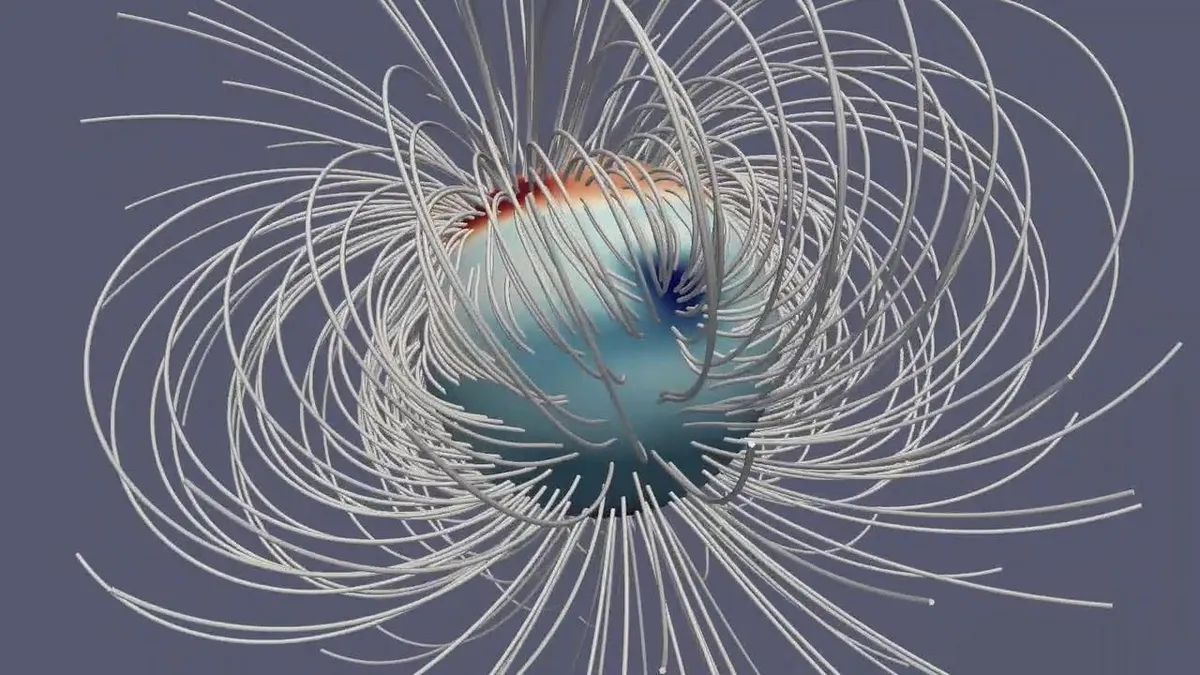
Earth’s magnetic field plays a key role in protecting life on our planet from the dangers of space.
That includes protecting us from massive solar storms erupting from the Sun and cosmic rays coming from deep space.
Other planets in our Solar System like Jupiter and Saturn have magnetic fields, too, but astronomers had never been able to directly measure the strength of magnetic fields at planets orbiting distant stars – until now.

To make the discovery, astronomers used two powerful ground-based telescopes, the European Southern Observatory’s Very Large Telescope and the Gemini North telescope.
"This breakthrough opens a completely new window on exoplanet research. It’s the first time we can compare the magnetic environments of other worlds," says Julia Seidel, astronomer at the Laboratoire Lagrange, Observatoire de la Côte d’Azur, France and lead author of the study published today in Nature Astronomy.
"It's a key step toward ultimately understanding which planets can stay alive, keep their water, and perhaps even, one day, host life as we know it."
Measuring cosmic hurricanes
The team began by measuring wind speeds on seven exoplanets orbiting different stars.
Each of the exoplanets is a gas giant, like Jupiter, and each is tidally locked to its host star.
That means the same side of the planet always faces the star, the way on Earth we always see the same side of the Moon.
One side of the planet is constantly experiencing daytime, getting blasted by scorching heat from the host star. The other side is stuck in freezing-cold nighttime.
That discrepancy generates extremely strong wind speeds, with winds ranging across the exoplanets from speeds of around 4,480 mph (7,200 km/h) to over 15,500 mph (25,000 km/h).

"In the beginning we set out to check if the atmospheric winds behaved the same way for all hot planets,” says Seidel.
But when the team looked more closely at how the wind speed on each planet varied with its temperature, they discovered a pattern.
The hotter the planet, the slower the wind.
"This is totally counter intuitive because, all things being equal, hot planets have more energy to accelerate the winds," says study co-author Vivien Parmentier, a professor at the Laboratoire Lagrange.
"Something must happen that slows down the wind speeds for hotter objects."

So what's going on?
The team say the likely solution is the presence of planet-wide magnetic fields, because such fields can work as a brake, slowing down the motion of charged particles in the atmosphere.
Using the data, the team could then estimate the strength of the magnetic field in each of the exoplanets.
They found the magnetic fields to be similar in strength to what we see in our Solar System: four times as strong as Saturn's magnetic field or about half the strength of Jupiter's.
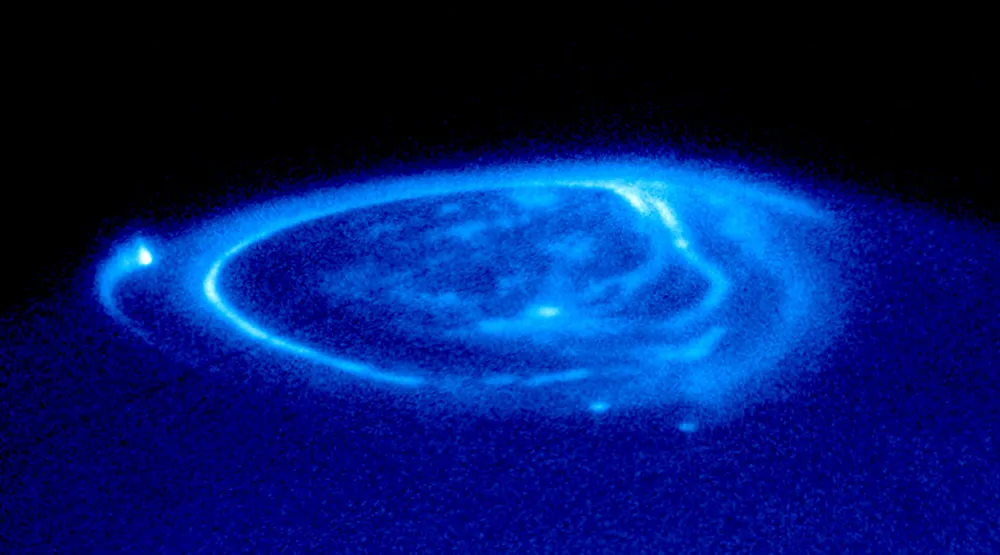
"Here on Earth, we know the beauty of the northern and southern lights, where particles from the Sun hit our magnetic field and are guided toward the poles, colliding with gases in the atmosphere to produce colourful displays of green, pink, and purple," says study co-author Bibiana Prinoth, an astronomer at ESO in Garching, Germany.
The team say the exoplanets' aurorae could be even more dramatic than Earth's.
"I like to imagine that some of these worlds have a sky filled not only with stars," says Prinoth, "but with vast curtains of colourful light dancing across a planet that’s half in perpetual day and half in endless night."

