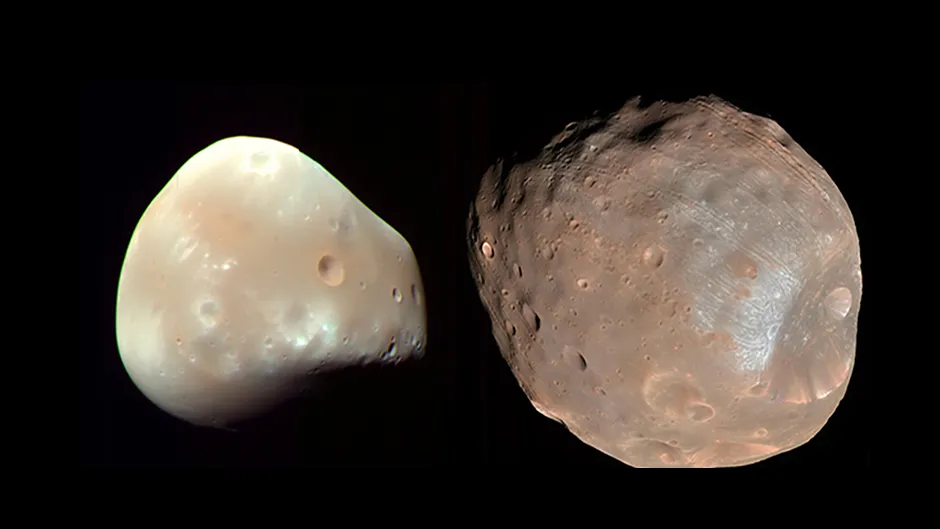
High above the rust-tinged, dusty surface of Mars, two small, misshapen and heavily cratered moons circle.
Phobos, a battered, potato-shaped world roughly 22km (14 miles) across, orbits just under 6,000km (3,700 miles) from its parent planet, whizzing around Mars in under eight hours.
Deimos is smaller still, little more than a lumpy 15km (9-mile) shard of rock, further from Mars at around 23,000km (14,300 miles), so that it takes 30 hours to complete one orbit.
Neither Phobos nor Deimos is a match for our larger, spherical Moon which, although much more distant from Earth, can still pull our oceans into tides. Neither Martian moon has nearly enough mass to do that.
More on Mars

And yet, in the sedimentary rocks of Gale Crater, just south of Mars’s equator where the southern highlands meet the northern plains, NASA’s Curiosity rover may have found evidence that something once did.
The discovery would suggest that Mars was once orbited by a third moon – one far larger than the two eccentric, asteroid-like bodies we see today – a previously unknown satellite capable of raising tides in ancient Martian waters.
If confirmed, it would be a missing chapter in the story of the Red Planet and its satellites, written not in the sky, but in stone.

Mars had water – rivers, oceans… and tides?
It’s increasingly accepted that Mars was once wet. New research led by the University of Bern, Switzerland, suggests that about three billion years ago, the Red Planet was a water-rich blue world.
Using images from the ExoMars Trace Gas Orbiter and data from Mars Express and the Mars Reconnaissance Orbiter, traces have recently been discovered that look like deltas, the fan-shaped forms created when a river flows into an ocean.
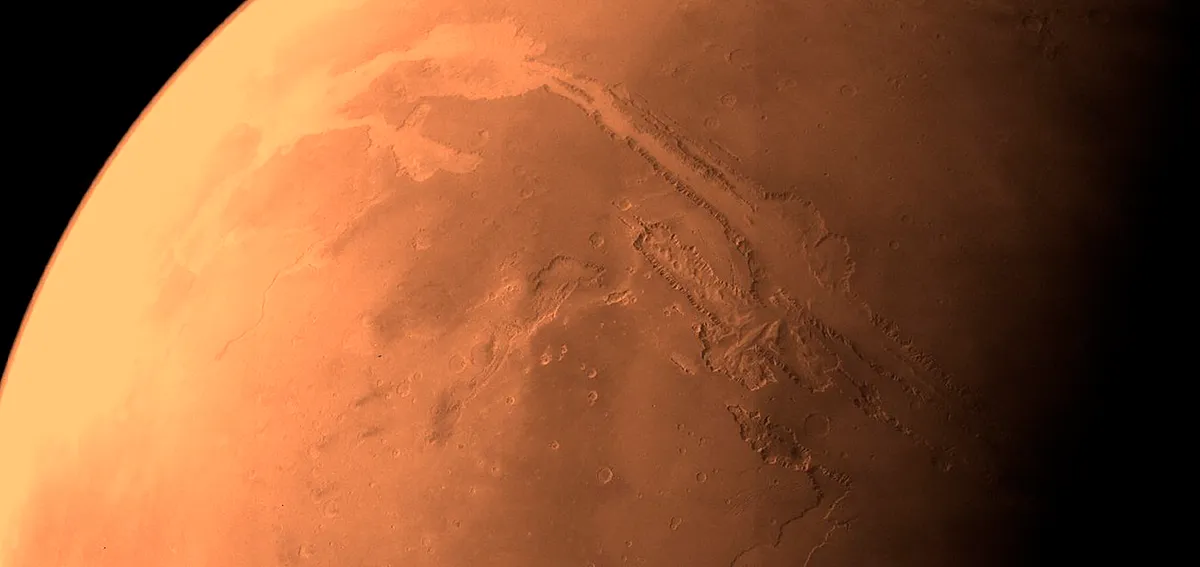
It’s evidence of a coastline. They were found in the Coprates Chasma, part of Valles Marineris, the largest canyon system in the Solar System, found near Mars’s equator.
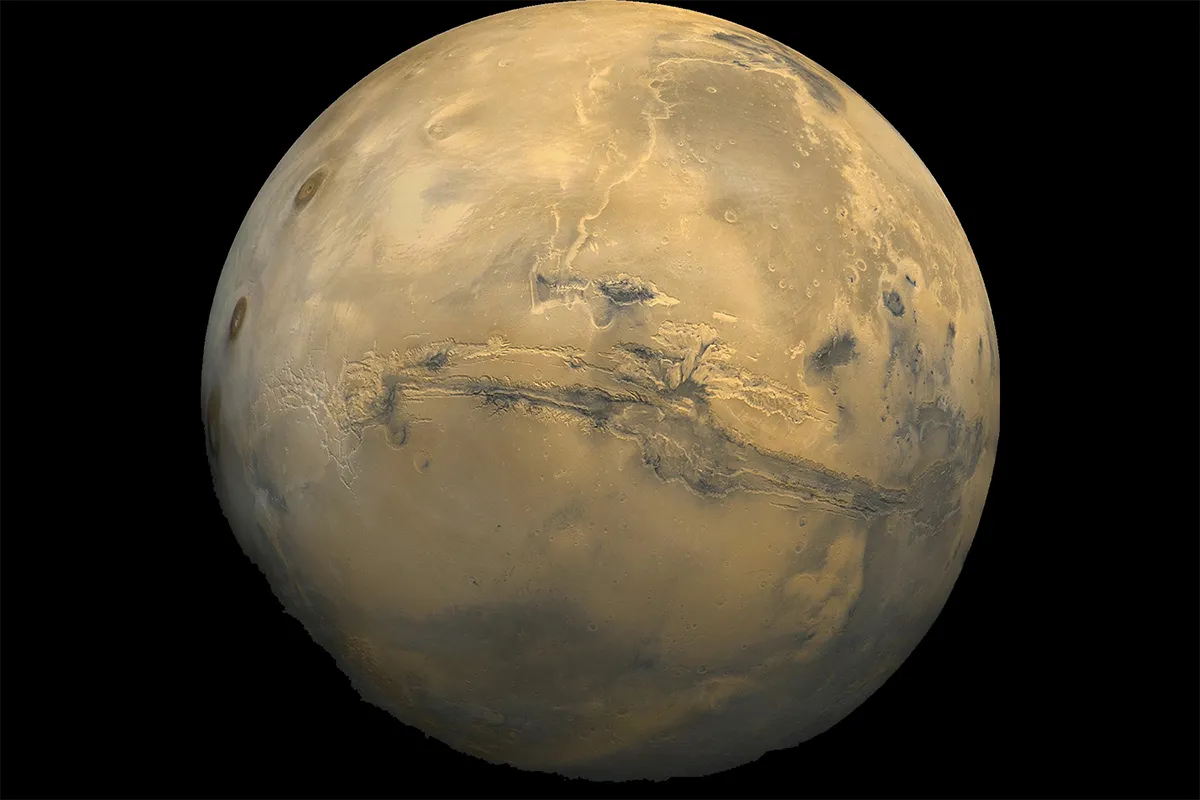
The discovery supports the existence of a so-called ‘Oceanus Borealis’, a hypothetical massive body of liquid water at least as large as Earth’s Arctic Ocean, that stretched across Mars’s northern hemisphere billions of years ago.
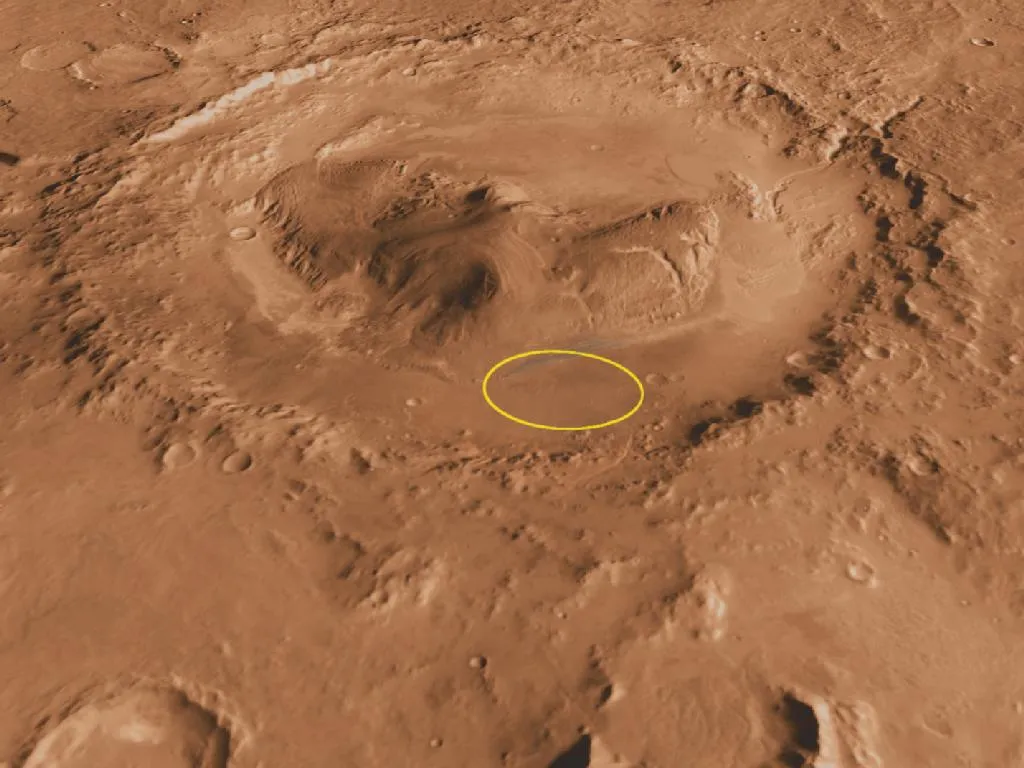
Gale Crater is not close to where the Oceanus Borealis is thought to have existed, but 3.5–4 billion years ago, it was not the arid depression seen today.
Geological evidence shows that it once hosted lakes. Rivers flowed into the basin, depositing sediment that gradually built the layered mound now known as Mount Sharp.
Finding evidence for a lost Mars moon
The evidence for a giant moon comes from what geologists call rhythmites, or rhythmic sedimentary layers – rock layers with a repetitive pattern in their spacing and thickness.
These patterns of light and dark represent not just the flow of water, but also variations in that flow over time.
On Earth, geologists have used rhythmites to study our Moon’s orbital dynamics, finding evidence that our planet’s rotational rate has slowed – increasing the length of a day – and that the Moon is receding from Earth at a rate of 3.8cm (1.5 inches) per year.
Could moonlit tides have once ebbed and flowed in an ancient lake in Mars’s Gale Crater?

That’s the suggestion, though rhythmic sedimentary layers have been seen on Mars before.
From orbit, vast stacks of alternating light-and-dark strata can be seen sweeping across the Martian surface in crater walls and canyon systems.
Most have been interpreted as records of seasonal differences (for example, more water flowing into lakes in summer than in winter), winds and long-term climate cycles – the latter driven by variations in Mars’s axial tilt.
However, orbital images lack the resolution for planetary geologists to explore in greater detail. And in the world of rhythmites, detail is everything.
What Curiosity rover found
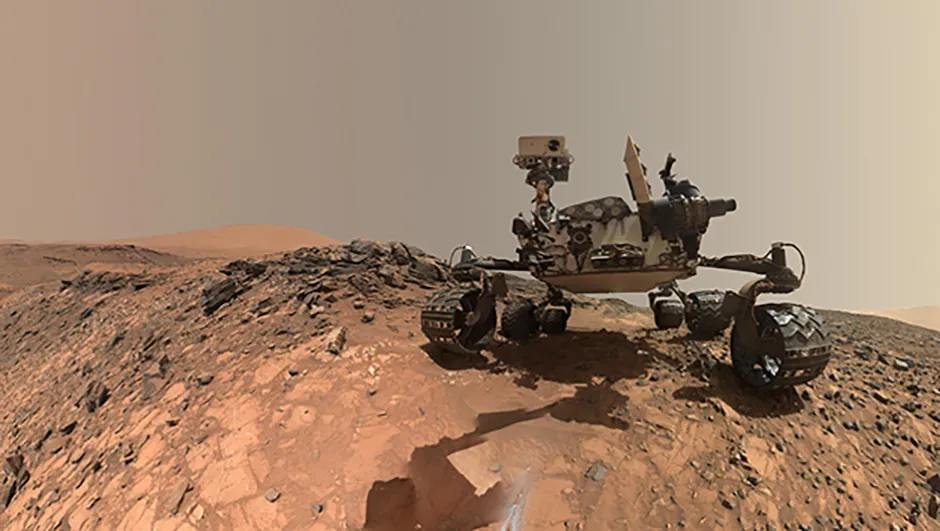
Cue Curiosity, the car-sized rover that landed on Mars on 6 August 2012 in a low-lying area that’s thought to have once hosted a lake.
The rover’s task is to determine if the Red Planet ever had the right environmental conditions to support microbial life.
In late 2017 and 2018, Curiosity spent four days exploring Vera Rubin Ridge, a band of rock on the lower slopes of Mount Sharp inside Gale Crater.
Using its high-resolution Mast Camera (Mastcam) and Mars Hand Lens Imager (MAHLI) instruments, the rover photographed a rock bearing exquisitely thin laminations – sub-millimetre to millimetre bands that repeated in a remarkably ordered pattern.
These features were subsequently identified in the rover’s images by a team of scientists at the Physical Research Laboratory in Ahmedabad, India, a unit of the Indian Space Research Organisation.

It was a serendipitous discovery.
"We found a few outcrops with special sedimentary structures not yet reported on Mars, which have a close similarity with tidal-like structures on Earth," says co-author Dr Priyabrata Das, an expert on the tidal‑type processes, morphologies and textures of our planet.
"You can see a clear, dark colour lamination – a pair of dark layers, then a gap, then again a pair, then a gap, then a pair," he says.
"If you are a geologist and you’re working on Earth, then it’s very common – dark pairing is associated with a tidal-like situation."

Patterns of rising water on Mars
More detailed measurements of what’s now called the Jura outcrop with Curiosity’s MAHLI instrument revealed a quasi-periodic signal.
Statistical analysis identified bundles of roughly 30 laminae alongside smaller paired sub-cycles.
Jura’s fine, evenly spaced laminae in bundles represent a repetition that’s unlike wind-blown deposits on Mars, which tend to produce cross-bedded dunes with layers at an angle to the main horizontal plane (since winds change direction).
What Curiosity found is much like
what geologists see in estuaries and shallow seas on Earth.
Not only is there evidence of the steady rise and fall of water laying down rhythmic deposits, but those smaller paired sub-cycles that mark slack water (or slack tide) – the brief pause when tidal currents are smallest.
These pauses can leave thin drapes of fine sediment that over time stack into recognisable tidal signatures.
The Martian layers appeared to echo the pattern seen on Earth.

A giant moon?
If the pattern does represent tidal rhythmites, it implies a regular forcing mechanism – something orbiting Mars that exerts a gravitational influence on standing bodies of water.
If there were a lake in Gale Crater today, neither Phobos nor Deimos could generate strong, periodic tidal signatures.
If tides did cause the structures, the researchers suggest – under certain modelling assumptions – that they were driven by a moon at least 15 times the mass of Phobos, which orbited about 10,000km (6,300 miles) from Mars.
Such a moon would have been capable of raising measurable tides in ancient lakes or seas.
In this scenario, the Jura laminae are the imprint of the orbital mechanics of a larger moon that may have birthed both Phobos and Deimos.

"We are not attributing the features we are seeing to Phobos and Deimos, but to a larger body which may have fragmented to produce Phobos and Deimos that we see today," says Suniti Karunatillake at Louisiana State University, who presented research on the topic at the American Geophysical Union’s Annual Meeting in New Orleans in December 2025.
"Even if those two satellites were much closer to Mars in geologic history, they wouldn’t exert the needed gravitational torques to create the type of tidal signatures that would be consistent with what we’re seeing in the Jura outcrop."
Testing the third moon theory
The possibility that Mars once possessed a larger moon is not a new theory.
It’s been proposed before that large moons form, migrate inward under tidal forces and eventually break apart under the planet’s gravity, forming debris rings that later reassemble into smaller moons.
Phobos and Deimos may be survivors – or remnants – of such a cycle.
Either way, the Jura outcrop in Gale Crater adds a new dimension to that hypothesis.
Rather than relying solely on orbital modelling, researchers may now have ground-based geological clues: a physical record of tidal processes locked in Martian mudstone.
For now, it’s a theory and the researchers remain cautious. Rhythmic layers can arise through multiple processes.
"This is an interpretation – it’s not the only interpretation possible for these laminations," says Karunatillake.
Proving that Mars definitely once had a much larger moon will require more direct evidence, beginning with a detailed, high-resolution survey of Vera Rubin Ridge to search for more of these types of thick–thin bands of lamination.
The researchers also want to search for tidal settings on Earth that closely match those on Mars.
However, if the Jura laminae do record tides, then each bundle of layers would mark not just a cycle of water, but the pull of a vanished world that once orbited the Red Planet.
Where did Mars' lost moon go?
Any lost moon may have been one in a long line of Martian moon‑making and moon‑breaking.
Mars’s moons are not permanent fixtures. Phobos is slowly spiralling inward and will likely break apart tens of millions of years from now, while Deimos is gradually moving away.
If Mars has hosted cycles of moon formation and destruction, then the lamination Curiosity spotted in rocks may be evidence of an earlier chapter in a repeating story – one in which satellites are born, shattered and reborn over billions of years.

Modelling by Matija Ćuk at the SETI Institute shows that some remnants of a large moon would draw closer, while others would disperse outward.
"That modeling can end up predicting the current position of both Phobos and Deimos," says geophysicist Suniti Karunatillake.
In-situ evidence may come soon. The Japan Aerospace Exploration Agency’s Martian Moons eXploration (MMX) launches in late 2026.

The mission will orbit the planet before travelling to Phobos to collect surface samples, returning them to Earth in 2031. It will also fly past Deimos.
Its main goal is to determine the origins of both moons – are they captured asteroids or fragments of a larger object formed in orbit? – but its findings may also inform the ‘lost moon’ hypothesis.
"MMX will get a detailed compositional characterisation of Phobos and Deimos and tell us about the feasibility of a ring–satellite system or past larger moons that evolved or co‑evolved with Mars," says Karunatillake.
The lost moon hypothesis may soon be in the hands of scientists on Earth.