
An asteroid about as big as a basketball court is swinging close to Earth, Monday 18 May 2026, passing well within the orbit of the Moon.
While astronomers say there's no danger it will hit Earth, 2026 JH2 is classed as a Near Earth Asteroid, and should be observable in the night sky using a small telescope.
Here's what we know so far.
For more on this story, get the key facts about asteroid 2026 JH2 from a professional astronomer.
More on asteroids

The discovery of 2026 JH2
Asteroid 2026 JH2 is set to zip past our planet on Monday 18 May 2026 at a very close distance, by astronomical standards.
It was first spotted on 10 May 2026 by the Mt. Lemmon Survey in Arizona, USA, which is a key science facility for discovering asteroids wandering close to Earth.
Because they're relatively small and hard to detect against the darkness of deep space, Near-Earth Objects – known as NEOs – often remain hidden until they're right on our cosmic doorstep.
The Small-Body Database led by NASA’s Jet Propulsion Laboratory suggests 2026 JH2 measures somewhere between 16–35 metres (50–115 feet) wide.
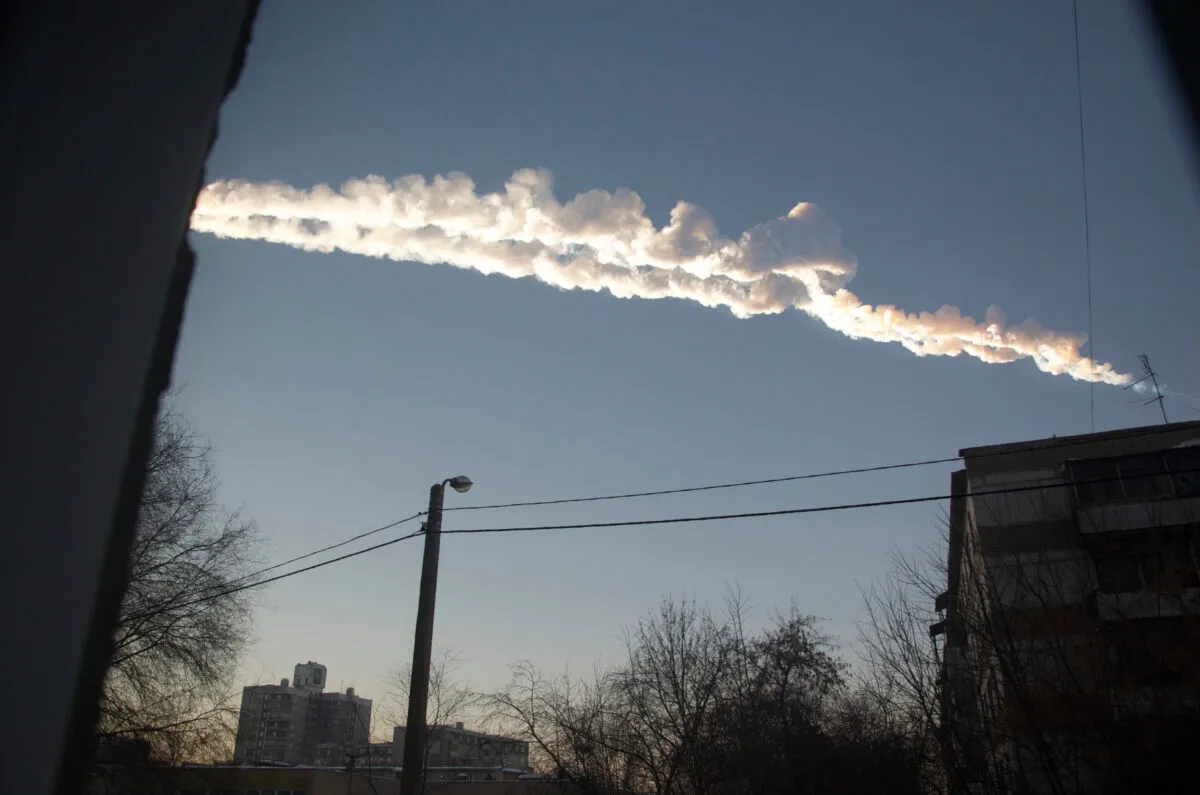
For comparison, the Chelyabinsk meteor that entered the atmosphere over Russia in 2013 was about 20 metres (65 feet) wide.
How close will it come?
Asteroid 2026 JH2's closest approach to Earth is expected at 21:23 UTC on 18 May 2026, when it will pass by at a distance of 90,000km (56,000 miles).
That may sound incredibly far away – and it is – but to put it into perspective, the average distance between Earth and the Moon is 385,000km (239,000 miles)
That means asteroid 2026 JH2 will pass Earth at just under a quarter of the distance between Earth and the Moon.
But while it will pass by our planet well within the Moon's orbit, it will still be beyond the orbit of geostationary satellites.
More data on 2026 JH2 can be found via the Minor Planet Center.

Is 2026 JH2 dangerous?
In a word, no. The idea of an asteroid flying by Earth and coming much closer than the orbital path of the Moon may sound alarming, but astronomers have said there is zero risk of impact.
The technology currently available to asteroid-trackers is highly advanced and enables astronomers to predict the orbits of space rocks to a high degree of accuracy, even years into the future.
And even if 2026 JH2 did manage to collide with Earth, it's likely any potential damage would be severely negated by the asteroid burning up as it entered Earth's atmosphere.
NASA says space rocks smaller than about 25m (82 feet) would most likely burn up and cause little or no damage.
Observing 2026 JH2
2026 JH2 is visible now in the southern sky after sunset, close to the constellations Ursa Major and Leo, but it will be trickier to see from some locations than others.
A good stargazing app should help you pinpoint it from your location, but you may need to update the software's database to include 2026 JH2, given it's a newly-discovered object.
We used the free software Stellarium to track 2026 JH2's location, and had to update its celestial objects database in order to do so.
2026 JH2 will be too faint to see with the naked eye, but as it makes its closest approach to Earth, the asteroid is expected to reach a magnitude of about +11.5.
That means it should be visible through modest amateur telescopes.
If you don't have a telescope or are unable to get out and observe it for yourself, the Virtual Telescope project is hosting a livestream, during which they'll attempt to capture 2026 JH2 and broadcast the view live.
You can watch their feed below.
If you manage to observe asteroid 2026 JH2, share your observations and images with us by emailing contactus@skyatnightmagazine.com

