The Moon occults the northern part of the Pleiades open cluster on the night of 27/28 October 2026, getting interesting from around 23:45 UT (19:45 EDT).
The Moon will be very bright, showing a 95%-lit waning gibbous phase.
Binoculars will show the Pleiades stars well, as will a small telescope with a low-power eyepiece.
When separated, the Moon looks quite large in the sky and the Pleiades look fairly small.
However, put them together and the truth is revealed: the Pleiades look significantly larger than the apparent size of the Moon.
Although the cluster doesn’t have a distinct, sharp boundary, the main stars will fit inside a circle 1° across.
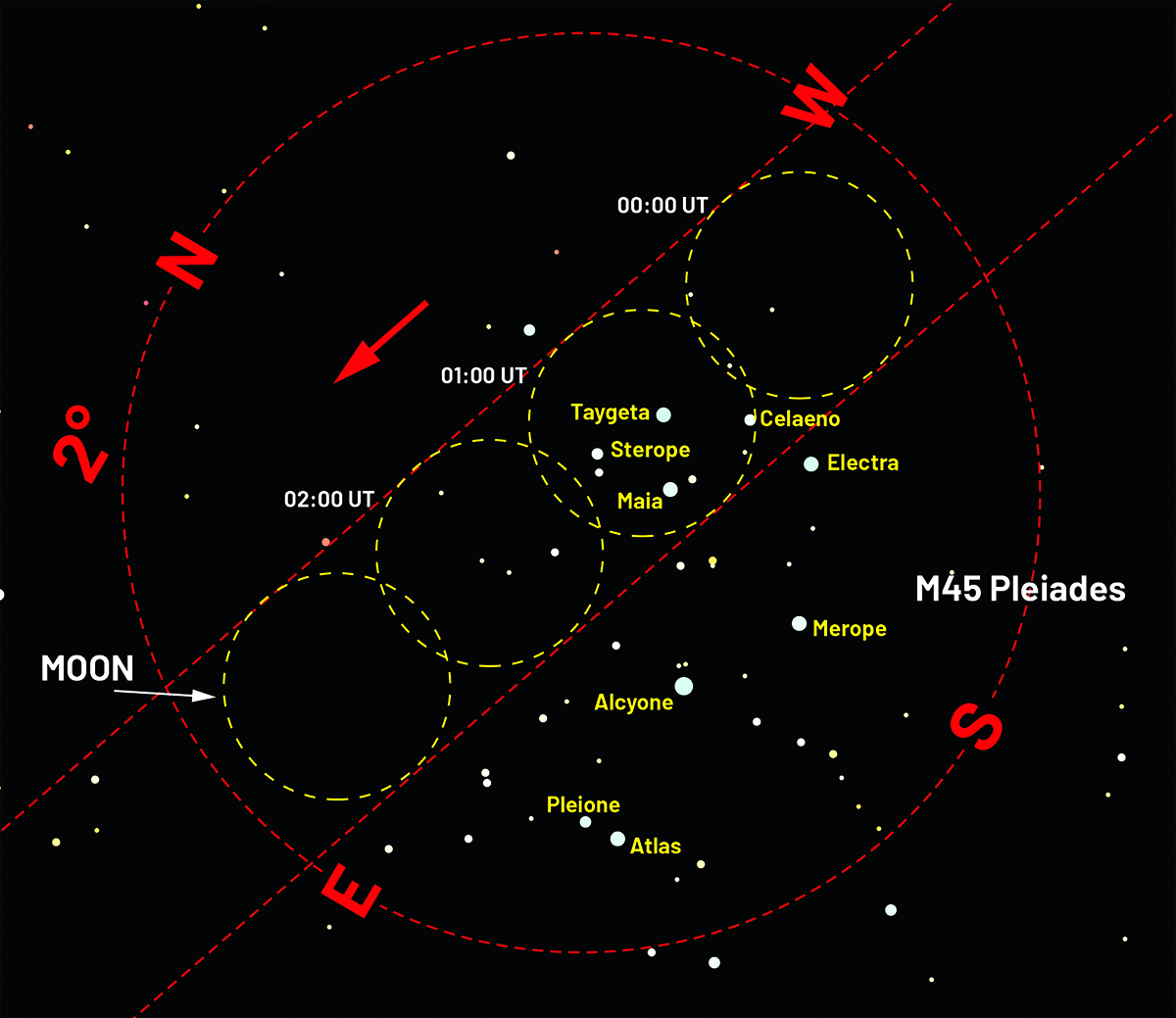
The Moon is 0.5° across and fits comfortably within the cluster.
From the UK, in the early hours of 28 October the Moon’s apparent sky track takes it across the northern part of the cluster, the brightest Pleiad occulted being mag. +3.8 Maia (20 Tauri).
Dimmer named Pleiads in the Moon’s path are Celaeno (16 Tauri), Taygeta (19 Tauri) and Sterope (21 Tauri).
For those in the north of the UK, the Moon will appear slightly more embedded in the cluster than it does to those in the south.
Times and positions will vary depending on your location. Start watching at least 15 minutes earlier than the time stated. Moon’s phase: 94% waning
If you manage to observe or photograph the lunar occultation, get in touch by emailing contactus@skyatnightmagazine.com