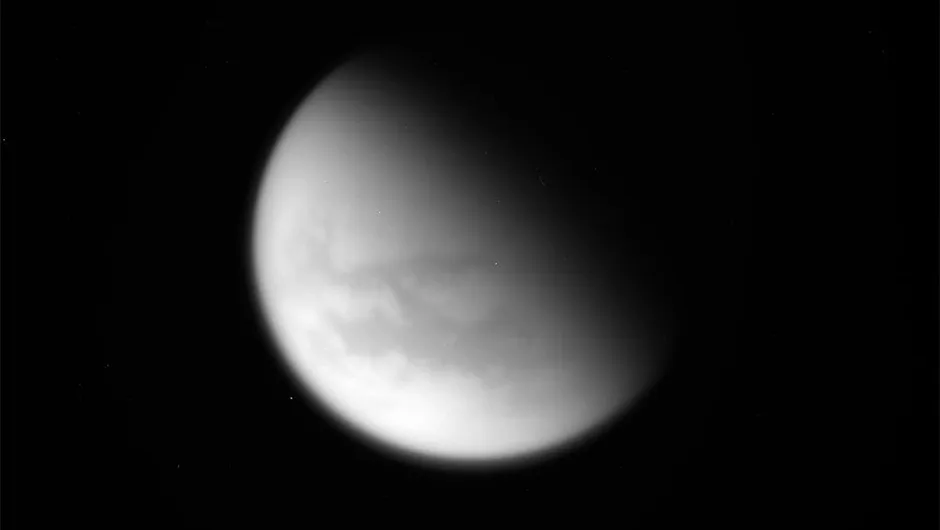
Saturn’s largest moon, Titan, may not be a relic from the dawn of the Solar System, but the product of a more recent violent collision and merger between two moons, according to research from the SETI Institute.
The findings offer an explanation for Titan’s unusual characteristics and may also explain the formation of Saturn’s famous rings.
Credit: NASA/E. Karkoschka (University of Arizona)
Using computer simulations, researchers found that the current configuration of Saturn’s moons, along with Titan’s slightly erratic orbit, are best explained by the existence of a now-lost satellite.
This extra moon likely orbited between Titan and Iapetus (the current outermost large moon) before becoming unstable and colliding with a ‘proto-Titan’ roughly 100 million years ago.
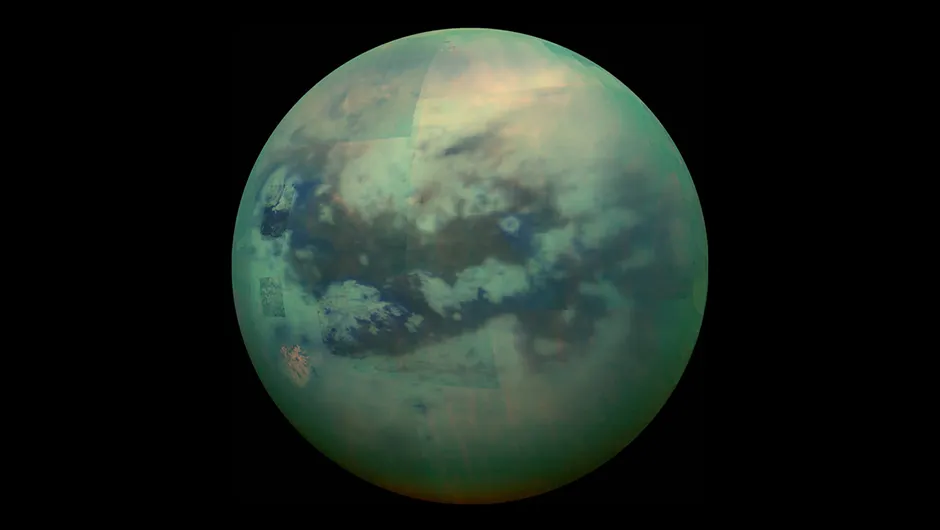
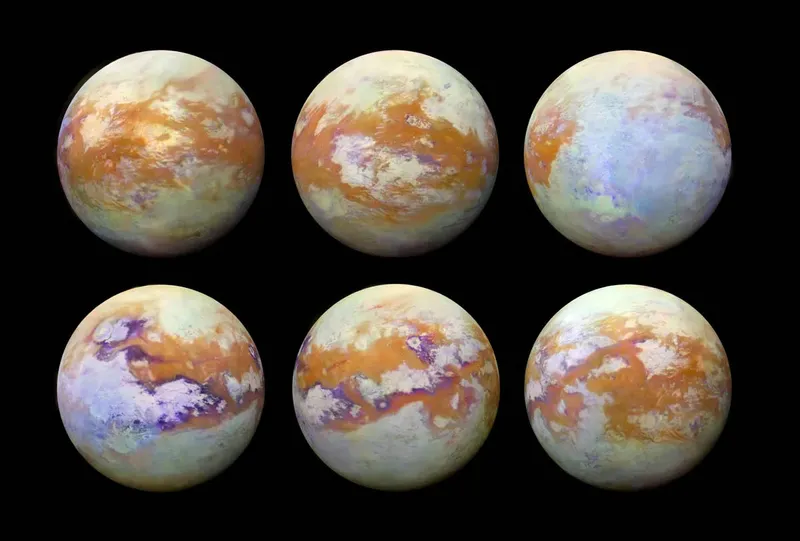
Six infrared images of Saturn's moon Titan captured by the Cassini spacecraft. Credit: NASA/JPL-Caltech/University of Nantes/University of Arizona
“Hyperion, the smallest among Saturn’s major moons, provided us the most important clue about the history of the system,” says SETI’s Dr Matija Ćuk.
The study, published in the Planetary Science Journal, notes that Hyperion’s strange, sponge-like appearance and its gravitational lock with Titan suggest a shared, chaotic origin.
The energy from such a monumental impact would have effectively given Titan a new surface, erasing billions of years of impact craters and shaping the moon’s relatively smooth modern appearance.
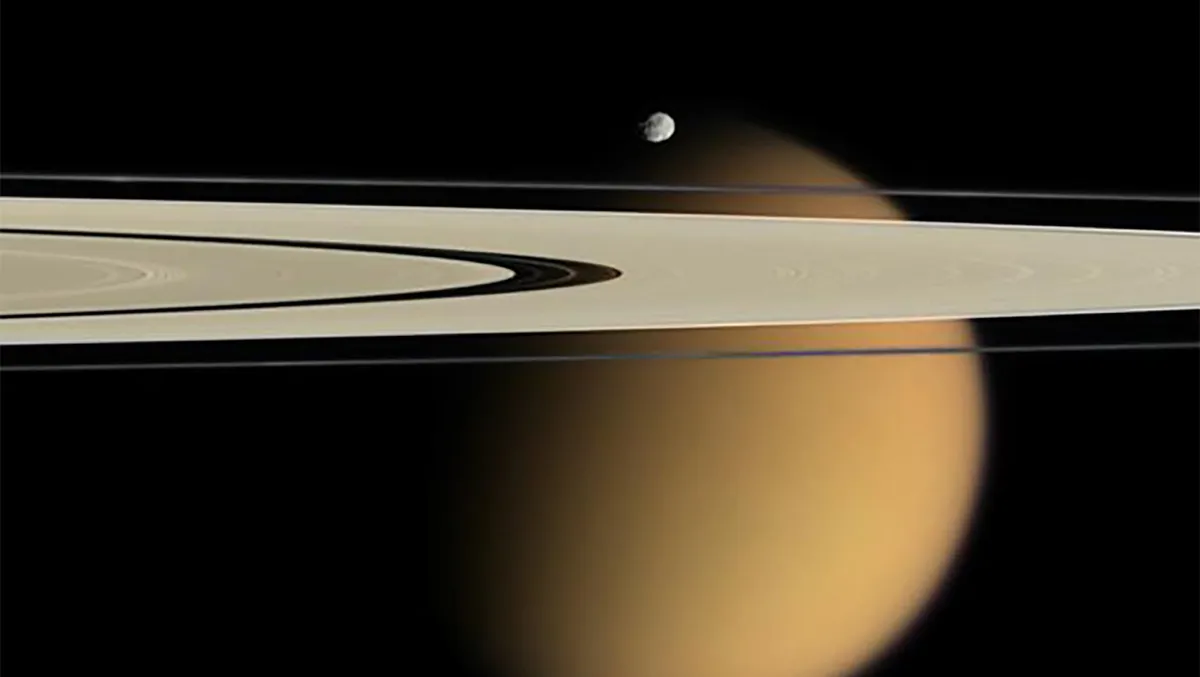
A Cassini image showing Titan, Saturn’s largest moon, behind the planet’s rings. The smaller moon Epimetheus can be seen in the foreground. Image Credit: NASA/JPL/Space Science Institute
Saturn's ring mystery solved?
The collision could also help explain the origin of Saturn’s rings.
The researchers propose that as Titan’s orbit expanded and became more eccentric following the merger, it triggered a gravitational chain reaction that destabilised medium-sized moons closer to the planet.
“If the extra moon merged with Titan, it would likely produce fragments near Titan’s orbit,” Ćuk explains. “That is exactly where Hyperion would have formed.”
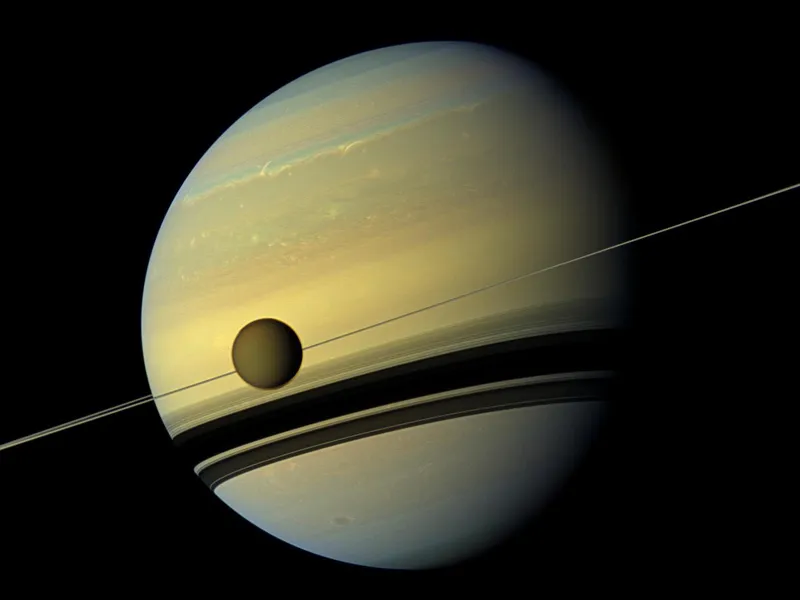
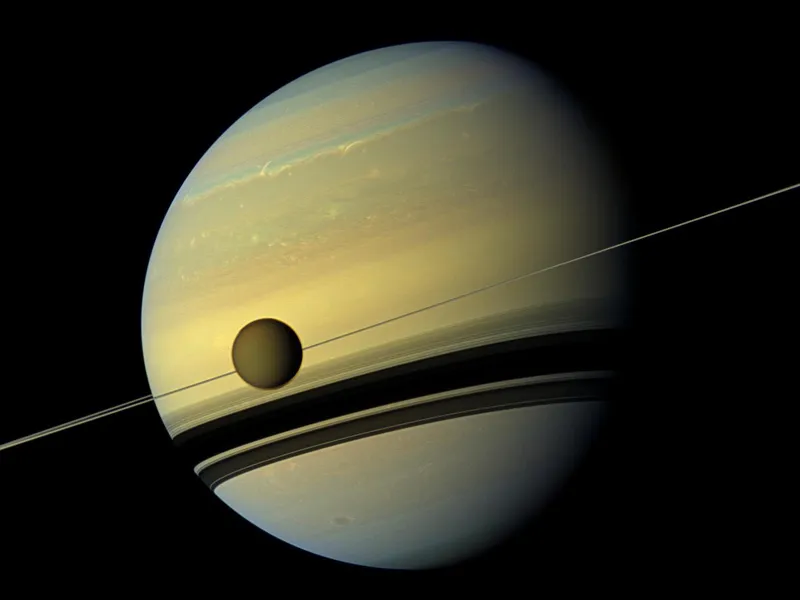
Moon Titan appears in front of Saturn in an image captured by NASA’s Cassini spacecraft. Credit: NASA/JPL-Caltech/Space Science Institute
This theory challenges the idea that Saturn’s rings formed billions of years ago, aligning with Cassini mission data that suggests they’re a mere 100 million years old – roughly the same era that the dinosaurs dominated Earth.
While the hypothesis remains difficult to confirm, scientists are looking to NASA’s upcoming Dragonfly mission, scheduled to arrive at Titan in 2034.
The nuclear-powered helicopter will analyse the moon’s chemical and geological composition, and could potentially uncover definitive proof of the ancient moon collision.
Cassini took many images of Titan over its 13 year mission at Saturn. The mission ended on 15 September 2017, when it plunged into Saturn’s atmosphere, but it’s data is still providing scientific insight. Image Credit: NASA/JPL-Caltech/ASI
Proof that Saturn's rings are rare?
Words: Chris Lintott
What a fun idea! I knew different strands of evidence pointed to Titan’s atmosphere being no more than a few hundred million years old – suggesting that, as my friend on the Dragonfly team Sarah Hörst puts it, “Something Happened” relatively recently – but the idea Titan might only have formed in the recent past is astounding.
It suggests that rings as magnificent as Saturn’s might be a temporary, and perhaps rare, phenomenon.
If so, they make our Solar System special. Maybe tourist guides for any aliens traversing this bit of the Milky Way will recommend a brief detour to see such an unusual wonder.
Gallery – images of Saturn's moon Titan
Six infrared images of Saturn's moon Titan captured by the Cassini spacecraft. Credit: NASA/JPL-Caltech/University of Nantes/University of Arizona
Titan passes in front of Saturn in an image from NASA's Cassini spacecraft. Credit: NASA/JPL-Caltech/Space Science Institute
Infrared-light images of Titan by the James Webb Space Telescope on 11 July 2023, showing methane clouds at different altitudes in Titan’s northern hemisphere. Credit: NASA, ESA, CSA, STScI, Keck Observatory
Infrared images of Saturn's moon Titan captured by the Cassini mission on 28 October 2005 (left), 26 December 2005 (middle) and 15 January 2006 (right). Credit: NASA/JPL/University of Arizona
Image of Kraken Mare on Titan, captured by NASA's Cassini spacecraft. Credit: NASA / JPL-Caltech / Agenzia Spaziale Italiana / USGS
Composite of the surface of Saturn's moon Titan, captured by the Huygens lander. Credit: NASA/JPL/ESA/University of Arizona
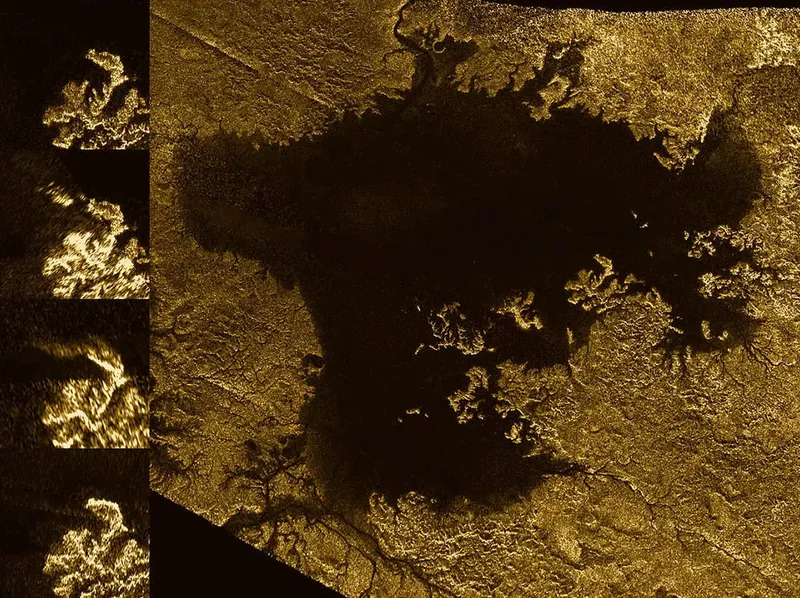
Images captured by the NASA Cassini spacecraft show the evolution of a transient feature in a large hydrocarbon sea called 'Ligeia Mare' on Saturn's moon Titan. Credit: NASA/JPL-Caltech/ASI/Cornell
Infrared images of Saturn's moon Titan, captured by NASA's Cassini spacecraft. Credit: NASA/JPL-Caltech/Stéphane Le Mouélic, University Of Nantes, Virginia Pasek, University Of Arizona
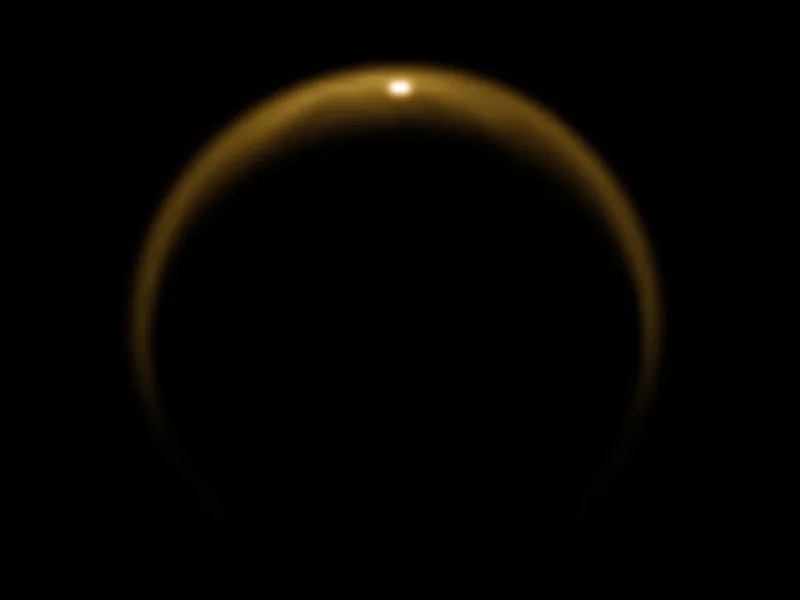
An infrared view of the Saturn moon Titan showing sunlight reflected off its polar lakes. Credits: NASA/JPL-Caltech/Univ. Arizona/Univ. Idaho
Saturn's moon Titan. Credit: Source: NASA/JPL-Caltech/Space Science Institute
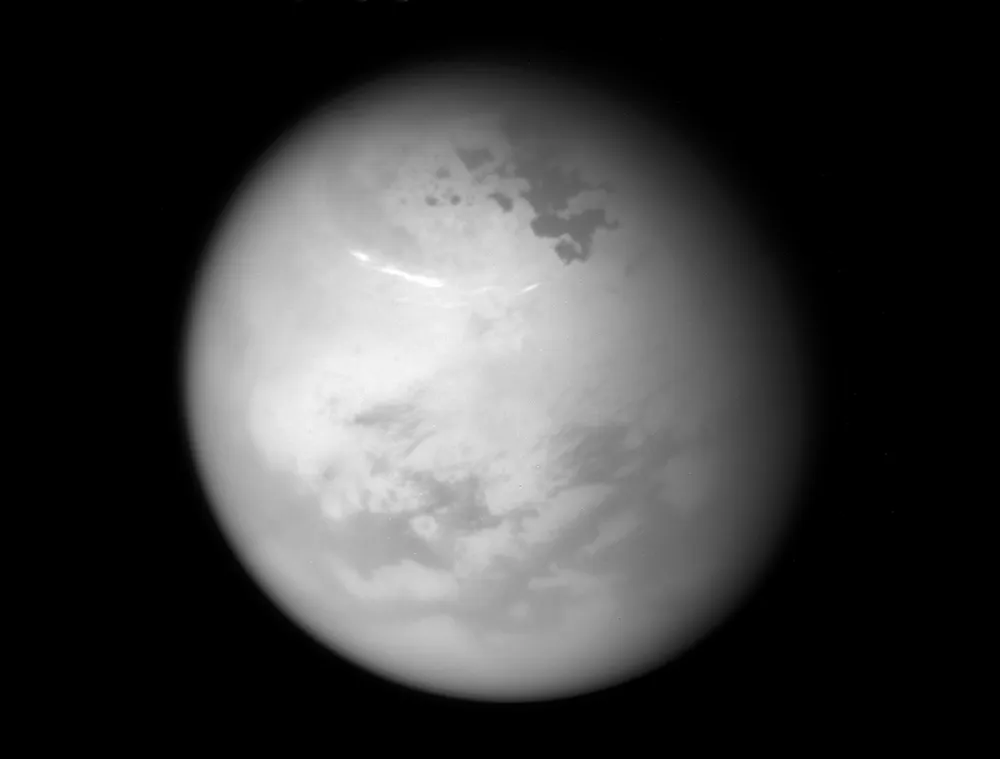
An image of Titan captured by the Cassini spacecraft on July 2009. The bright spot at the top of Titan’s disc is sunlight reflecting off the surface of a hydrocarbon lake. Dragonfly will explore these pools of liquid to search for conditions suitable for the development of life. Credit: NASA/JPL/University of Arizona/DLR
Moon Titan appears in front of Saturn in an image captured by NASA’s Cassini spacecraft. Credit: NASA/JPL-Caltech/Space Science Institute
Cassini takes a last look at Saturn's moon Titan on 21 April, before manoeuvring to begin its series of ring dives on 26 April.
Credit: NASA/JPL-Caltech/Space Science Institute
A Cassini image showing Titan, Saturn’s largest moon, behind the planet’s rings. The smaller moon Epimetheus can be seen in the foreground. Image Credit: NASA/JPL/Space Science Institute
Cassini took many images of Titan over its 13 year mission at Saturn. The mission ended on 15 September 2017, when it plunged into Saturn’s atmosphere, but it’s data is still providing scientific insight. Image Credit: NASA/JPL-Caltech/ASI
Like Earth, Titan has an atmosphere, seen here as a hazy blue outline around the moon’s limb. But Cassini scientists have discovered another similarity between our planet and Saturn’s largest moon.To the upper left of Titan in this image taken by the Cassini spacecraft is Tethys, another of Saturn’s satellites.Credit: Cassini Imaging Team, ISS, JPL, ESA, NASA