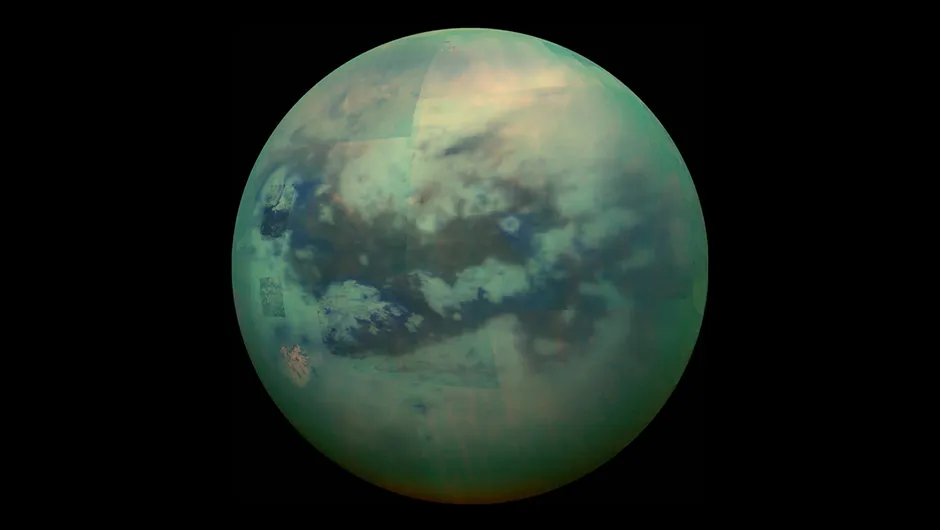
Saturn has 274 moons, but by far the ringed planet's biggest natural satellite is Titan.
Like Earth, it has a water cycle of sorts, with clouds, rivers and lakes. Except instead of water, Titan's rivers flow with liquid methane.
Its lakes contain complex hydrocarbons and organic chemistry, making the moon one of the best places to search for signs of life.
More Solar System facts
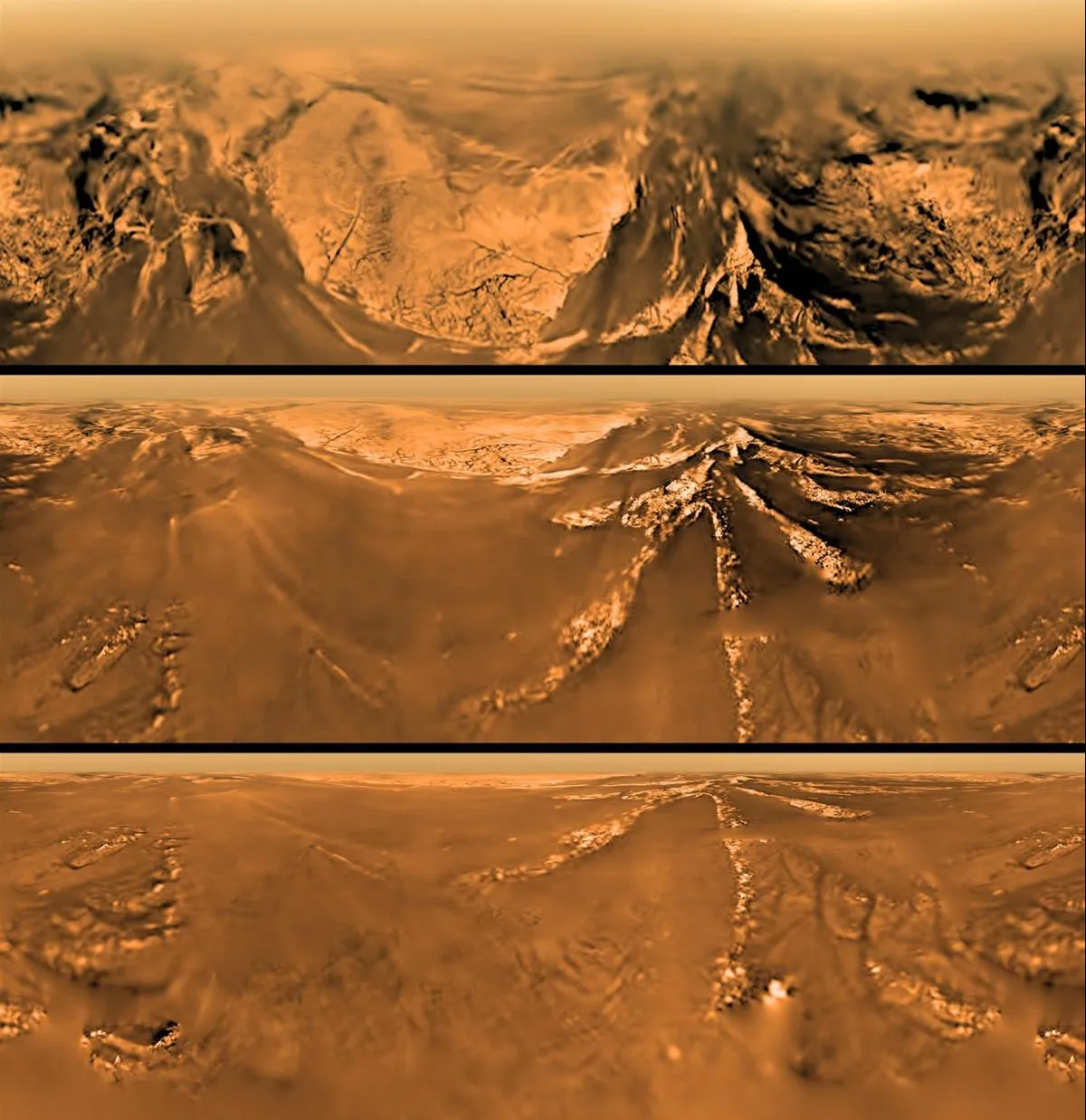
And its one of the few bodies of the Solar System we've landed a spacecraft on. The Huygens probe– part of the Cassini mission – landed on Titan in January 2005 and captured images of this strange world on its way down.
We've much to learn about Titan, but we do know quite a bit. Here are some of the most amazing and important facts about Saturn's largest moon.

Titan is Saturn’s largest moon and the second largest in the Solar System
Titan has a mean radius of 2,574km (1,599mi) – only Jupiter’s largest moon, Ganymede, is bigger, with a mean radius of 2,634km (1,637mi). Titan is 48% larger in diameter than Earth's Moon, and 80% more massive.
It’s the 10th largest object in the Solar System
Beating Titan in the physical size stakes are the Sun, seven of the eight planets (Mercury is actually smaller than Titan) and the aforesaid Ganymede.
Until the Voyager missions, we thought it was larger
Seen through a telescope, Titan appears slightly larger than Ganymede, rather than slightly smaller.
That’s due to its dense atmosphere, which creates an opaque ‘haze’ layer 100-200km (62-124mi) above the surface, making Titan look bigger than it actually is.

Titan has the densest atmosphere of any Solar System moon
Titan’s dense atmosphere gives it an atmospheric pressure at surface level of 1.48 bar, or nearly 1.5 times the atmospheric pressure on Earth.
By way of comparison, the moon with the next-densest atmosphere, Triton, can muster only a paltry 0.000014 bar of pressure.
Unusually for a moon, it has weather
As most Solar System moons don’t really have atmospheres worth speaking of, they don’t have weather, either.
In fact, features like clouds, hazes and winds are only seen on two natural satellites in the Solar System: Titan and, yes, Triton – because even a paltry 0.000014 bar of pressure is better than none!

It’s mostly made of rock and ice
Titan has a rocky core surrounded by layers of ice of various kinds, as well as a sub-surface layer of ammonia-rich liquid water.
The high (roughly 60:40) ice:rock ratio means that despite being larger than the planet Mercury, Titan has just 40% of its mass.
Titan's atmosphere is mostly nitrogen
Nitrogen accounts for around 94% of Titan’s atmosphere. Most of the rest is methane, with a small amount (around 0.1%) of hydrogen and tiny traces of argon, ethane and propane.

Methane’s important on Titan
Titan has a methane cycle like Earth has a water cycle: methane evaporates upwards from the surface then falls back down again in liquid form (ie, rain).
It’s the breakup of this methane by the Sun’s UV radiation that causes hydrocarbons to form in Titan’s upper atmosphere – yet no one knows where it came from.
Titan's methane is a mystery
Theoretically, all the methane in Titan’s atmosphere should have been converted into hydrocarbons by the action of the Sun’s UV light within the first 50 million years of its existence.
This suggests the moon’s methane supply is being constantly topped up – perhaps by cryovolcanism.
Titan has lakes, rivers and seas
Apart from Earth, Titan is the only other Solar System object known to have large bodies of liquid on its surface.
On Titan, that means liquid methane, which forms lakes, seas and rivers, mostly in the northern polar region.

We don’t know for sure how it formed
Titan may have coalesced out of the Sun’s protoplanetary disc around the same time as Saturn itself.
Alternatively, several smaller Saturnian moons may have formed at that time, with Titan forming later as a result of their suffering giant impacts, and/or of collisions between them.
Titan orbits Saturn once every 16 days (approx.)
To be more precise, Titan completes an orbit of Saturn every 15 days and 22 hours, in Earth terms.
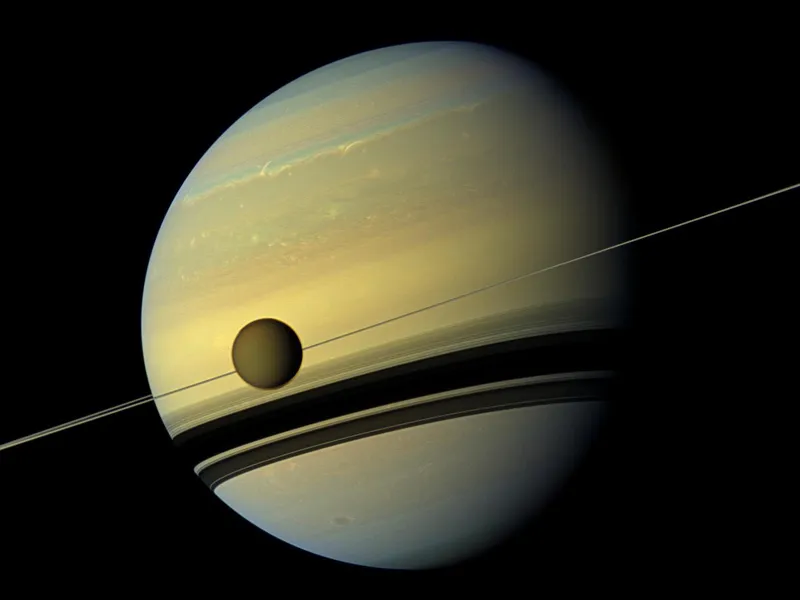
It orbits at a distance of 1.2 million kilometres (745,645mi), and just like Earth’s moon, it is tidally locked, meaning that the same side is always facing the planet.
It’s cold, everywhere, all the time
Being that much further from the Sun, Titan receives just 1% of the solar energy that Earth does – and thanks to its thick atmosphere, 90% of that 1% never reaches the surface!
This leaves the satellite with an average surface temperature, day or night, of just –179.2°C (–290.5°F).
It has a smooth, young surface
While Titan itself formed 4–4.5 billion years ago, its surface is geologically much younger – between 100 million and 1 billion years old.
It is largely quite smooth – most impact craters appear to have been filled in by geological processes unknown (possibly cryovolcanism again) and there is little topographical variation, though the moon does have a handful of mountains, some of which reach over 1km (0.62mi) in height.

It is not a naked-eye object
With an apparent magnitude of +8.2, Titan is too small and dim to be seen with the naked eye. You might get lucky with a pair of large binoculars, but realistically you’re almost certainly going to need a telescope to see it.
It was discovered by Huygens in 1655
On 25 March 1655, the famous Dutch astronomer Christiaan Huygens became the first person ever to observe Titan through a telescope.
At the time it was one of only six known Solar System moons – the others being our own Moon, and the four Galilean moons of Jupiter, which had been discovered just a few decades earlier.
It’s named after a race of gods in Greek mythology
Per Greek mythology, the Titans were a race of gods with Cronus (or Cronos/Kronos) as their leader.
They ruled the world after Cronus (son of Uranus and Gaia) overthrew his father, until they in turn were overthrown by Cronus’ own son Zeus, ushering in the age of the Olympians.
John Herschel named the moon Titan
Huygens called his discovery Luna Saturni (quite simply, “moon of Saturn”). Once other Saturnian moons started being discovered, they were known as Saturn I, Saturn II and so on, until John Herschel (son of William) proposed a nomenclature for them based on Greek gods in 1847.

The first probe to visit was Pioneer 11
NASA’s Pioneer 11 craft launched in April 1973 and arrive at the Saturnian system in September 1979.
Pioneer 11 sent back images of Titan and confirmed its extremely cold climate, but we got better images and data from the Voyager 1 mission, which conducted a flyby of Titan on 12 November 1980.
Cassini-Huygens studied it in detail
The joint NASA/ESA/ASI Cassini-Huygens mission was designed to study Saturn and its moons, and reached the Saturn system in 2004.
The Cassini craft conducted over 40 flybys of Titan, the closest coming within 880km (550mi) of the surface on 21 June 2010, while the Huygens lander touched down on Titan’s surface on 14 January 2005.
It’s the most distant object we’ve ever landed on
When Huygens landed on Titan, it set a new world (or should that be galactic?) record: the moon became the furthest object from Earth that humankind had so far managed to land a spacecraft on, a record it holds to this day.
NASA’s Dragonfly mission is heading there soon
Dragonfly is the fourth mission in NASA’s New Frontiers programme. It’s scheduled to launch in July 2028 and should arrive at Titan in 2034.
Assuming the craft gets there and lands safely, it will then launch a robotic helicopter that has been designed to study the satellite’s atmospheric chemistry and assess its suitability for hosting life.
There could be life in its sub-surface ocean
From an astrobiologist’s point of view, Titan is one of the Solar System’s most intriguing environments, because it’s believed the conditions in its vast sub-surface ocean could be suitable for hosting microbial life.
There could be life in its lakes and seas
While conditions on Titan’s surface and in its large bodies of liquid methane aren’t suitable for hosting Earth-like life, that doesn’t mean nothing could ever live there.
It’s been suggested that lifeforms which breathed hydrogen in and methane out (instead of oxygen in and carbon dioxide out), and used acetylene where our metabolisms use glucose, would be able to survive there.
Such lifeforms are, for now, entirely putative – but in 2015 scientists did model a hypothetical cell membrane that could function in liquid methane under deep freeze conditions, so they are theoretically possible.

NASA/Johns Hopkins APL/Steve Gribben
It’s not a bad analogue for the early Earth
In some ways, conditions on Titan mimic those that were believed to prevail on our own planet billions of years ago, before complex life evolved.
And what’s intriguing about that, is that lab experiments have shown that if you subject a combination of gases similar to those found in Titan’s atmosphere to bombardment by UV radiation, many different chemical compounds can be produced – among them nucleotide bases (the ‘building blocks’ from which RNA and DNA are constructed) and amino acids, which you need to create proteins.
Titan will become a lot more ‘liveable’ in the far future
If you did want to visit Titan, you’d be well advised to wait a little while… like, 5 billion years or so!
By that time, the Sun will have commenced expanding into a red giant, while the UV content of its energy output will decline.
Between them, these two things will cause Titan’s atmosphere to warm considerably, to the point where it could support liquid water (and hence Earth-like life).
Such conditions should then persist for several hundred million years.
What are your favourite Titan facts? Let us know by emailing contactus@skyatnightmagazine.com