Every Halloween, space agencies love to celebrate the spooky season by releasing images showing creepy, ghostly views of the cosmos.
From glowing stellar eyes peering through dark cosmic dust to ghostly hands woven from magnetic fields, the Universe is full of hauntingly familiar shapes.
But behind every eerie apparition lies fascinating space science: stories of stellar birth, violent galactic collisions and dying stars shedding their final layers into the Universe.
We've pulled together the spookiest space photos ever captured and revealed the scientific reality behind these terrifyingly beautiful objects.
NASA's cackling Jack-O'-Lantern Sun
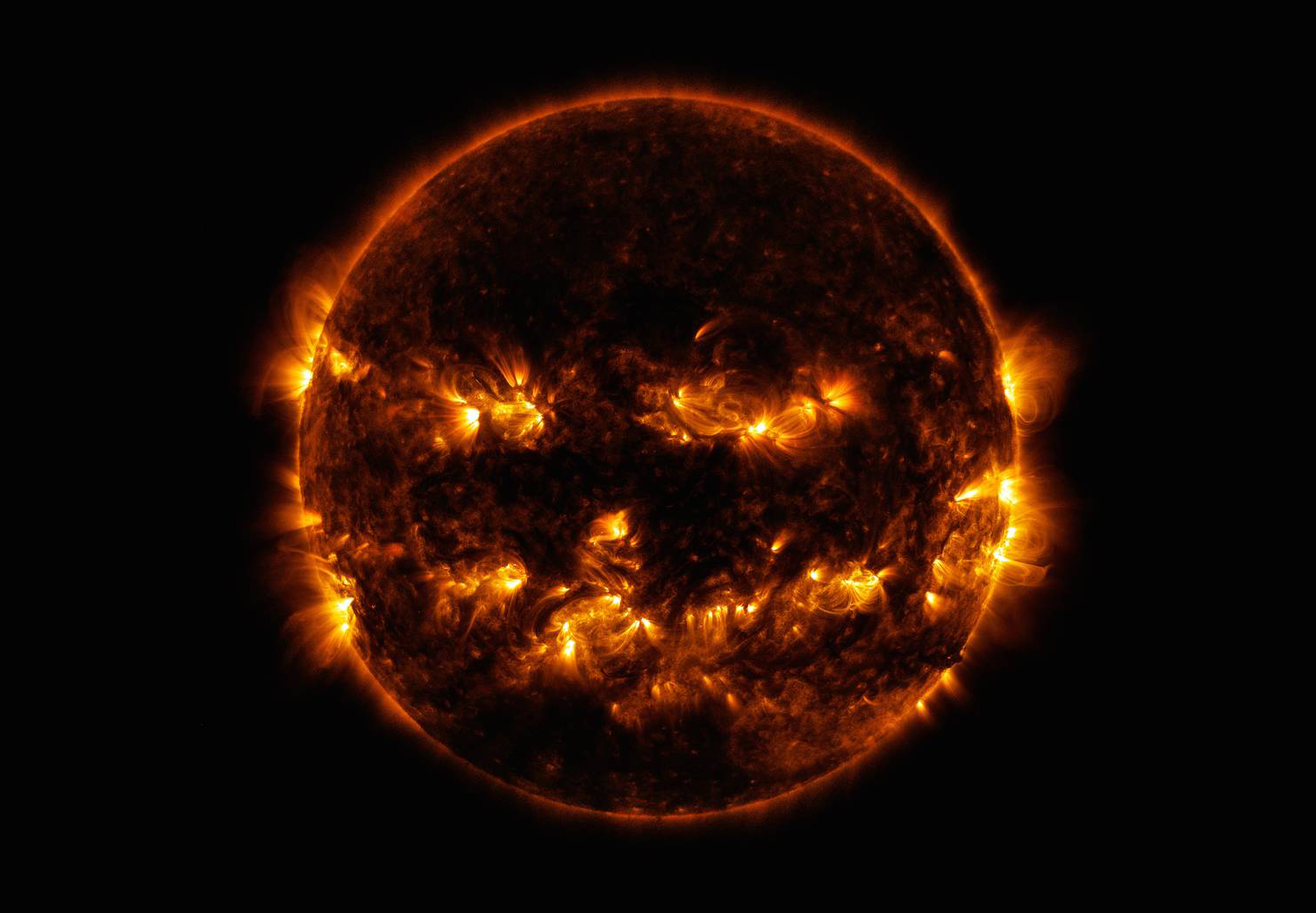
This striking jack-o'-lantern face, captured by NASA’s Solar Dynamics Observatory (SDO), is a real image of our Sun.
SDO observes our host star from Earth orbit and this iconic image has become widely known over the years as the 'NASA Halloween Sun'.
The resemblance to a carved pumpkin comes down to active regions on the solar surface.
These areas are intense magnetic fields in the corona – the outermost part of the Sun’s atmosphere – and they appear much brighter because they emit higher levels of light and energy.
The fiery image blends two sets of extreme ultraviolet wavelengths (171 and 193 ångströms) that are typically rendered in gold and yellow hues.
However, processing the same observation through different wavelengths creates entirely different cosmic portraits.
In 335 ångströms, the solar pumpkin takes on an eerie blue appearance.
Viewing it in 171 ångströms reveals a brilliant golden-yellow hue that brings the surrounding solar surface into clearer focus alongside the glowing jack-o'-lantern features.
See the different colours and get all the science in our full article on NASA's Halloween Sun
A ghostly X-ray hand
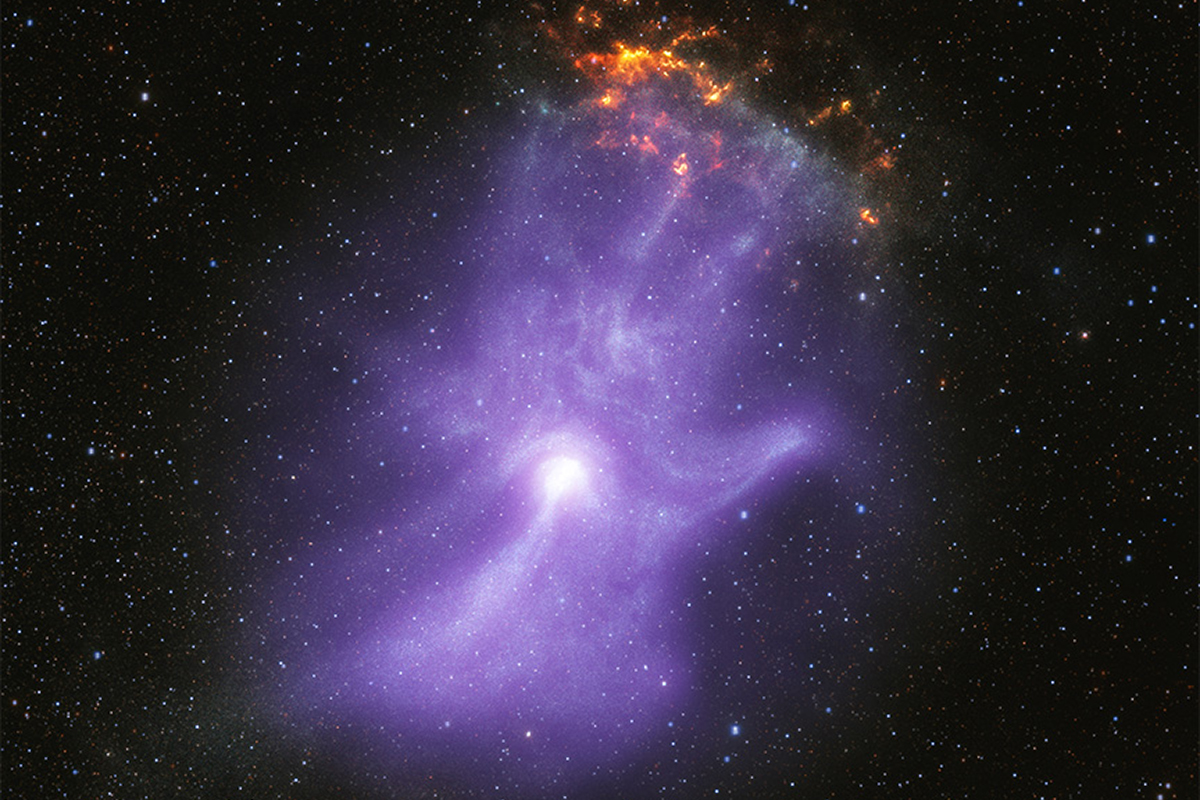
Three of humanity's most powerful observatories – NASA's Chandra X-ray Observatory, the Imaging X-ray Polarimetry Explorer (IXPE) and the Dark Energy Camera Plane Survey (DECaPS2) – teamed up to capture a ghostly 'hand' in space.
This haunting feature is actually a pulsar wind nebula called MSH 15-52, which surrounds the spinning neutron star, pulsar PSR B1509-58.
Pulsars act like lighthouse beacons, emitting pulses of energy towards Earth.
While Chandra first observed the pulsar in 2001, this multi-observatory image blends orange, green and blue from Chandra, diffuse purple from IXPE and red and blue from the Dark Energy Camera.
IXPE data allowed astronomers to map the nebula's magnetic field for the first time by tracking X-ray electric field orientations.
Visualised using short straight lines – orange representing the most precise measurements and cyan and blue the least – this magnetic field mapping further accentuates the nebula's eerie, hand-like qualities.
Read our full article on the ghostly pulsar hand PSR B1509-58
Spooky orange eye cloaked in dark dust
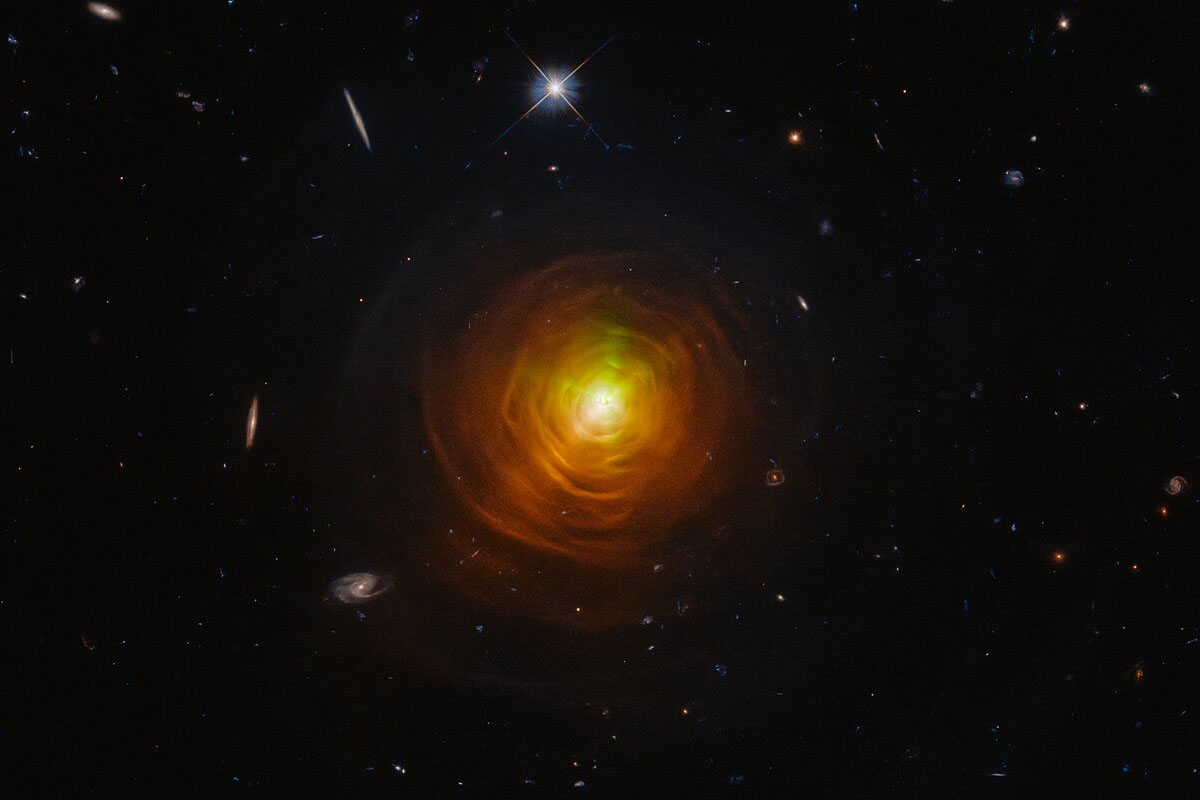
This spooky, ethereal observation captures CW Leonis, a glowing red giant star enveloped in a dense cloak of cosmic dust roughly 400 lightyears away in the constellation Leo.
CW Leonis is a star that has begun shedding its outer layers into space. This process occurs as an ageing star runs low on the hydrogen fuel required to sustain itself.
No longer able to push outwards to counter its own immense gravity, the star begins to collapse in on itself.
As a result, a shell of plasma surrounding its core heats up, causing the star's outer layers to expand dramatically and eject massive quantities of gas and dust.
The carbon-rich atmosphere surrounds the dying star in a thick, smoky cloud.
In this striking image, CW Leonis emits a fiery orange glow that pierces through the dense dust, reminiscent of a cosmic jack-o'-lantern shining through autumn mist.
Read our full article on Hubble's image of CW Leonis
Glowing eyes in deep, dark space
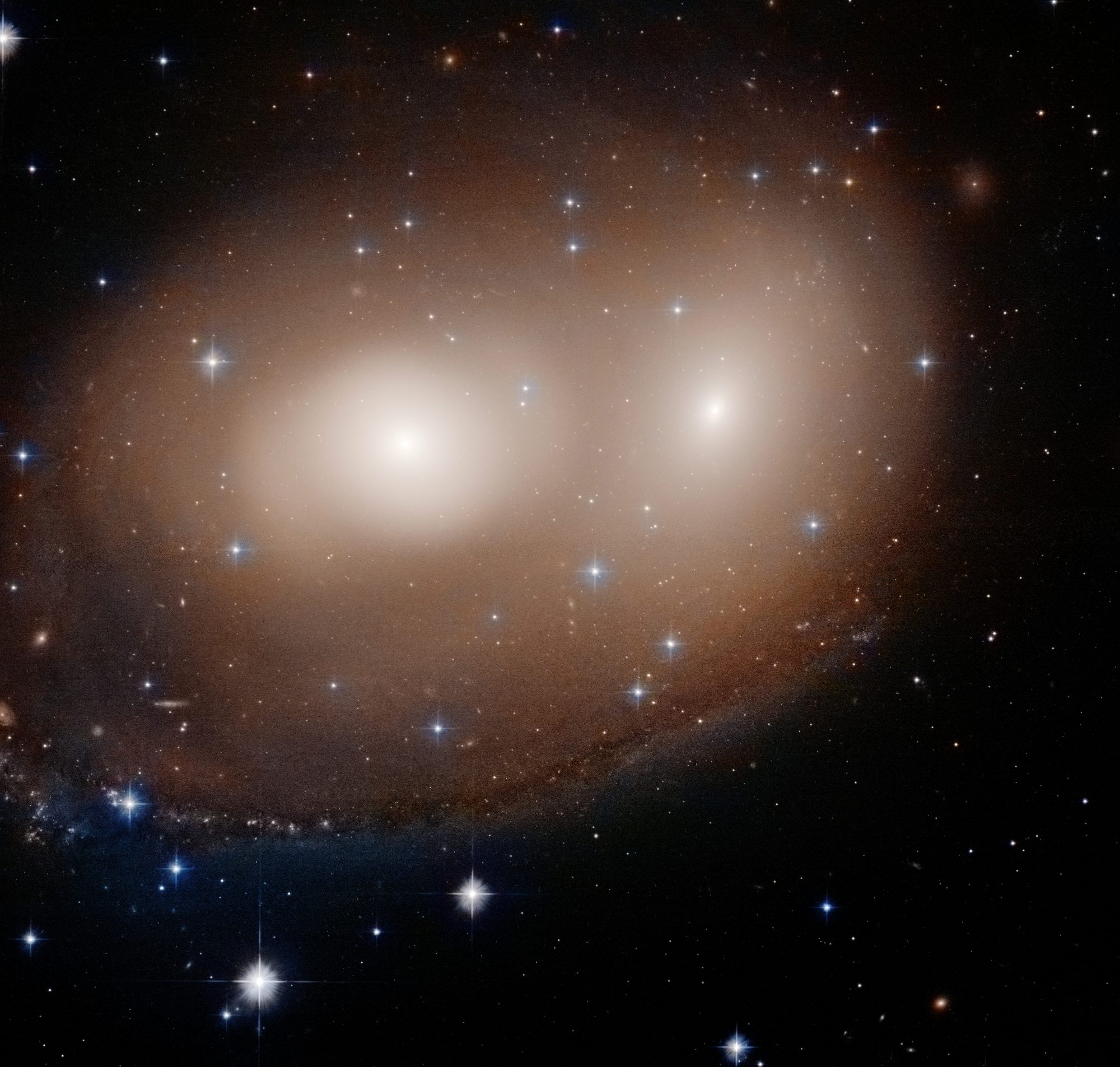
Resembling a spooky cosmic jack-o’-lantern complete with glowing eyes and a crooked smile, this Hubble Space Telescope image actually captures two colliding galaxies located in the constellation Canis Major.
The two 'glowing eyes' are galaxies NGC 2292 and NGC 2293, which are in the early stages of merging as they are pulled together by immense gravitational forces.
Though a galactic collision sounds catastrophic, individual stars in galaxies are spaced so far apart that it's very unlikely they'll actually collide.
Instead, the gravitational tug-of-war churns up interstellar gas and dust, triggering energetic bursts of new star formation.
The pumpkin-like orange glow radiating across the image comes from ageing red stars within both galaxies.
Adding to the jack-o’-lantern appearance is the crooked smile at the bottom, which is likely the birth of a new galactic spiral arm created as interstellar gas was compressed during the initial stages of the merger.
Read our full article on Hubble's galactic Halloween pumpkin
A ghostly galactic collision
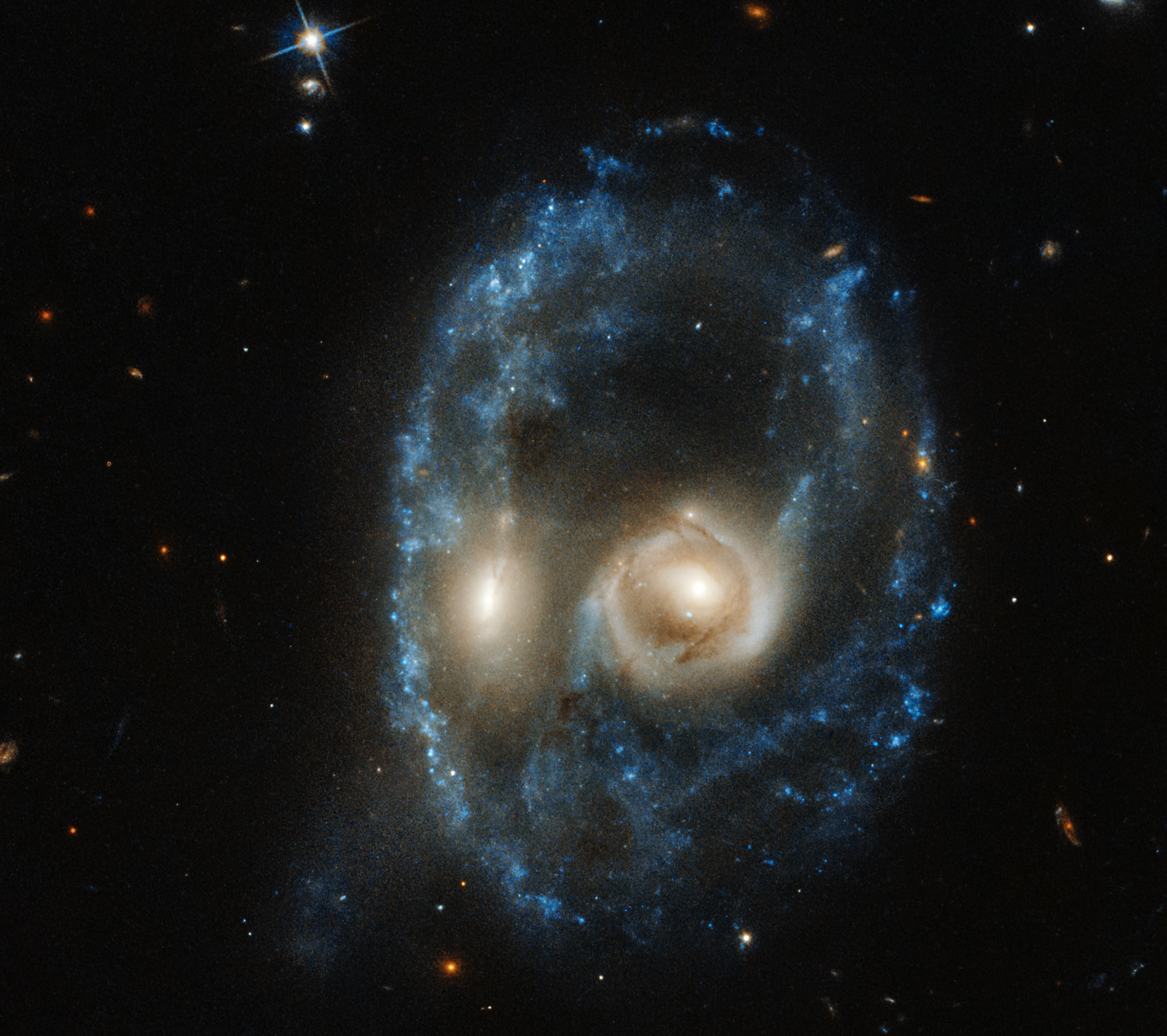
Captured by the Hubble Space Telescope to mark Halloween, this spooky observation reveals a ghostly face with two glowing eyes staring back across space.
The object is another galaxy collision: an interacting system designated Arp-Madore 2026-424 (AM 2026-424).
The haunting 'eyes' are the bright central cores of two colliding galaxies, while the striking ring forming the outline of the face is composed of intensely hot newborn stars.
Unlike typical galactic mergers, where a massive galaxy usually devours a much smaller neighbour, this collision is unusual because both galaxies are similar in size.
Hubble captured the image through a special initiative that utilises gaps between scheduled observations to target additional cosmic phenomena.
Astronomers hope this ongoing programme will provide broader insights into how galaxies in the early Universe expanded and evolved through collisions and gravitational interactions.
The Jack-o’-Lantern Nebula

Captured by the Spitzer Space Telescope, this striking astronomical feature earns its name from its uncanny resemblance to a carved Halloween pumpkin.
The image was created by combining three distinct wavelengths of infrared light.
Blue light highlights stars and intensely hot regions while green and red wavelengths show cosmic dust glowing at varying temperatures.
At the heart of the nebula lies a massive star, roughly 20 times the mass of the Sun, which appears as a white dot nestled inside the central red region.
The hollowed-out shape of the cloud was created by powerful outflows of radiation emanating from this heavy star, which continuously sculpts and pushes away surrounding interstellar dust.
To make this nebula look even more spooky for Halloween, the image processing team enhanced the red and green tones to generate a vibrant orange pumpkin hue.
A howling dark wolf in space
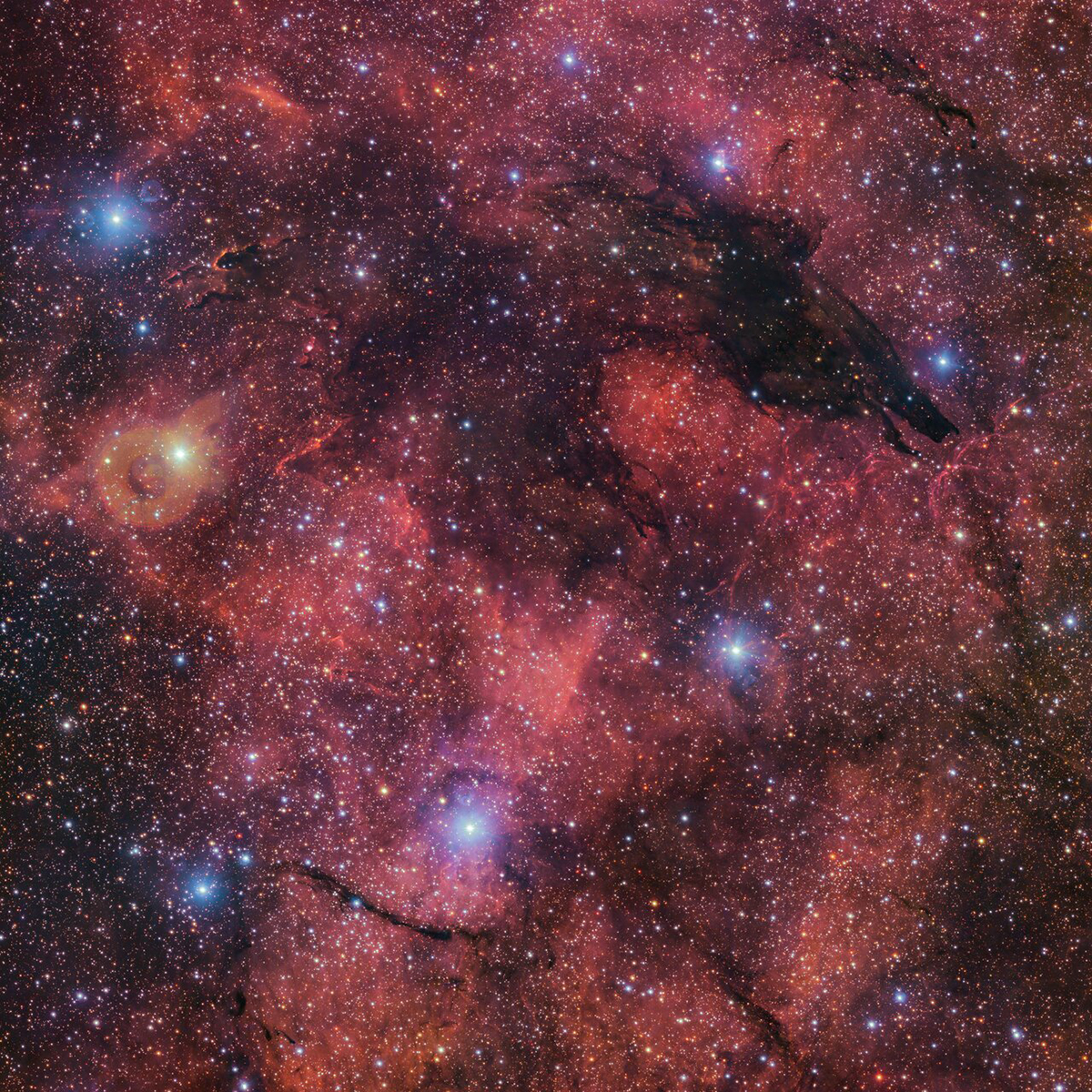
Captured in a stunning 283-million-pixel image by the VLT Survey Telescope at the European Southern Observatory’s Paranal Observatory in Chile, this wolf-like silhouette of cosmic dust is fittingly known as the Dark Wolf Nebula.
Located 5,300 lightyears away in the constellation Scorpius, the nebula is part of an even larger cloud named Gum 55. From our perspective on Earth, it spans a massive area of the night sky equivalent to four full Moons.
While patches of blackness in space were once assumed to be regions devoid of stars, they are actually dark nebulae: thick clouds of cosmic dust that block visible light from background stars.
Although invisible in standard optical light (allowing only longer wavelengths of light like infrared to pass through), these seemingly lifeless structures actually harbour the key ingredients for new star formation.
The vibrant, colourful clouds surrounding the silhouette consist primarily of hydrogen gas, glowing under the intense radiation emitted by newborn stars nestled within.
Read our full article on the Dark Wolf Nebula