
A group of astronomers believe they may have finally worked out what the 'Star of Bethlehem' really was, and how to account for its strange behaviour, as described in the the Gospel of Matthew.
The mystery of the 'Christmas Star', or the 'Star of Bethlehem', is one that continues to intrigue historians of astronomy.
But Matthew's account makes for strange reading, if we are to take it as a reliable record of a visible celestial object in the night sky.
It doesn't appear to make sense, given what we know about how stars or planets appear to move in the night sky.
This new study offers an explanation that could mean the Star of Bethlehem's strange behaviour is finally solved.
More Christmas astronomy

What makes the Star of Bethlehem so strange
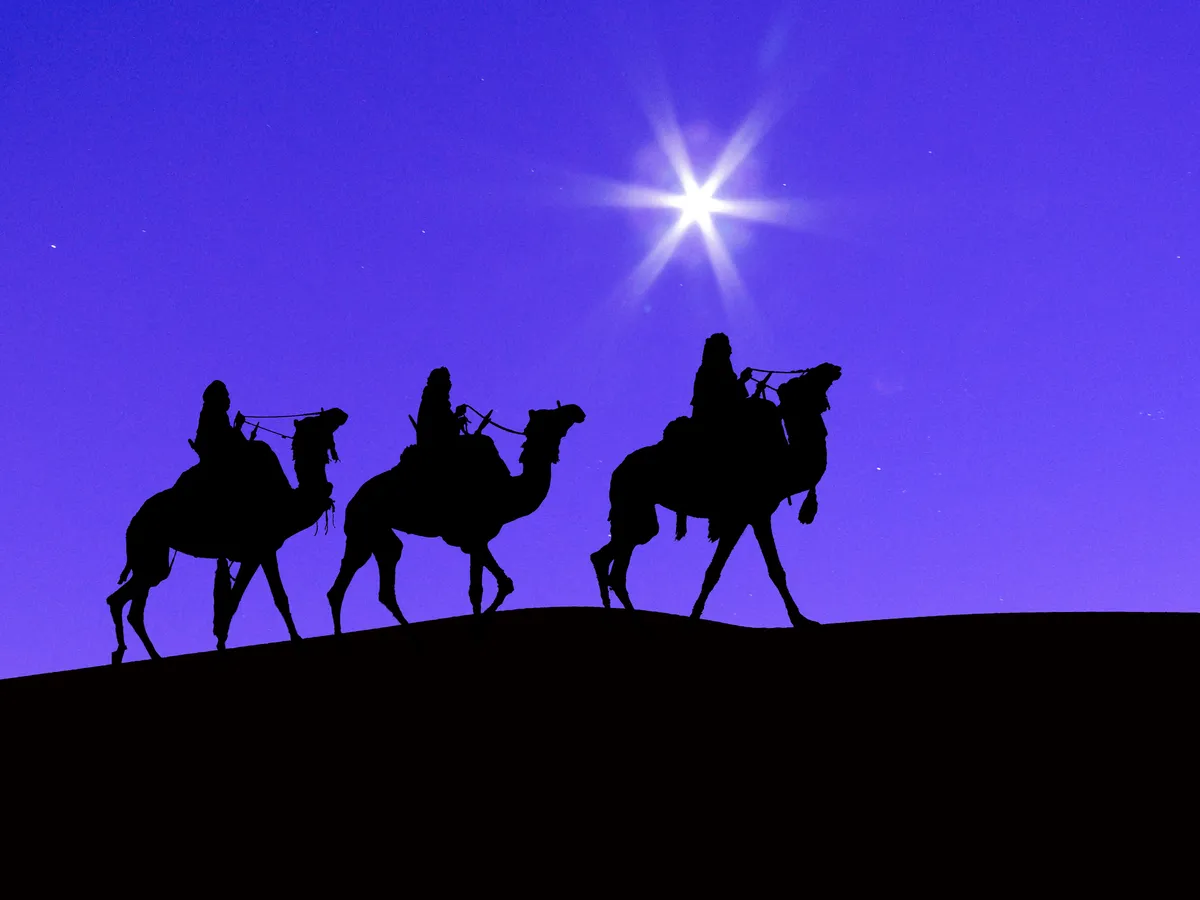
In Matthew’s account, Magi from the East – who some believe were ancient astrologers – saw a bright star-like object in the sky, and they interpreted this as signifying the birth of a new king in Judea.
Back in the days when astrology and astronomy were one and the same, celestial events were often interpreted as portents indicating something significant was about to occur.
The Magi travelled to Jerusalem, then on to Bethlehem, where the ‘star’ is said to have ‘gone before them’ then ‘stood over’ the place of the child.
There have been many candidates put forward for what this 'star' could have been over the years.

One suggestion is a nova, which is a binary star system that temporarily brightens, seemingly creating a 'new star' in sky, but which is actually a star that was previously dim, all of a sudden becoming easily seen with the naked eye.
Another suggestion is a type of exploding star known as a supernova, which could again appear as a 'new star' in the sky.
Or, it may have been a planetary conjunction, with two planets appearing so close together, they look like one bright star to the naked eye (a recent example of which was the Great Conjunction of Jupiter and Saturn on 21 December 2020).
However, none of these candidates can account for the strange apparent motion Matthew describes.
A new study may have cracked it, and names a 5 BCE comet as the most likely explanation for the Star of Bethlehem.
Cracking the Christmas case
The peer-reviewed study is published in the Journal of the British Astronomical Association and led by planetary scientist Dr Mark Matney.
The team used ancient observations to calculate an orbit for the 5 BCE comet, which could explain the strange 'stopping' behaviour.
Dr Matney says he combined analysis of the ancient Koine Greek language in Matthew’s Gospel, historical and cultural context from ancient astrology and politics, along with astronomical modelling of the 5 BCE comet recorded by ancient Chinese astronomers.
Addressing the language used by Matthew, the study says the original text does not report that the star ‘led’ the Magi on their journey ‘from the East’ to Jerusalem.
Instead, the study says, the text reports the star appeared each night like a natural phenomenon.
It was only on the short trip from Jerusalem to Bethlehem that the star displayed the strange stopping motion, from the Magi's perspective.
The paper argues the Magi could have interpreted it as an omen signalling the birth of a new ruler.
The ancient Han Shu Chinese text describes a ‘broom star’ in 5 BCE that remained visible for over 70 days, the study authors say.
If true, this would be behavioru consistent with a long-duration comet and places it in the right time period.
The team then used computer simulations to calculate a selection of possible orbits for the comet.

Was the stopping star a comet?
They say the best-fit orbit for the Star of Bethlehem is a sun-grazing comet with low inclination whose orbit would have brought it close to Earth in early June, 5 BCE.
Their computer model shows that, on the morning of 8 June, the comet’s apparent motion as seen from Judea would have matched Matthew’s description.
Here are the explanations detailed by the team:
"As the comet neared closest approach to Earth, its apparent angular motion slowed dramatically when viewed from the rotating Earth, creating a temporary geosynchronous effect – an illusion in which the comet appeared nearly motionless in the sky for several hours.
"As the Magi travelled south from Jerusalem to Bethlehem, the comet would have paused in a southward azimuth roughly aligned with the road, creating the impression of ‘going before’ them.
"As they approached Bethlehem, the comet would not have moved westward due to the Earth’s rotation like typical astronomical objects, but would have gradually moved higher in the sky, while maintaining its southerly azimuth, until it reached the zenith, ‘stopping’ directly overhead of the Magi for several hours when they arrived at Bethlehem.
"The model thus demonstrates that this ‘standing still’ behaviour is physically possible for a comet on such a trajectory and matches the Gospel’s description without invoking non-astronomical phenomena."
The team also say their calculations show the comet would have been as bright as a full Moon, visible even in daylight.
That could explain how the Magi were able to travel safely by day and still see the 'Star of Bethlehem'.

Dr Matney says: "The 'stopping' behaviour of the Star of Bethlehem described in the biblical book of Matthew has long puzzled astronomers because natural objects in the sky do not typically behave this way.
"I had theorised for many years that a comet traveling very close to the Earth at just the right speed and direction could appear to 'stop' over a particular location on the rotating Earth for several hours.
"A news article about ancient Chinese observations of a comet in 5 BCE spurred my interest, and I realised there was sufficient information to compute an orbit for this comet that took it close to the Earth.
"The results were more impressive than I had foreseen, with behaviour that fits all the characteristics of the Star described in the Bible."
Read the full paper via the British Astronomical Association

