February 2026 could be a landmark month for Earth's Moon.
The month begins with a full Moon rising on 1 February. This is the year's Snow Moon, marking the full Moon that rises in the depths of winter.
February 2026 could also be the month that humans return to the Moon for the first time since the Apollo landings.
The Artemis II mission could launch in early February, and its crew will see a side of the Moon we never get to see from Earth.
They'll view our natural satellite from a perspective never experienced by any human before them.

Seeing the Snow Moon
If you're excited about the Artemis II mission, this weekend's Snow Moon is a great opportunity to get out and marvel at our celestial companion.
On the evening of Friday 30 January, the nearly-full Snow Moon will be close to the planet Jupiter in the night sky.
You can see the pair rise in the east after sunset and, if you're able to stay up past midnight, you'll be able to watch the Moon and the planet get closer together in the evening sky.

By Saturday and Sunday this weekend, the Moon will be full and visible in the eastern part of the night sky.
If you're an early riser, winter's late sunrise will give you a chance to see the Snow Moon setting towards the west before daylight breaks.
A morning full Moon against the onset of dawn is a marvellous thing to see.
The February full Moon is called the Snow Moon because traditionally February is the month when it is most likely to snow in the Northern Hemisphere.
If you're out observing the full Moon this weekend, take a moment to savour it, as this could be the last full Moon we see before the launch of humanity's next lunar adventure.

Artemis II and its unique view of the Moon
According to NASA's Artemis II launch dates, the mission could lift off as soon as 6 February 2026. That means the Snow Moon could be the last full Moon we see before Artemis II has launched and landed.
Artemis II is a crewed mission that will take four astronauts around the Moon and back.
The Artemis II crew consists of NASA astronauts Reid Wiseman, Victor Glover and Christina Koch, along with Canadian Space Agency astronaut Jeremy Hansen.
They won't land on the Moon, but instead will launch towards the Moon, travel beyond it – further than any human has travelled before – then use the Moon's gravity to pull them back for the return journey to Earth.

As well as preparing for the upcoming Artemis III mission – which will land humans on the Moon for the first time since the Apollo missions – Artemis II will provide a unique perspective of the Moon that no human has seen before.
The side of the Moon that we see from Earth never changes. The Moon is tidally locked to our planet, which means the same side always faces Earth.
We never see the lunar far side from the ground, but various spacecraft have captured images of it.
The Apollo astronauts caught the first glimpse of the far side ever seen with human eyes when they orbited around it during their missions to the Moon.

However, while the Apollo missions flew about 100–200km (60–120 miles) above the surface of the Moon, the Artemis II astronauts will travel much further beyond it.
The Orion capsule housing the Artemis II astronauts will travel about 6,500–9,500km (4,000–6,000 miles) above the lunar surface.
NASA says from this distance, the Moon will appear to be about the size of a basketball held at arm's length.
That means that, while the Apollo astronauts were given a close-up, and therefore restricted view of the far side of the Moon, the Artemis II astronauts will be able to see the entire far side of the Moon all at once.

Artemis II and lunar science
As well as being an amazing experience for the Artemis II crew, this never-before-seen view of the far side of the Moon provides an opportunity to carry out scientific observations of the lunar surface.
They'll be equipped with a Nikon D5 camera and 80-400mm lens, which they'll use to capture images of the Moon for analysis back on Earth.
Lunar scientists will give the crew specific targets to observe and photograph on their journey, such as impact craters formed by huge space rocks smashing into the far side of the Moon.

They may also see ancient lava flows and other hints of the Moon's active, chaotic past.
The Artemis II astronauts have been given extensive geology training, meaning they'll be able to conduct their own analysis of the Moon as they're observing it.
They may even be able to give us clear views of regions on the Moon that are tantalisingly out of reach from our perspective on Earth.
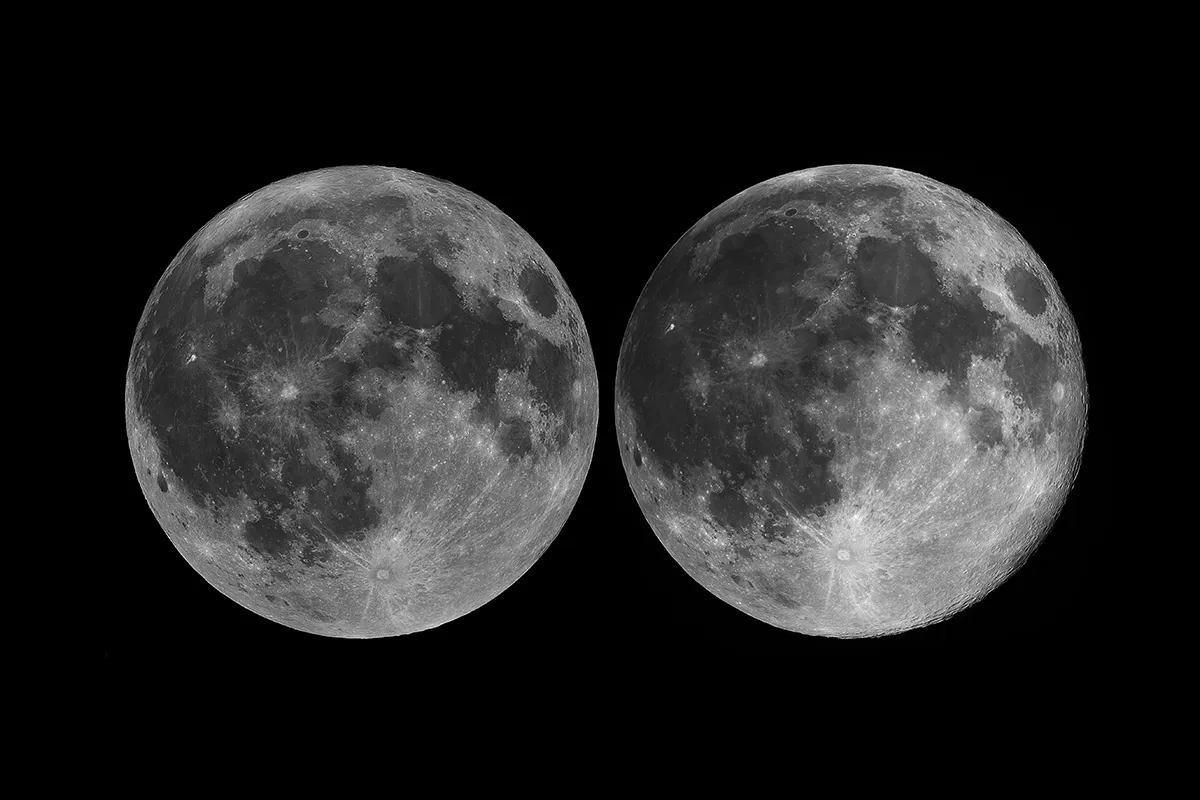
As the Moon orbits Earth, from our perspective it appears to wobble slightly, which means we actually get to see more than 50% of the Moon over time.
This wobble is called lunar libration, and it has the effect of bringing some of the features on the visible edge of the Moon into our view for a short period of time.
The most famous of these features is perhaps Mare Orientale, a lunar 'sea' that can only be seen during lunar libration.
The Artemis II astronauts may get a view of this incredible impact basin face-on.
NASA says the crew may also see flashes of light on the Moon caused by space rocks hitting its surface.
This data will give scientists a better view as to how often the far side of the Moon is hit.

Preparing for the next lunar touch-down
As well as lunar science, the Artemis II crews' view and images of the Moon will enable NASA to prepare for Artemis III, which is set to launch in the next few years and land on the Moon, putting human feet on the lunar surface for the first time since the Apollo missions.
Artemis II could help inform exactly where Artemis III will land, and identify interesting formations near the landing site worth investigation.
"Whether they’re looking out the spacecraft’s windows or walking the surface, Artemis astronauts will be working on behalf of all scientists to collect clues to the ancient geologic processes that shaped the Moon and our solar system," says Cindy Evans, NASA’s Artemis geology training and strategic integration lead, based at NASA Johnson.
Are you excited about the Artemis II mission? Share your thoughts with us by emailing contactus@skyatnightmagazine.com


