We're potentially just weeks away from the launch of Artemis II, the first mission to send a human crew to the Moon since the Apollo programme of the 1960s.
Artemis II won't land on the Moon, but will instead send a crew of four astronauts around the far side of the Moon, using the Moon's gravity to 'slingshot' them back to Earth.
Artemis 2 is the next step in the Artemis Programme, NASA’s quest to put the first female astronaut and first astronaut of colour on the Moon.
More on Artemis II

NASA and the Canadian Space Agency announced the crew of the Artemis II mission to the Moon on 3 April 2023.
The Artemis II crew consists of:
- Commander: Reid Wiseman (NASA)
- Pilot: Victor Glover (NASA)
- Mission Specialist 1: Christina Koch (NASA)
- Mission Specialist 2: Jeremy Hansen (CSA)
“For the first time in more than 50 years, these individuals – the Artemis II crew – will be the first humans to fly to the vicinity of the Moon.
Among the crew are the first woman, first person of colour and first Canadian on a lunar mission, and all four astronauts will represent the best of humanity as they explore for the benefit of all,” says Vanessa Wyche, director of NASA’s Johnson Space Centre.
 Credit: NASA/Joel Kowsky" class="wp-image-117714" title="">
The launch windows for Artemis II currently run between the beginning of February and beginning of April 2026, meaning the mission could launch on any of a series of dates between those months.
Artemis II will launch into space using the Space Launch System (SLS) rocket, the crew traveling in the Orion Crew Module.
The 10-day mission will be the first time a crew has been cleared to fly on either of these systems following the success of uncrewed test flight Artemis I, which launched in November 2022.

As such, Artemis II will test both the technical capabilities of the vehicles and the procedures future missions will follow.
Should all go well with Artemis II, then the first landing mission, Artemis III, is expected to follow in 2027.
"The Artemis II crew represents thousands of people working tirelessly to bring us to the stars. This is their crew, this is our crew, this is humanity's crew,” says NASA Administrator Bill Nelson.
"Each has their own story, but, together, they represent our creed: E pluribus unum – out of many, one.
"Together, we are ushering in a new era of exploration for a new generation of star sailors and dreamers – the Artemis Generation."
Meet the Artemis II crew
 Credit: NASA/Josh Valcarcel" class="wp-image-117709" title="">
Commander Reid Wiseman
Wiseman previously spent 165 days on the International Space Station as part of Expedition 41 from May to November 2014. He also served as chief of the Astronaut Office from December 2020 to November 2022.
Pilot Victor Glover
Glover piloted the SpaceX Crew-1 mission, the first operational flight to depart from US soil since the Space Shuttle retired. He stayed on the ISS for 168 days during Expedition 64 returning home in May 2021. He participated in four spacewalks during his stay.
Mission Specialist 1 Christina Hammock Koch
Koch has the record for the longest single spaceflight by a woman, clocking in at 328 days for her role in Expedition 59, 60 and 61. She has conducted six spacewalks, totalling 42 hours and 15 minutes – three of these were the first all-female spacewalk, which she completed alongside Jessica Meir.
Mission Specialist 2 Jeremy Hansen
Hansen is a Canadian astronaut making his first flight on Artemis 2. He previously served in the Canadian Armed Forces as a fighter pilot. After completing his astronaut training with the Canadian Space Agency in 2011, he served as Capcom at Mission Control Centre at Johnson Space Center, and helped lead training for new astronaut candidates.
Artemis II mission overview
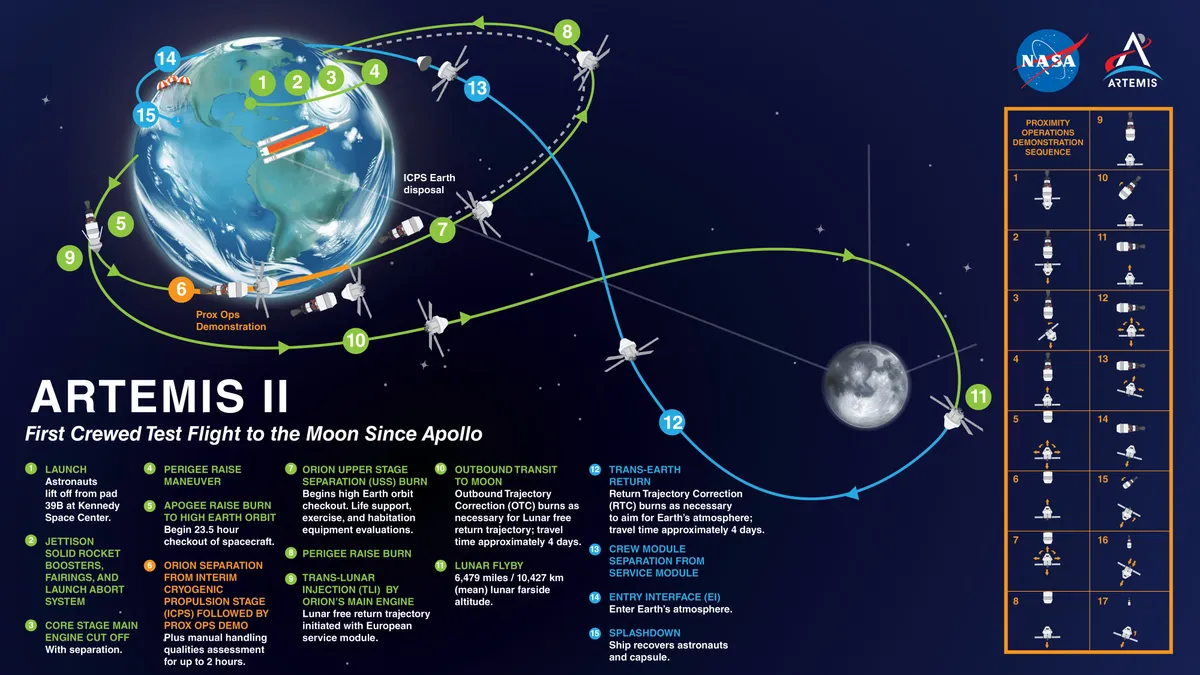
The Artemis II crew will launch from Kennedy Space Centre in Florida, initially entering an elliptical orbit around Earth of 185km by 2,900km.
After one 90 minute orbit, Orion’s thrusters will fire to reach an orbit of 185km by 74,000km.
This orbit will allow Artemis II to build up speed for their eventual push towards the Moon, and take 23.5 hours to complete. During this time the crew will check all systems are working well.
Once that is confirmed, the crew will conduct a translunar injection burn sending them on a path to the Moon.
It will take the Artemis II crew four days to complete the 370,000km journey to the Moon, but they will not enter orbit at the end of it. Instead, Orion will fly a figure-8 path, taking them 10,300km beyond the Moon.
From this vantage point, the crew will be able to see both Earth and the Moon from Orion’s windows – the first-time human eyes have been able to see the whole planet at once since Apollo 17.
The Artemis programme aims to allow a more diverse group of people to experience this powerful and affecting sight, known as the Overview Effect.
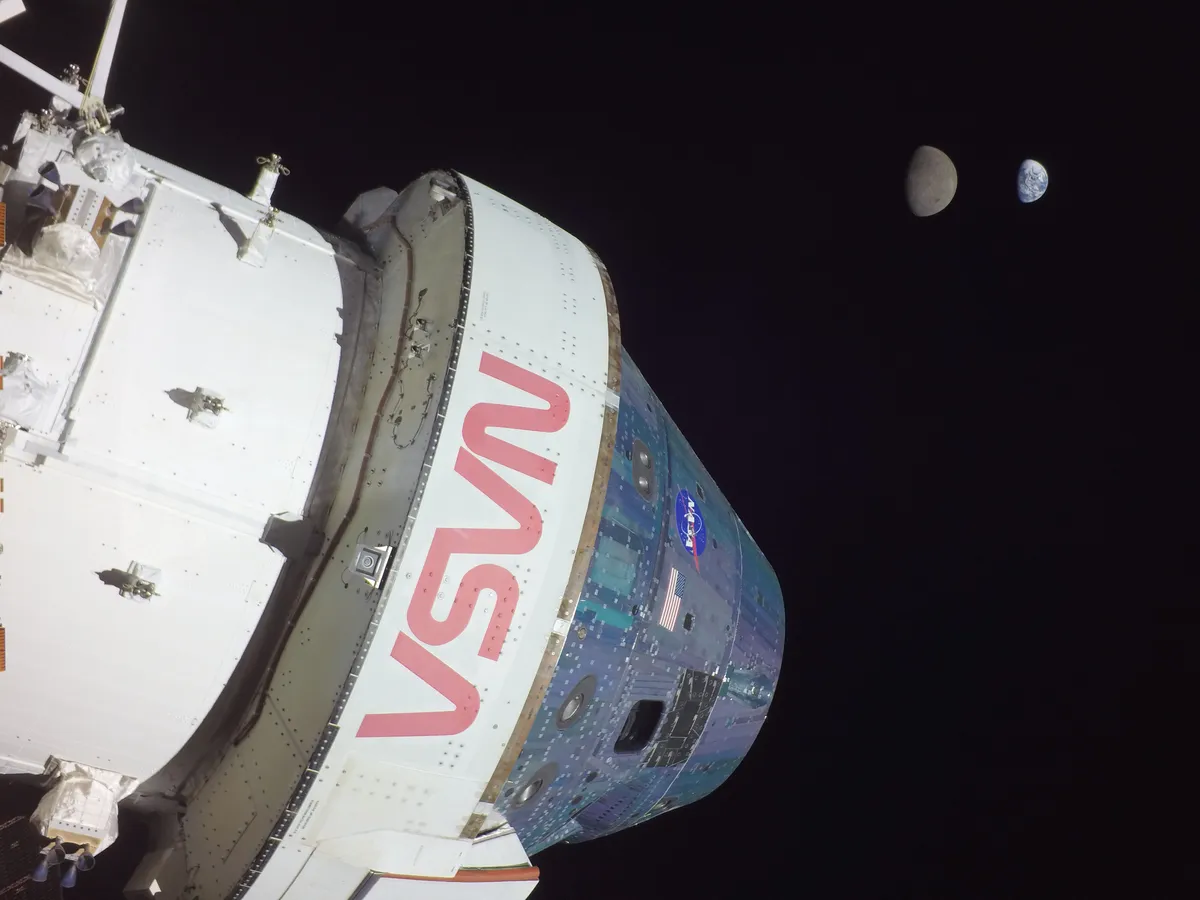
The figure-8 path means the Artemis II crew will be able to better harness the Earth-Moon gravity field and return home with a highly efficient ‘free-return’ trajectory, using Earth’s gravity to pull them home.
The return journey will take another four-days and will splash down in the ocean for recovery. After the mission, the Orion capsule will be refurbished for use on a future spaceflight.
Let us know your thoughts on the Artemis II mission by emailing contactus@skyatnightmagazine.com