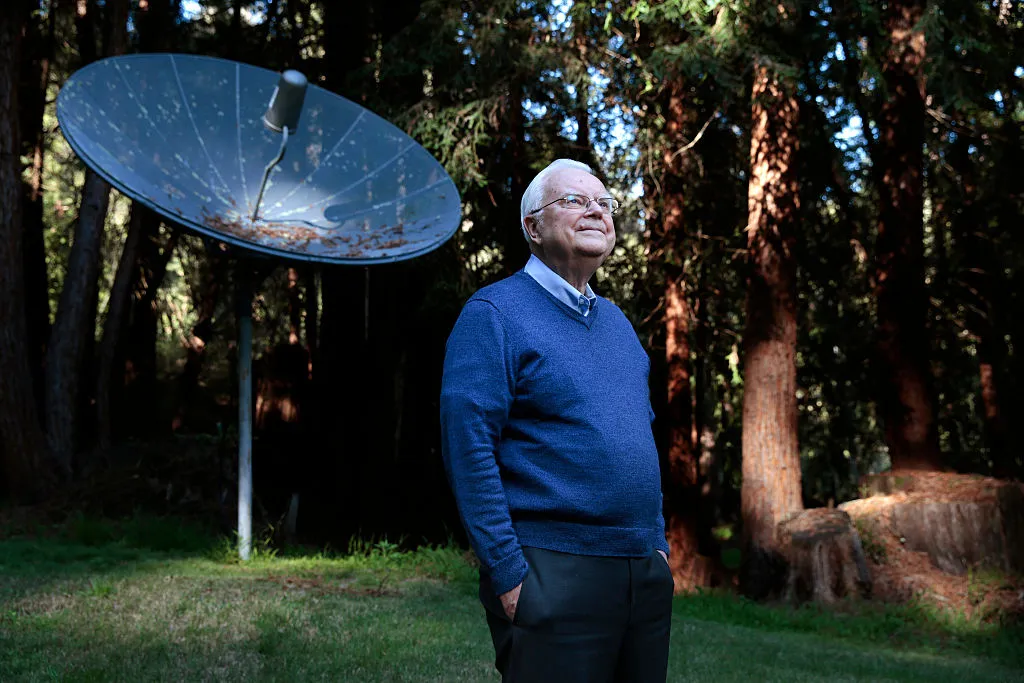
One of the foremost pioneers in the search for extraterrestrial life (SETI), Frank Drake, died on 2 September 2022 at the age of 92.
Born on 28 May 1930 in Chicago, Drake first began wondering about extraterrestrial civilisations at the age of eight, when his father told him of the existence of worlds beyond Earth.
At 17, he enrolled at Cornell University on a Navy scholarship, initially intending to be an airplane designer, but he changed his plans when he first glimpsed the moons of Jupiter during an astronomy lesson.
More on alien life

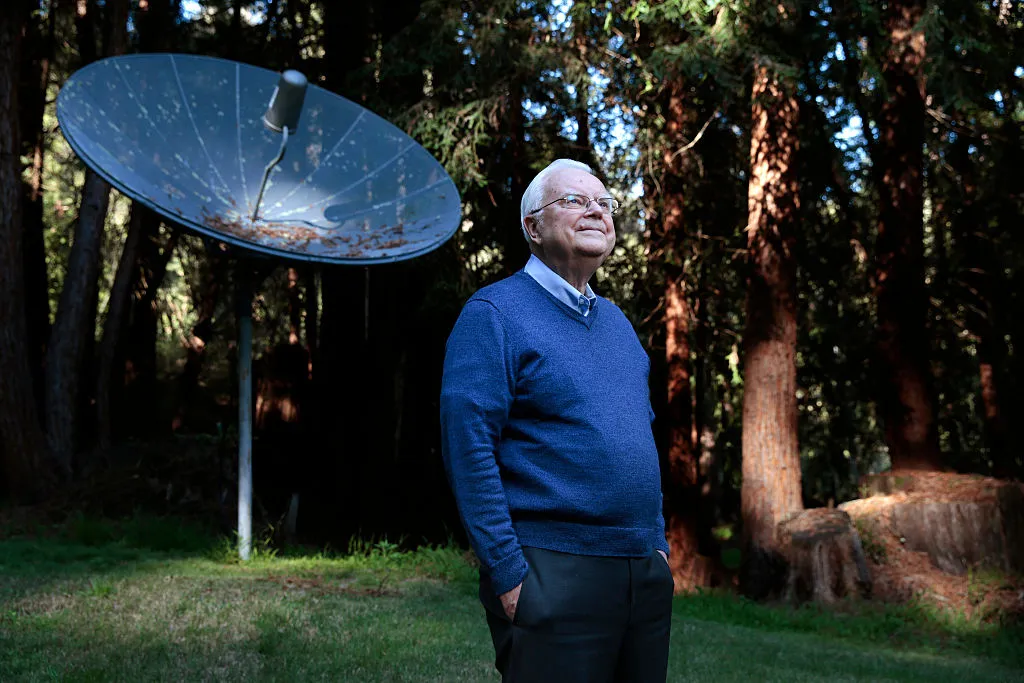
This renewed his curiosity about whether alien life existed and, crucially, how it could be discovered.
Frank Drake began his PhD at Harvard University in 1952, studying star formation and investigating the planets of the Solar System by bouncing radio waves off them.
It was here he first theorised that extraterrestrial life may also be emitting radio signals that could be detectable.

Drake's time at Green Bank
After serving in the Navy from 1955 to 1958, Drake took a position at the National Radio Astronomy Observatory at Green Bank, West Virginia, in April 1958.
He used the 26-metre radio telescope to pierce through the cosmic dust and map the centre of the Milky Way for the first time.
He also discovered the radiation belts around Jupiter and measured the scorching temperature of Venus’s surface.
But the telescope at Green Bank was also powerful enough to detect radio signals (extraterrestrial or not) from up to 12 lightyears away – a volume encompassing around 30 stars.
On 8 April 1960, Drake and several colleagues embarked on Project Ozma, searching for signs of life around two specific Sun-like stars.
They did so in secret, scared of public ridicule, and after two months found nothing. Despite this, Drake published the study. It would turn out to be a career-making decision.
Firstly, it inspired astronomer Carl Sagan to reach out to him, and secondly, his work led to him being asked to organise the first-ever conference on the search for life on other planets by the National Academy of Sciences in 1961.

Conference on the search for life beyond Earth
With a list of distinguished scientists from across disciplines due to attend, Drake first had to organise the agenda of the conference.
On a blackboard in the basement, he wrote all the factors that would need to be discussed to determine how common life was in the Universe.
Each of these, he realised, could be expressed as a number and multiplied together to estimate the number of civilisations in the Universe that humanity could detect.
This was to become the now famous Drake equation.
What the Drake equation shows

The letters in the Drake equation represent the following:
N = Number of detectable extraterrestrial civilisations in the Milky Way
R = Rate at which stars in the Milky Way are born
fp = Fraction of stars with planets
ne = Number of habitable planets per system
fl = Fraction of planets on which life appears
fi = Fraction of those planets that develop intelligent life
fc = Fraction sending signals into space
L = Length of time such civilisations send detectable signals
Drake and the Arecibo Message
From 1966 to 1968, Frank Drake lived in Puerto Rico, as director of Cornell’s 305-metre-wide radio telescope at Arecibo, overseeing its transition from missile defence facility to astronomical tool.
By the 1970s, Drake was not just listening for alien signals, but reaching out to distant civilisations.
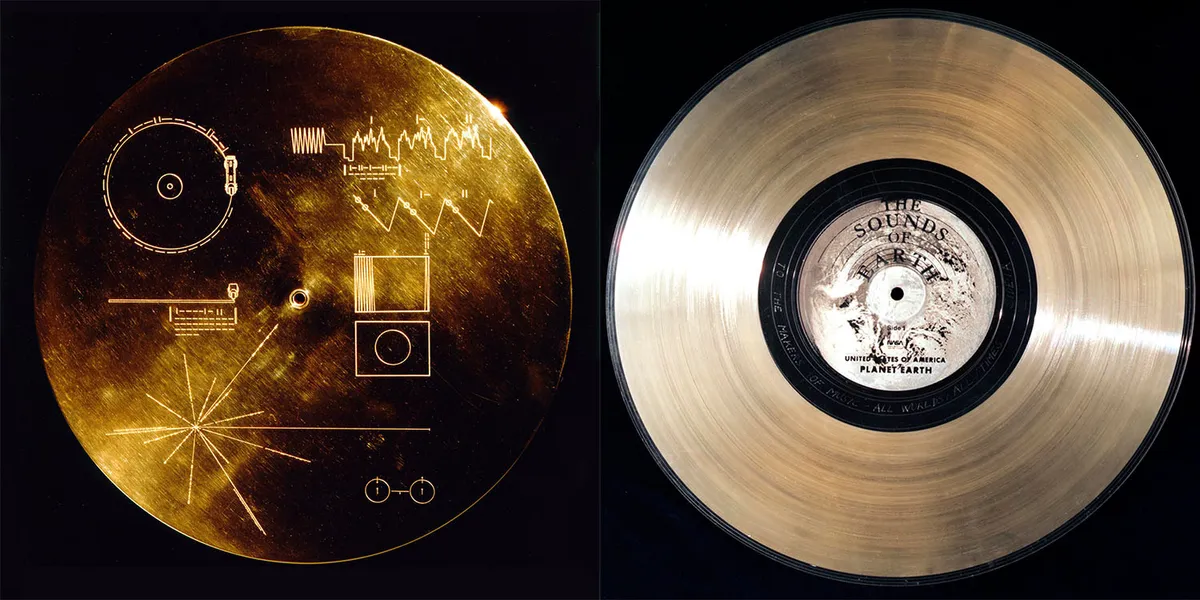
He worked with Sagan to produce both the Pioneer plaque and the Voyager Golden Records – pictorial depictions of humanity and our location in the cosmos.
These were attached to the Pioneer and Voyager probes, just in case an alien lifeform should stumble across them out beyond the Solar System.
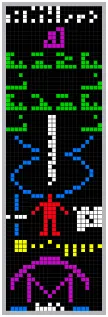
In 1974, he again paired with Sagan to transform this same information into a radio signal that could be decoded by another intelligent race.
On 16 November they used Arecibo’s powerful transmitter to broadcast it towards globular cluster M13, where it will arrive in 25,000 years’ time.
He served as director of the Carl Sagan Centre at the SETI Institute from 1984 to 2010, but continued to support many long-term SETI projects after his retirement.
Frank Drake died on 2 September 2022, aged 92.
His dedication helped make SETI a legitimate scientific discipline and inspired the generations after him to continue the search.