We wouldn’t know anything about the stars at all if light wasn’t able to travel vast distances, because their light would never reach us!
But exactly how far can light travel? Does light ever 'run out' on its journey, or does it just carry on travelling forever?
First, let's go back and look at what light actually is.
More amazing science
A quick primer on light itself
Light is a form of electromagnetic radiation, which means that – just like radio waves, microwaves or X-rays – it has no mass.
And having no mass means it is able to travel at extremely high speeds. In fact, there is nothing in the Universe that can travel faster than light – other than the expansion of the Universe itself – which is why the speed of light is often referred to as the 'universal speed limit'.
Light being able to travel at such great speed is a big advantage for us, of course, because space is, as the late, great Douglas Adams once pointed out, “vastly, hugely, mind-bogglingly big”.
Thankfully, light moves fast enough that even light from extremely distant objects can reach us eventually – even though it does still take some time.
As an example: it takes eight minutes for light from the Sun to reach us here on Earth.
It takes four years for light to get here from Alpha Centauri, the closest star to our Sun, and a whopping 2.5 million years for light to reach us from the Andromeda Galaxy, our nearest neighbouring galaxy.

Looking at light's journey
Light can only travel so far across space because space is all but empty, and light encounters very little matter en route.
Once it does – such as when it enters the atmosphere around Earth or another planet, or when it passes through a nebula (a huge swirling cloud of gas and dust in space) – two things start to happen.
The first is that solid objects, even teeny-tiny ones such as motes of dust, will simply deflect light and block its path altogether. You know this: it’s why we get shadows.
The second is that other materials (such as liquids, water vapour or glass) allow light to pass through them, but refract it as it does so.
You know this, too: it’s why we see rainbows when its sunny but raining.

So while a beam of light will in theory travel through a vacuum forever, in the context of light from the stars reaching our planet, much of it will have been deflected or refracted along the way.
This means that when light from distant objects does eventually arrive at our eyes (or our telescopes), we’re only actually seeing a fraction of the light that was originally emitted.
That’s why distant objects of the same luminosity appear dimmer than nearby ones. Less of their light actually reaches us.
There’s another factor to consider here, too: redshift.
Consider the expansion of the Universe
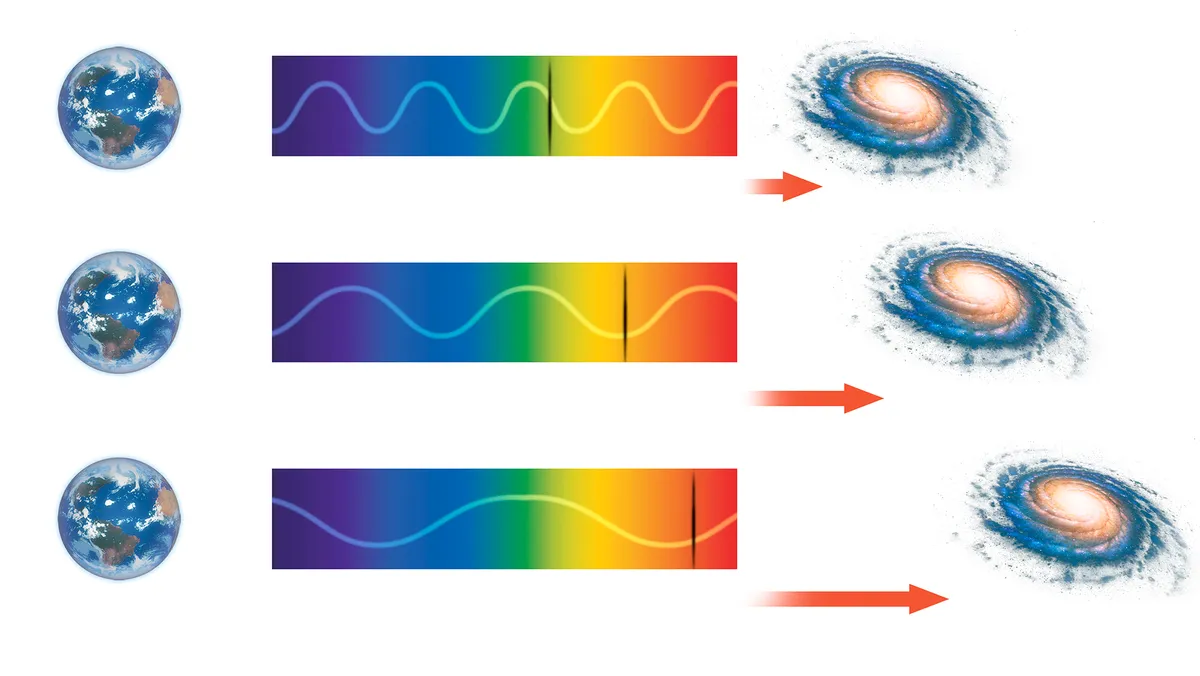
Redshift is an example of the Doppler effect, which says that waves from an object that’s moving towards us shorten (causing their frequency to increase, which makes soundwaves rise in pitch, and light appear bluer), while waves from an object that’s moving away from us stretch out (causing their frequency to decrease, which makes soundwaves decrease in pitch, and light appear redder).
Redshift is often compared to how an ambulance's siren changes pitch as it's moving away from us.
The Universe is always expanding, so the stars in the sky get further from Earth with every passing minute.
As described above, this causes the light emitted by them to lengthen in wavelength, and so appear redder by the time it reaches Earth – that’s redshift.
In other words, light from a distant galaxy is actually stretched by the expanding Universe on its journey from the galaxy to our eyes.
The further away an object is, the more this will happen, – until eventually, the light will become so low-frequency/long-wavelength that it won’t be visible any more, and will reach us instead in the less energetic radio, microwave and infrared bands.
So will light travel forever?

Put all these things together – deflection, refraction and redshift – and a more nuanced answer to the question would be that yes, in a vacuum, light will in theory travel forever.
But from a practical point of view – and certainly for observers here on Earth – there are impediments to that which mean that, over time, light will eventually, or at least appear to, wear thinner. This is known as attenuation.

That said… light will still be around very faintly even then. Which is why we are still able to detect the Cosmic Microwave Background, or CMB.
First mapped by NASA’s COBE (Cosmic Background Explorer) satellite in 1989, the CMB consists of light emitted during the Big Bang itself.
It’s light, in other words, that’s been travelling across the Universe for 13.8 billion years.
And as that’s the entire lifespan of the Universe to date, you could argue that for all practical intents and purposes, it’s also a pretty close approximation of ‘forever’!