Space, as we’re often told, is vast and empty. The Sun is a big ball of gas. And here on Earth, balls of gas don’t, generally, float in mid-air.
They either rise (eg, a cloud of helium) or they sink to ground level (eg, a cloud of carbon monoxide, AKA dry ice).
More mind-boggling science
So why doesn’t the Sun do something similar… either float off into space or sink?
The answer to that is actually quite simple: it’s a combination of motion, gravity and inertia. So let’s start by defining terms.
Motion

Motion is what you think it is: movement. Although of course, when you’re talking about space, you’re talking about a whole new level of movement.
On Earth we consider 160km/h (100mph) pretty darned fast, whereas in space that’s unbelievably slow.
Earth orbits the Sun, for instance, at a speed of around 107,200 km/h (66,600mph) and speeds are usually measured in kilometres per second, not per hour.
But still: motion = movement.
Gravity

Gravity, on the other hand, is a bit less intuitive.
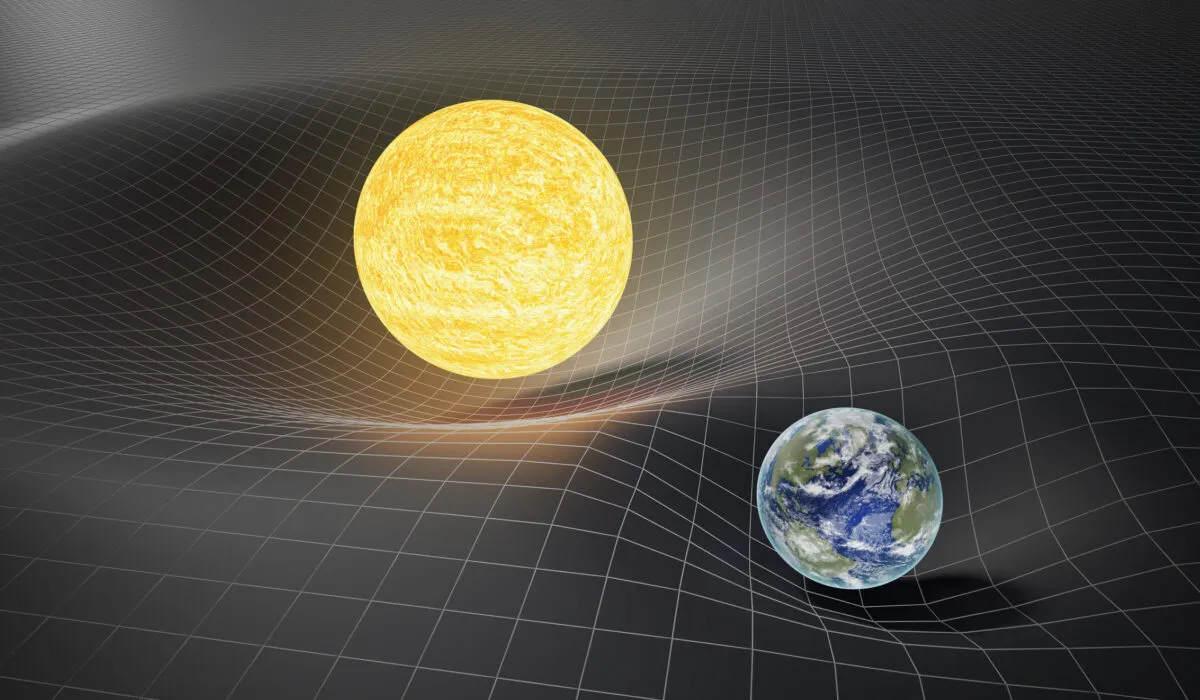
In reality, gravity is a warping of spacetime caused by mass and energy, often exemplified as placing a ball on a taught bedsheet.
The ball – a planet – bends the sheet – spacetime – causing any less-massive objects also placed on the sheet to fall towards the ball. This gives the impression that gravity acts like a pulling force.
That's why on Earth, we think of gravity as a force that makes things fall to the ground, but it’s also a force that makes the ground fall upwards to things!
Take two opposing forces: that of planet Earth vs a ping-pong ball, for example.

Newton's third law states that both these objects exert an equal force on each other. Earth pulls on the ping-pong ball the same as the ping-pong ball pulls on Earth.
It's just that it takes a lot less for the ping-pong ball to move, than it does for Earth to move, so Earth wins!
The two opposing forces (the entire planet vs the 2.7g ping-pong ball) are so out-of-balance that only the more massive one has any noticeable effect.
In space, when you have two absolutely enormous objects of roughly similar mass (e.g. two planets or stars) then you start to see the effects of the gravity of both objects: in the trajectories, behaviour and evolution of binary stars for instance.
Inertia

This is the principle that things stay the same unless a force is applied.
For instance, the coffee cup sitting on your desk right now won’t go flying off the desk unless you give it a shove, whether intentionally or not.
If you do, it should fly off in a straight line, but Earth's gravity 'pulls' it towards the floor.
Once it starts falling to the ground it won’t stop falling, unless you introduce some kind of force to stop it (e.g. by blocking its fall with your foot, or by the cup hitting the floor).
Why the Sun doesn't float away
Now back to the Sun and why it doesn’t float away. If you’ve read our other article about why planets orbit the Sun, then the answer here is much the same.
In that article, we explained how planets are essentially 'falling' towards the Sun all the time.
The Sun contains 99.8% of all the mass in the Solar System, so of course they are.
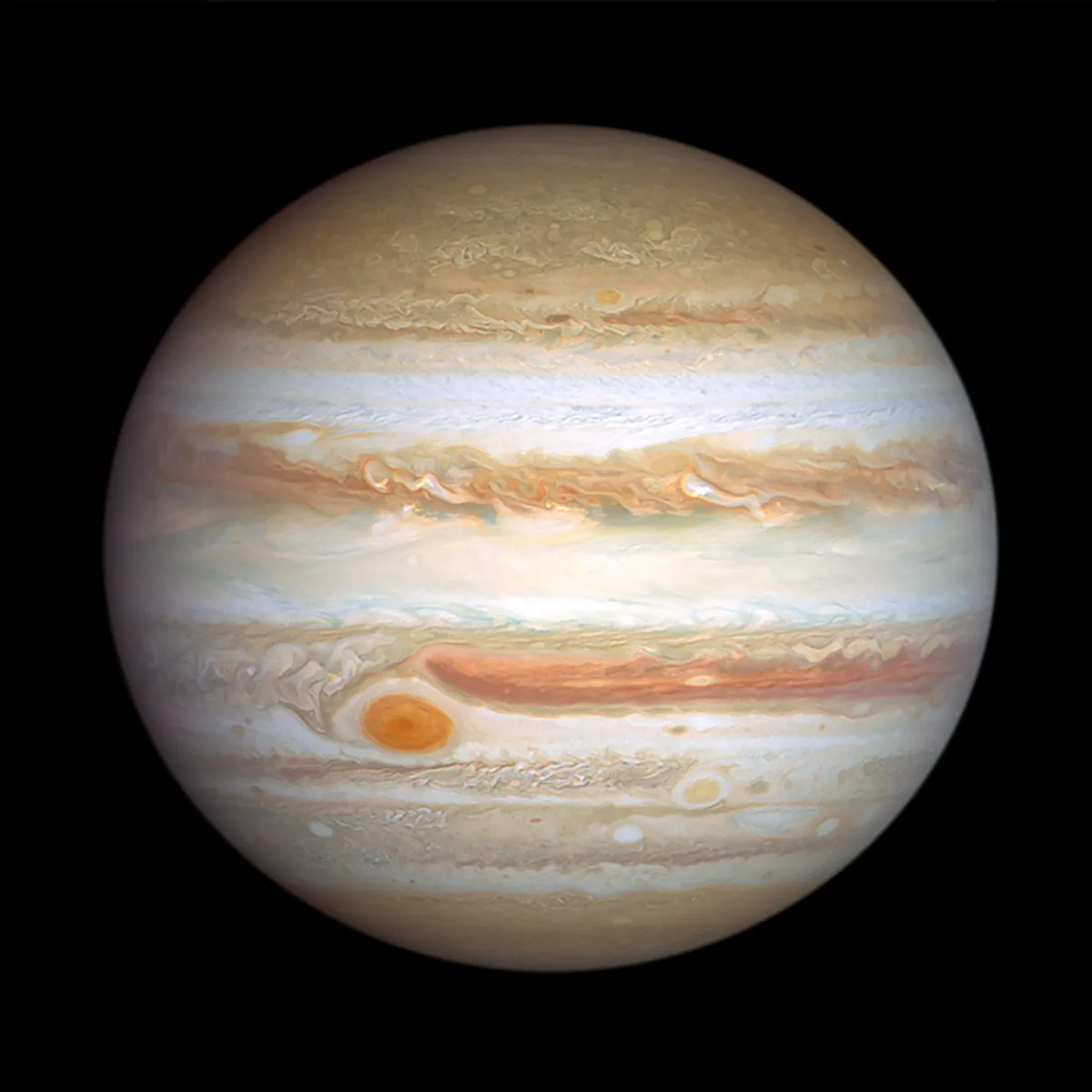
Even mighty Jupiter, in the context of our Solar System, is like that little ping-pong ball on Earth. Its gravity can’t compete with the Sun’s, so it starts falling towards it.
However, Jupiter also has motion, because nothing in space is ever standing still. And that motion gives it inertia.
So at any given moment, gravity is dragging Jupiter (or Earth, or Mars or any other planet) towards the Sun, while motion and inertia are both telling it to keep moving in a straight line.
Jupiter stays in orbit around the Sun because it is moving through space so fast that, as it falls toward the Sun, it always misses.
Hence, rather than just whizzing off into space, Jupiter becomes locked into an orbit around the Sun, just like the other planets.
The Sun, too, is falling
It’s the same story with the Sun! The Sun doesn’t float away because it’s locked into orbit around Sagittarius A*, the supermassive black hole that sits at the heart of the Milky Way.
So is the entire Solar System that’s in orbit around it, for that matter.
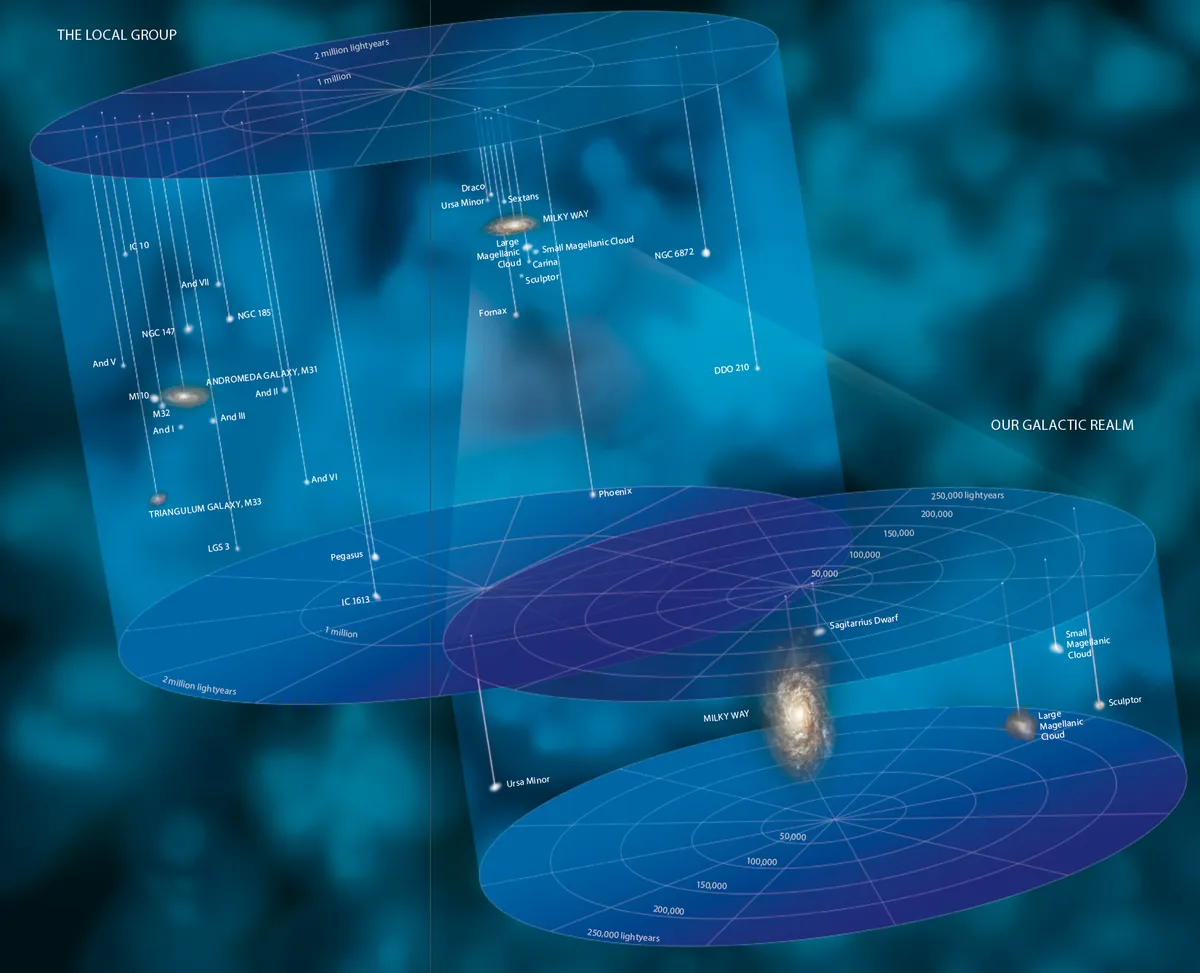
The Milky Way is itself in orbit, except the orbit of the Milky Way isn’t around a physical object – it’s around the gravitational centre of the local group of galaxies.
And so it goes on.
The entire Universe is made up almost entirely of vaguely round-ish things orbiting other vaguely round-ish things, from moons around planets, to planets around stars, up to galaxy clusters locked into orbits around each other within superclusters
The entire cosmos is awash with motion, and between them, motion, gravity and inertia keep the stars, planets and other objects locked together in one incredibly beautiful, complex dance.
And what all these complex interacting and opposing forces don't leave much room for… is burning balls of gas sitting around idly in empty space!