HAT-P-7b (or Kepler-2b) is an exotic exoplanet. Discovered in 2008, it has a radius greater than that of Jupiter and an orbital plane so tilted relative to its star (108°) that it’s nearly in a polar orbit.
But what makes the planet truly exceptional is how hot it is.
HAT-P-7b hugs its bright, A-class star so tightly that its orbit takes less than three days – it’s over 20 times closer to its sun than Earth is to ours.
Day-side temperatures on the planet are calculated to be regularly above 2,200°C – similar to many stars themselves.
You may have heard of a type of exoplanet known as a hot Jupiter. Well, fittingly, HAT-P-7b sits in a class of planet known as ‘ultra-hot Jupiters’.
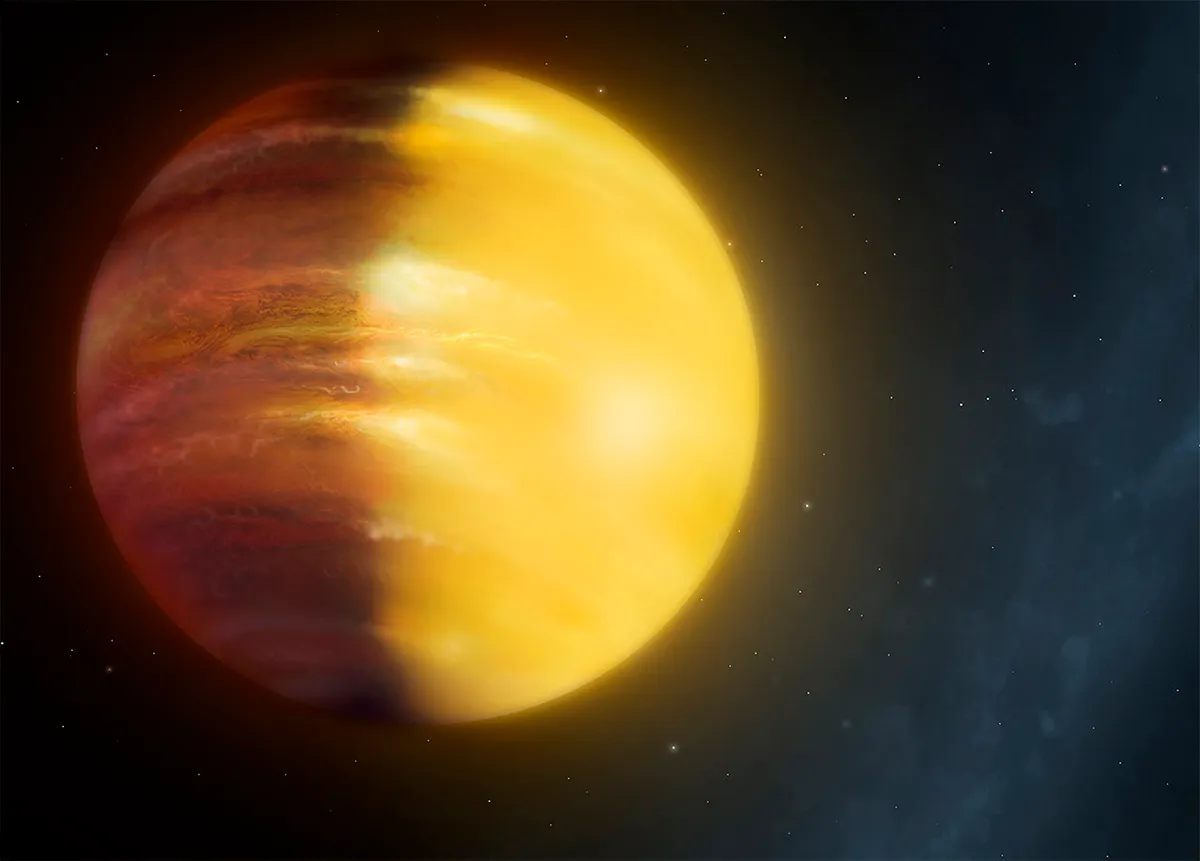
It’s also one of the darkest planets ever observed, with an albedo (surface reflection) of less than 0.03 – roughly that of a lump of charcoal.
The planet is so black it absorbs more than 97% of visible light shining onto it.
Chemical models of its atmosphere predict that on its slightly cooler night-side the crystalline aluminium oxide mineral ‘corundum’, the same substance as rubies and sapphires, condenses as clouds.
The enormous heating has also inflated the planet’s upper atmosphere into a puffy envelope and this, combined with the brightness of its sun, means that HAT-P-7b is an ideal target for studying with transmission spectroscopy.
In this technique, the starlight that passes through a planet’s atmosphere is analysed to reveal information about the chemicals that have become imprinted on it.
Aaron Bello-Arufe at the National Space Institute, part of the Technical University of Denmark, and his colleagues were the first team to analyse HAT-P-7b using transmission spectroscopy, and they discovered even more astonishing details.

Observing HAT-P-7b passing its host star
The astronomers used the High Accuracy Radial velocity Planet Searcher for the Northern hemisphere (HARPS-N), a high-resolution spectrograph on the 3.6m Telescopio Nazionale Galileo at the Roque de los Muchachos Observatory on La Palma in the Canary Islands.
They observed a single transit of HAT-P-7b across its star on the night of 18 December 2020 and recorded the spectrum of light passing through its atmosphere.
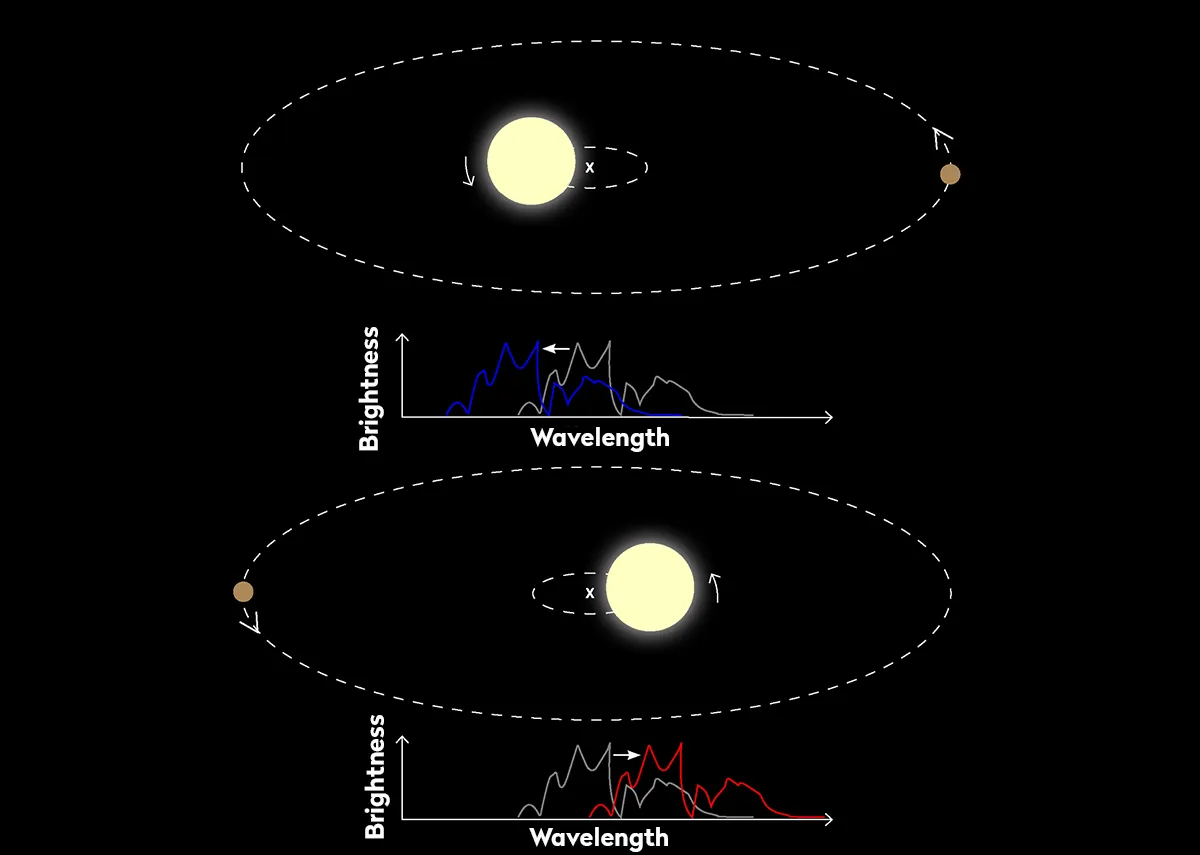
They reported detecting a whole host of elements including iron, calcium, magnesium, sodium and chromium – possibly titanium too.
Bello-Arufe’s work has marked HAT-P-7b out as one of the exoplanets with the greatest number of atomic species detected in its atmosphere.
And this metal-laden air is testament to just how hot the planet is.
But Bello-Arufe’s team also discovered that the spectroscopic lines of these atmospheric atoms are significantly blue-shifted in their observations, revealing just how fast the atmosphere is churning in the heat.
They calculated wind speeds of over 2km per second – some 7,200 km/h – as the expanding day-side air rushes towards the cooler night-side.
What’s more, because different atomic species are expected at different altitudes, the team was able to construct a rough wind-speed profile.
The next step, they say, would be to use emission spectroscopy to study the chemical composition of the day-side of the planet.
Lewis Dartnell was reading Mining the Ultra-Hot Skies of HAT-P-7b: Detection of a Profusion of Neutral and Ionized Species by Aaron Bello-Arufe et al. Read it online at: arxiv.org/abs/2112.03292.