In recent decades, scientists have turned their attention to an elusive ghost-like subatomic particle known as the neutrino.
We know very little about these bizarre particles. But what we do know implies they may hold the clue to not only the origin of matter, but the nature of mysterious ‘dark matter’ too.
The Universe is filled with neutrinos. Many were born in the Big Bang, but they are also created in the hearts of supernova explosions and the nuclear furnaces of stars.
Yet, despite the fact that 100 trillion of them are passing through your body every second, not a single neutrino is ever likely to interact with you.
But how did scientists get put on the trail of a particle smaller than an atom that defies detection?

First hints
Neutrinos were a theory first, before they were detected. As early as 1930 physicist Wolfgang Pauli postulated them to explain a peculiar feature of radioactive decay.
During this ‘beta decay’, where an atom decays by emitting an electron, the pre-decay and post-decay energies (and motion) of the particles are different.
Pauli suggested this could be explained if a massless neutral particle was created during the decay. Indirect evidence for the existence of these neutrinos came in 1938 and they were experimentally confirmed in the 1950s.

Like many particles in modern physics, neutrinos have an associated antiparticle – the ‘antineutrino’.
Antineutrinos are produced by some nuclear fission processes, such as those in nuclear reactors.
Confirmation of the neutrino’s existence has been backed up by modern cosmology. This tells us that the Big Bang should have produced equal quantities of matter and antimatter, and that these particles would eventually annihilate each other, the Universe ending up containing just energy – devoid of all matter.
However, there is clearly an imbalance – an ‘asymmetry’ – since matter exists but antimatter is rare.
It’s a problem that scientists have been trying to reconcile for decades.
More about particle physics
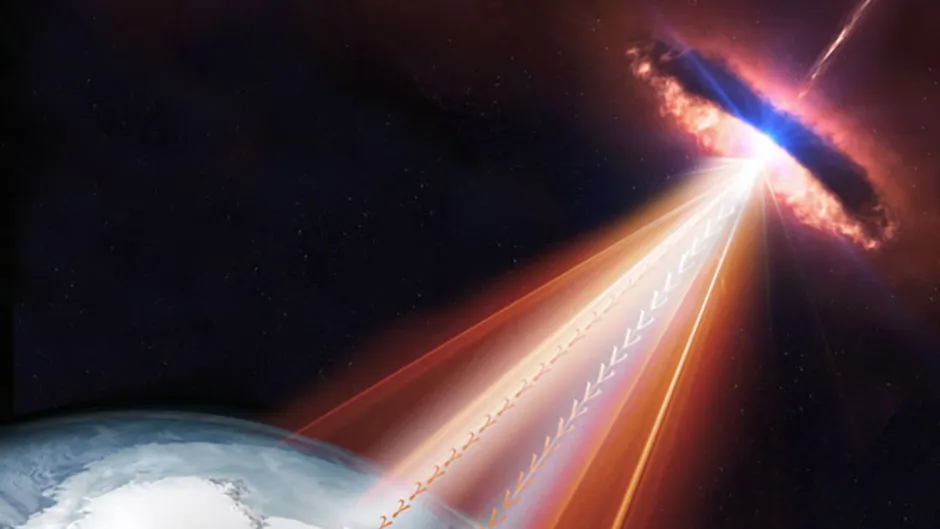
Credit: IceCube/NASA
One idea is that matter and antimatter particles may not be exact opposites – something which scientists call ‘CP violation’ (CP stands for Charge-Parity). For example, if their masses, charges or magnetic moments differ, even minutely, this can explain how the asymmetry arose.
CP violation has indeed been seen among particles called quarks, in numerous laboratory experiments. Unfortunately, this is way too small to pin the huge matter–antimatter asymmetry we see in the Universe on. There must be another culprit, the neutrino.

Invisible to light
But the problem with studying neutrinos is that they are extremely uncooperative – they rarely interact with other particles, including photons, the particles that make up light. One estimate suggests a neutrino could pass through a lightyear of solid lead without being noticed.
Neutrinos just don’t interact with electromagnetic forces like electrons do. They don’t interact with the ‘strong’ nuclear force that binds protons and neutrons together, and only participate in the ‘weak’ nuclear force, which is primarily involved in radioactive decay.
So a device to detect neutrinos has to rely on force of numbers. If vast quantities of neutrinos enter the detector, a very occasional interaction can be isolated.
These detectors have been built, usually far underground to shield them from cosmic rays. Many consist of huge tanks of water surrounded by detectors that pick up tiny flashes of light when passing neutrinos hit atoms and create electrons or muons.
Other instruments search for traces of argon or germanium when neutrinos interact with chlorine or gallium atoms in vast tanks.

A problem solved…
In the 1960s, when scientists turned these instruments to the Sun, far fewer neutrinos were found than expected.
This led to a surprising realisation. Neutrinos come in several identities, or ‘flavours’ – known as ‘electron neutrinos’, ‘muon neutrinos’, and ‘tau neutrinos’. An even weirder discovery came next: neutrinos can swap between these flavours as they move through space.
The Sun produces only electron neutrinos, some of which change into other flavours en route to Earth. This solved the so-called ‘solar neutrino problem’ because the available instruments could only detect electron neutrinos.
But the discovery also led to serious problems. Neutrinos are only able to oscillate between flavours if they have mass, but the standard model of particle physics predicts that neutrinos should be massless.
While their mass may be tiny – the electron neutrino is less than one-ten-millionth the mass of the next heaviest particle (the electron) – tiny is not zero.

…brings more problems
This conundrum comes from a property inherent to fundamental particles known as ‘fermions’, a category which neutrinos fall into. Fermions are either ‘left-handed’ or ‘right-handed’ (what scientists call ‘chirality’) depending on the orientation of the particle’s spin in relation to the direction of its momentum.
Fermions get their mass because they interact with the Higgs boson (sometimes referred to as the God particle), but this interaction switches the fermion’s handedness from left to right or right to left.
The problem is that experiments have failed to detect any neutrinos that are right-handed or any antineutrinos that are left-handed.
If neutrinos have mass, where are all these missing particles? Their absence may mean there is another entirely different mechanism for neutrinos to gain their mass.
Some physicists speculate that these opposite-chirality neutrinos (sometimes called ‘sterile neutrinos’) could have formed in the hot early Universe.
They may have been as much as 1015 times heavier than protons, but would have decayed into lighter particles almost as soon as they formed, moments after the Big Bang.

If these heavyweight neutrinos and antineutrinos decayed with CP violation, this could result in the matter-antimatter asymmetry seen today. This makes the mysterious neutrino an interesting specimen.
In theory, any CP violation in these primordial heavy particles should also be seen in the lightweight ones that remain in the Universe today.
In fact, several experiments to date have shown that neutrinos and antineutrinos may have different probabilities of oscillating between different flavours. This staggering result, if confirmed, is a clear CP violation.

Searching for a double
To add to the weirdness, the same theory which predicts heavyweight neutrinos also suggests that they may be their own antiparticle. Proving so could give scientists greater confidence that these primordial heavy particles actually existed.
To determine whether neutrinos are their own antiparticles, researchers are looking for a phenomenon called ‘neutrinoless double beta decay’.
In some atoms a neutron can decay and release an electron and a neutrino. If two neutrons decay at the same time (‘double beta decay’) two released neutrinos would be observed. If, however, these two neutrinos are their own antiparticles, they may annihilate each other and no neutrinos would be seen.
There are a number of experiments trying to detect this phenomenon, as yet without success. But if the neutrino does turn out to be its own antiparticle, it could explain why the Universe is made of mostly matter and not antimatter.

Searching in the dark
Intriguingly, this weird neutrino may also explain another mystery of the cosmos; dark matter – the 85 per cent of matter in the Universe that we simply can’t see.
Astronomers infer the presence of dark matter because it explains how galaxies manage to hold themselves together, how gravitational lenses work and the temperature distribution of hot gases observed in galaxy clusters.
Despite dark matter’s ubiquity, astronomers have no real idea what it is. But neutrinos seem an ideal candidate – they are stable, have mass and do not interact electromagnetically. But there’s a problem: Observations suggest that dark matter is primarily slow-moving, or ‘cold’.

The small mass of normal neutrinos, however, means they travel very fast – close to the speed of light – and are essentially too ‘hot’ to allow the formation of the dark matter structures needed to hold galaxies and clusters together.
On the other hand, sterile neutrinos, those of the heavy type, do match the properties of dark matter. Unfortunately, the latest detailed studies have cast serious doubts on whether these sterile neutrinos actually exist.
So, the humble, unassuming neutrino could solve two of the major problems in modern cosmology; the matter-antimatter asymmetry and the nature of dark matter. Ultimately, the neutrino may also be the reason we and all matter in the Universe exists!
So far, modern particle physics can only explain a fragment of the neutrino’s strange ghost-like behaviour. Time will tell if this weird particle steps up to the mark.