Saturn's largest moon has enormous lakes and ferocious winds. Sounds like Earth? There's one key difference

Saturn's largest moon has enormous lakes and ferocious winds. Sounds like Earth? There's one key difference

The Saturnian moon Titan has lakes with remarkably gentle breezes not dissimilar to Earth's

Get monthly inspiration to your door with BBC Sky At Night Magazine - subscribe today


One of the most stunning discoveries delivered by NASA’s Cassini probe to the Saturn system was that its moon Titan hosts a number of lakes (confirming evidence from the Hubble Space Telescope).

Titan is a giant moon with a thick atmosphere, and had long been suspected to offer appropriate conditions for bodies of liquid methane and ethane on its surface.

The largest of Titan's lakes, Cassini found, range from hundreds of kilometres to over 1,100km in length, and so are referred to as seas.

The probe also spotted hundreds of other smaller lakes, ranging from just a few kilometres to 240km.

Some of these bodies exhibit intricate shorelines, and many cluster together near the north pole: a Titanic Lake District.

Saturn's moon Titan has its own 'Lake District'. Credit: Joe Daniel Price / Getty

Seas and large lakes on Earth affect the local wind conditions.

They take longer than the land to warm up and cool down on a day-to-night cycle, as well as over the seasons, and evaporation from their surface also affects heat transfer.

The temperature differentials created by these factors generate either onshore or offshore winds.

So a natural question arises: how do Titan’s large methane lakes affect the moon’s winds?

Previous studies have explored this with 2D models, but Audrey Chatain at the Department of Space Studies, Southwest Research Institute (SwRI) in Boulder, Colorado, and her colleagues, improved on these efforts by simulating atmospheric movements around Titan’s lakes in all three dimensions.

Chatain’s models show that although the conditions on Titan and Earth are extremely different, the breezes formed around Titan’s lakes are actually broadly similar to those on Earth in terms of the extent of the winds above the surface and how far inland they penetrate.
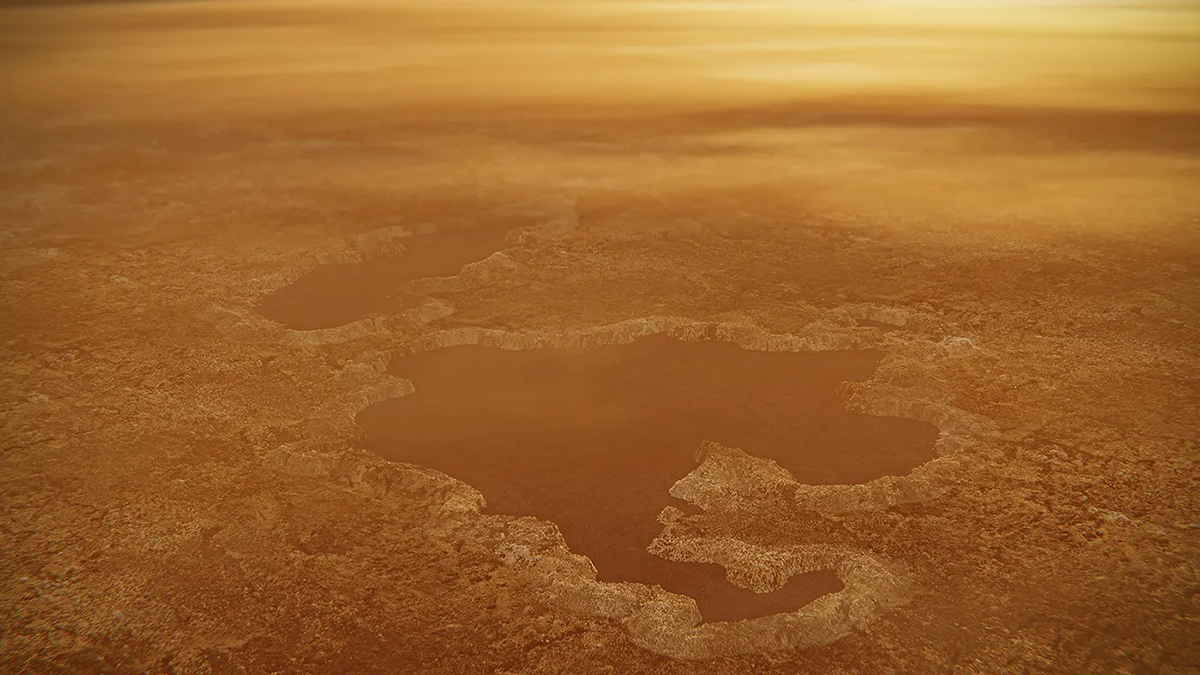
Artist’s concept of a lake at the north pole of Saturn’s moon Titan. Credit: NASA/JPL-Caltech

Her team also found that these surface winds are strongest around the edges of the largest seas, and for lakes nearer the equator during summer, as would have been expected.

But even in these situations, Chatain calculates that these lake winds never exceed a very gentle breeze
of 0.2m/s – far slower than analogous lake winds on Earth of around 5m/s.

She notes that even these strongest lake breezes on Titan would not be enough to create wind-driven waves on the moon’s seas.

Chatain’s team also determined an evaporation rate from Titan’s lakes of around 6cm per Earth year,
which is far lower than the values of 20–50cm suggested by previous, simpler 2D models. 
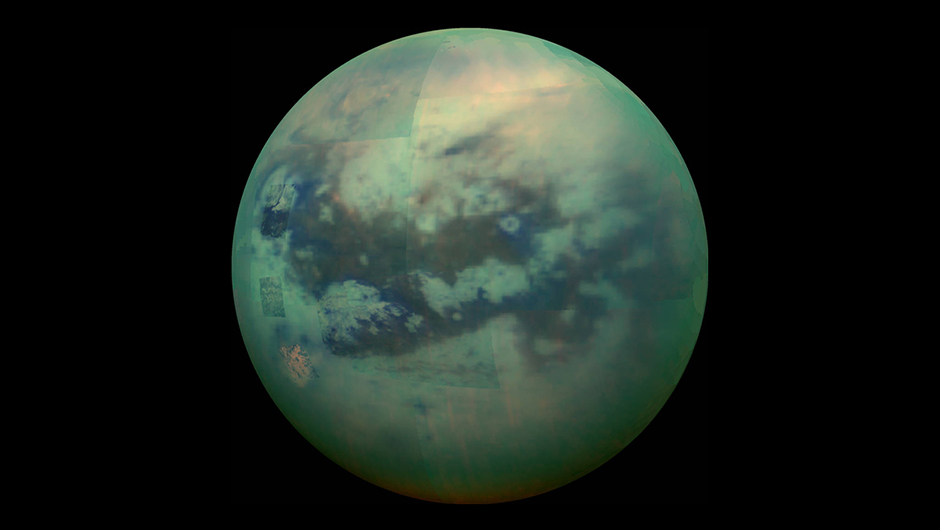
Cassini took many images of Titan over its 13 year mission at Saturn. The mission ended on 15 September 2017, when it plunged into Saturn’s atmosphere, but it’s data is still providing scientific insight. Image Credit: NASA/JPL-Caltech/ASI
Cassini took many images of Titan over its 13 year mission at Saturn. The mission ended on 15 September 2017, when it plunged into Saturn’s atmosphere. Credit: NASA/JPL-Caltech/ASI

Another new result from these 3D models is the formation of a stable layer of cold but moist air in the first few metres above the lakes.

Chatain calculates that under these conditions the evaporating methane could reach saturation and condensation: Titanic sea fogs. 

Overall, the winds on Titan are much weaker than those on Earth, so although far-future explorers may experience the singular pleasure of a boat ride on liquid hydrocarbon seas, they’d struggle to go sailing.

More images of Titan
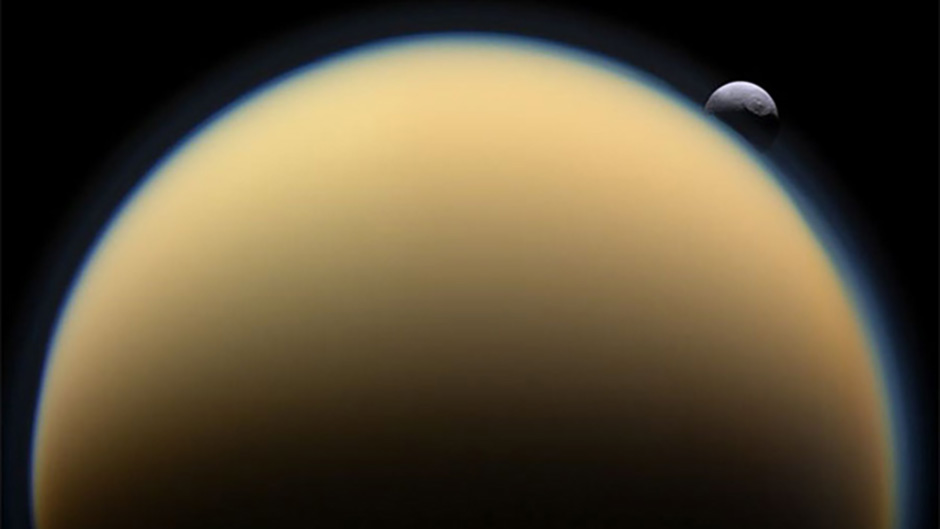
Like Earth, Titan has an atmosphere, seen here as a hazy blue outline around the moon’s limb. But Cassini scientists have discovered another similarity between our planet and Saturn’s largest moon.To the upper left of Titan in this image taken by the Cassini spacecraft is Tethys, another of Saturn’s satellites.Credit: Cassini Imaging Team, ISS, JPL, ESA, NASA
A view of Titan captured by the Cassini probe. Titan's atmosphere is seen here as a hazy blue outline around the moon’s limb. To the upper left of Titan is Tethys, another of Saturn’s moons. Credit: Cassini Imaging Team, ISS, JPL, ESA, NASA
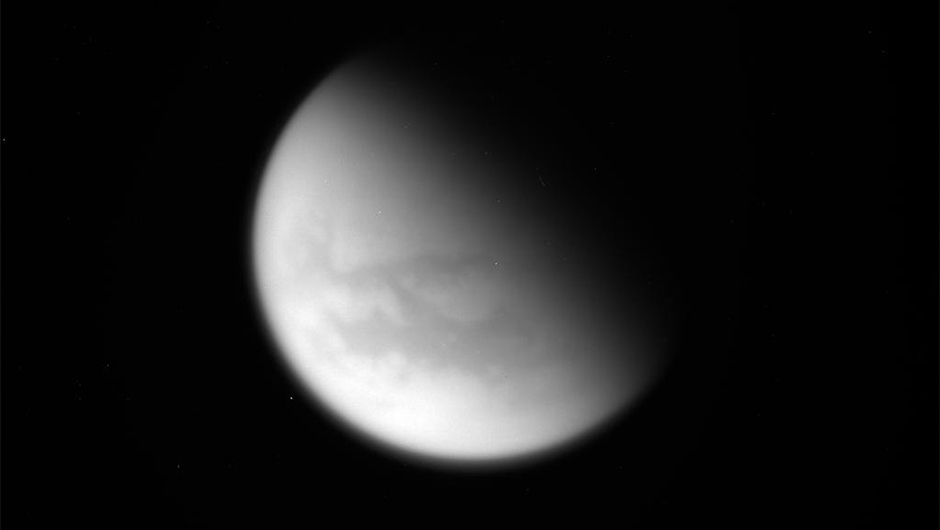
An unprocessed image of Saturn's moon Titan taken during Cassini’s final close flyby of the moon, 22 April 2017. Credit: NASA/JPL-Caltech/Space Science Institute
An unprocessed image of Saturn's moon Titan taken during Cassini’s final close flyby of the moon, 22 April 2017.Credit: NASA/JPL-Caltech/Space Science Institute
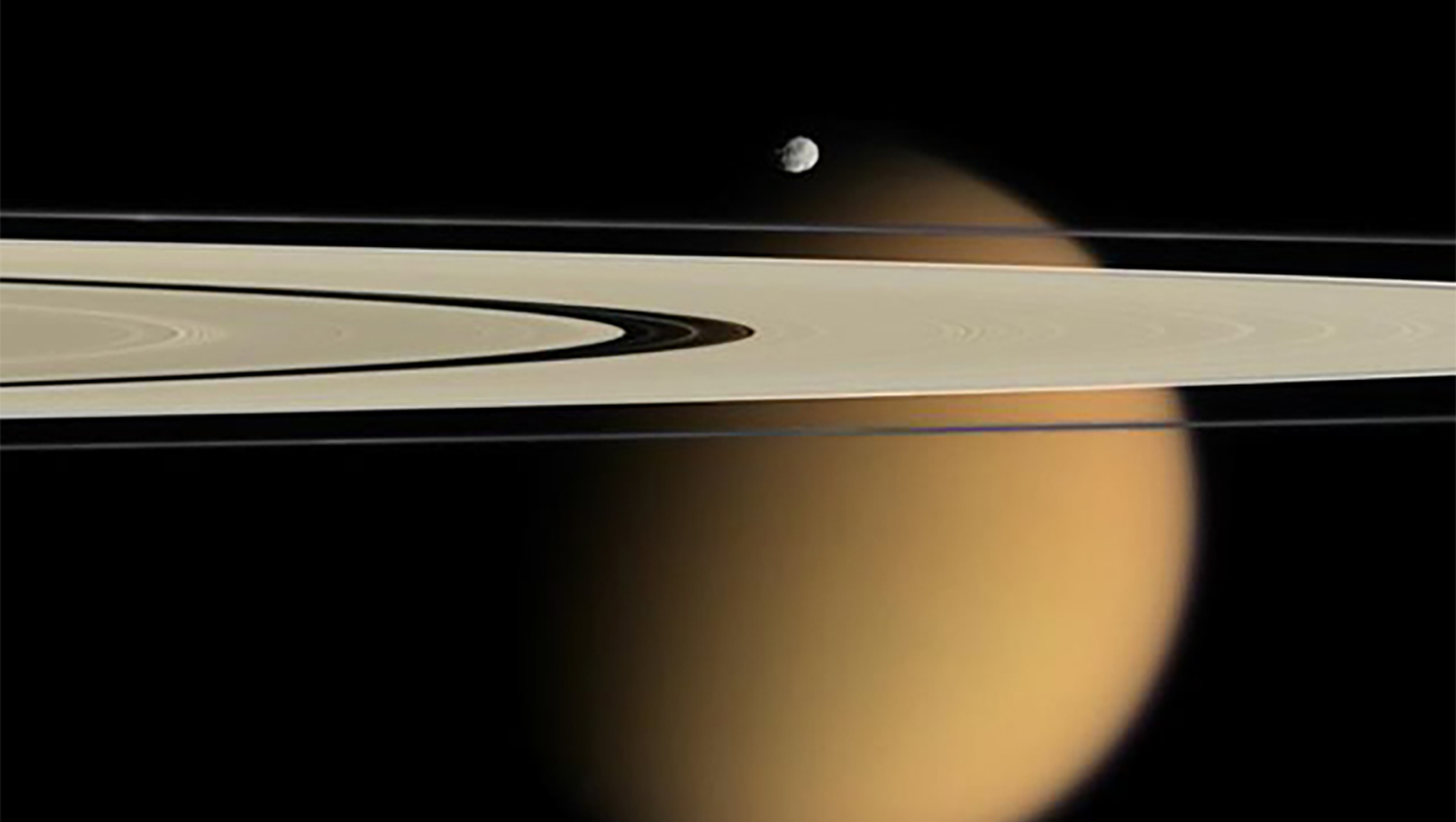
A Cassini image showing Titan, Saturn’s largest moon, behind the planet’s rings. The smaller moon Epimetheus can be seen in the foreground. Image Credit: NASA/JPL/Space Science Institute
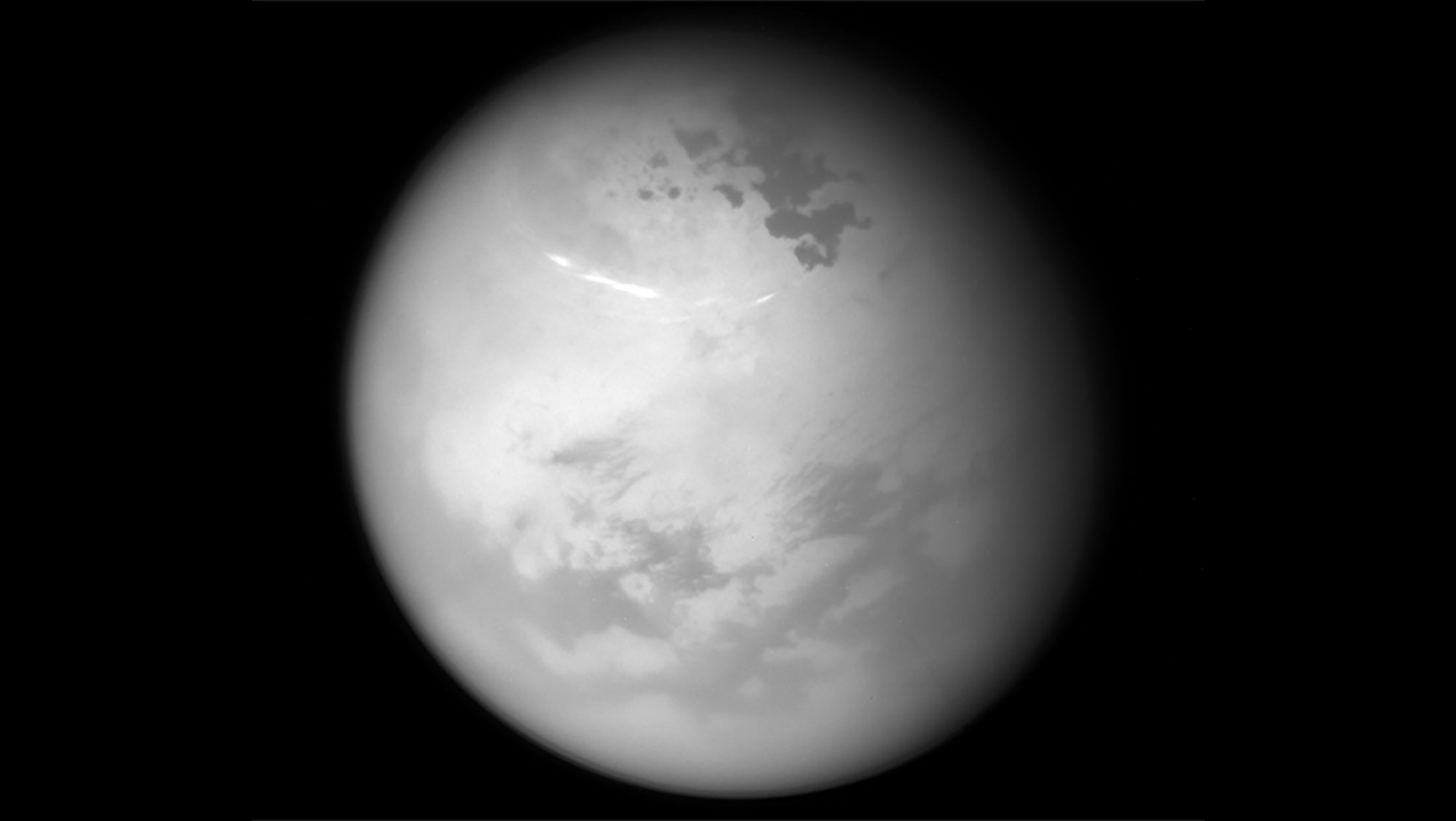
Methane clouds drift across Titan’s summer skies in this Cassini image. The darker patches are hydrocarbon lakes. Credit: NASA/JPL-Caltech/Space Science Institute
Methane clouds drift across Titan’s summer skies in this Cassini image. The darker patches are hydrocarbon lakes.
Credit: NASA/JPL-Caltech/Space Science Institute
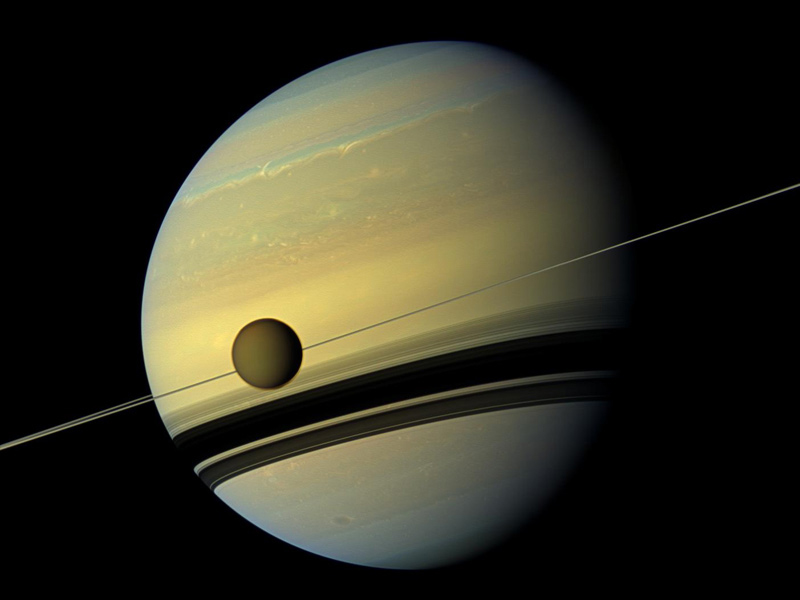
Moon Titan appears in front of Saturn in an image captured by NASA’s Cassini spacecraft. Credit: NASA/JPL-Caltech/Space Science Institute
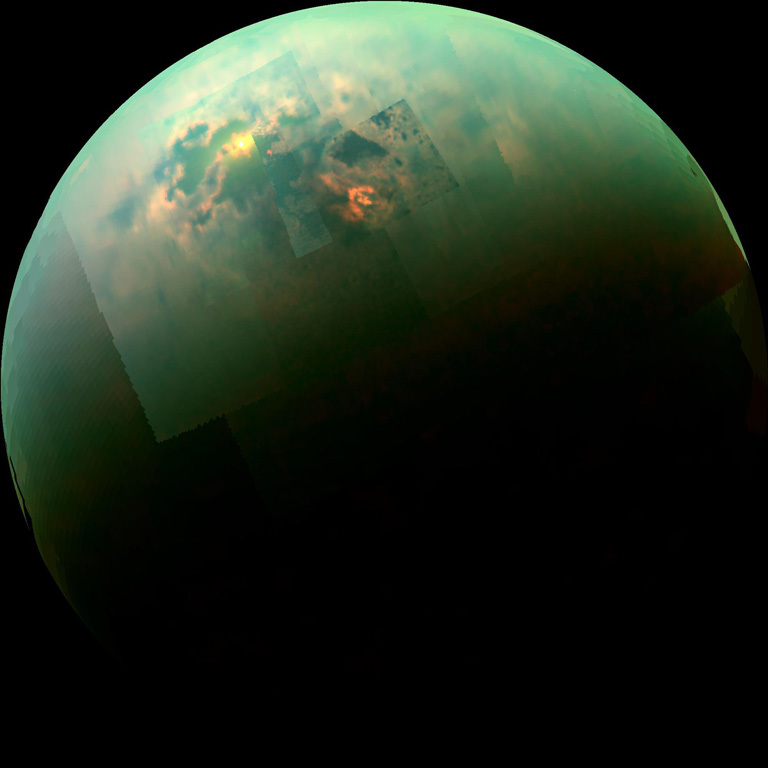
Near-infrared colour mosaic of Titan’s north pole showing the sunlight reflecting off its seas. (Credit: NASA/JPL-Caltech/Univ. Arizona/Univ. Idaho)
Near-infrared colour mosaic of Titan’s north pole showing the sunlight reflecting off its seas. Credit: NASA/JPL-Caltech/Univ. Arizona/Univ. Idaho
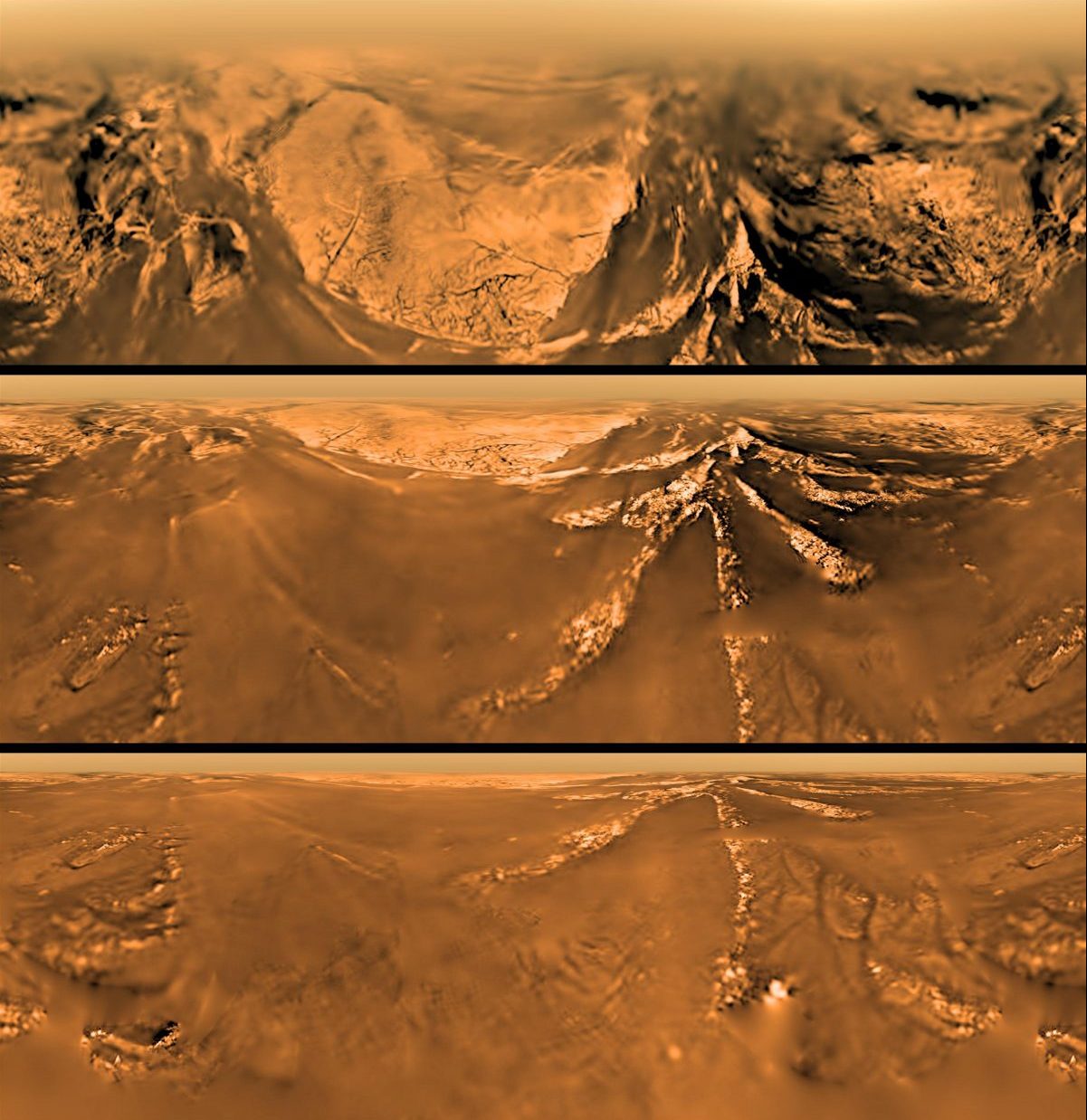
Views of Titan’s surface as seen by the Huygens lander during its descent onto the surface of the icy moon, 14 January 2005. Credit: ESA/NASA/JPL/University of Arizona
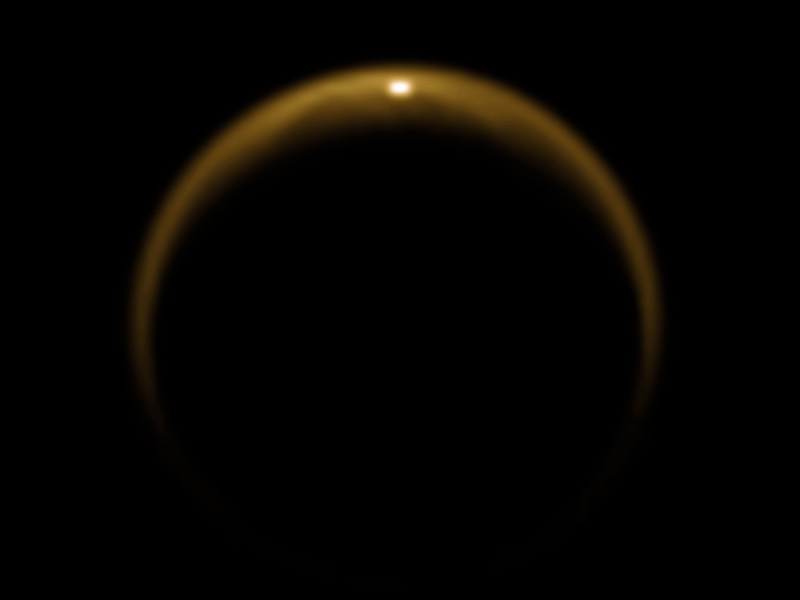
An image of Titan captured by the Cassini spacecraft on  July 2009. The bright spot at the top of Titan’s disc is sunlight reflecting off the surface of a hydrocarbon lake. Credit: NASA/JPL/University of Arizona/DLR
An image of Titan captured by the Cassini spacecraft on July 2009. The bright spot at the top of Titan’s disc is sunlight reflecting off the surface of a hydrocarbon lake. Credit: NASA/JPL/University of Arizona/DLR

Lewis Dartnellwas reading The Impact of Lake Shape and Size on Lake Breezes and Air–Lake Exchanges on Titan by Audrey Chatain et al. Read it online at: arxiv.org/abs/2309.07042

Footer banner
This website is owned and published by Our Media Ltd. www.ourmedia.co.uk
© Our Media 2026