
What would happen if humanity encountered aliens? If there a plan? And if not, should we have one?
Numerous movies and TV shows feature humanity encountering extraterrestrials.
In films such as Independence Day and War of the Worlds, the scenario is an alien invasion.
Elsewhere, encounters are more ambiguous and the extraterrestrials more enigmatic, as we see in movies such as Contact or Arrival. But what if any of this happened for real?
More on alien life

Over the past few years in the US, the subject of UFOs (or UAPs – unidentified anomalous phenomena – as they're officially designated) has transitioned from fringe to mainstream.
This resulted from the release of photos and videos of UAP taken from various military platforms, and led to classified briefings and public hearings in Congress.
The Pentagon set up a unit to investigate UAP called the All-Domain Anomaly Resolution Office (AARO), and the subject is now being treated as a defence and national security issue.
Are we prepared?
All this brings into focus the question of what would happen if we actually found aliens – or if they found us.
It would be the biggest scientific discovery in history, and would likely have profound – but difficult to predict – effects on every aspect of society, from politics and religion, through to science, technology, the economy and philosophy.
Individuals would probably react in different ways, some with fear and panic; others with awe and wonder.
Surprisingly perhaps, there doesn't seem to be a co-ordinated, overall plan for an eventuality like this.
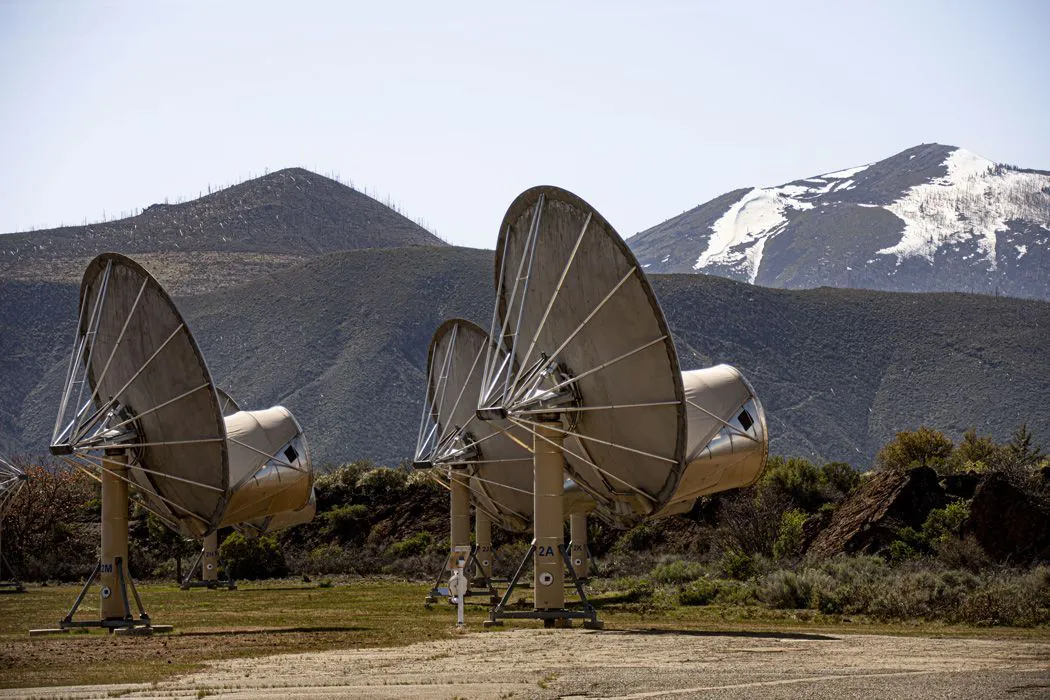
While the Search for Extraterrestrial Intelligence (SETI) Institute authored a document titled the Declaration of Principles Concerning the Conduct of the Search for Extraterrestrial Intelligence, these protocols only cover what to do if a radio signal from another civilisation is detected, and the document isn't legally binding on nation states.
Beyond this, it's theoretically possible that there's a highly classified government plan, the existence of which is known only to a few key personnel.
However, I got no hint as to the existence of any such document when I handled the UAP issue for the British Ministry of Defence in the 1990s, and neither has such a plan been mentioned in any of the Congressional hearings on UAP.
The nearest Britain came to a plan for making contact with aliens was in 2023, when the Department for Science, Innovation and Technology (DSIT) produced an outline report titled ‘UK readiness for black swan scientific events: Case Study – The discovery of life beyond Earth’.
DSIT's Ideas Lab wrote an eight-page draft before the study was indefinitely paused in 2024.

What do we mean by alien?
A key problem in devising any plan is the wide range of variables when it comes to alien life.
Discovering microbial life in our Solar System, for example, would raise the issue of planetary protection – we don't want to be wiped out by the Venusian flu.
Detecting a radio signal from another civilization would raise very different issues: could we decipher a message from aliens; should we reply; what should we say; and who should reply?
The last question raises the issue of who could truly speak for Planet Earth.
No political or religious leader could speak for everyone, and while a scientist or an academic might be a better choice, what about the billions of people who effectively have no voice? Who speaks for them?
These issues were explored during two meetings at Britain’s Royal Society, held in 2010.
The first was titled, ‘The detection of extra-terrestrial life and the consequences for science and society’ and the second, ‘Towards a scientific and societal agenda on extra-terrestrial life’.
These were multidisciplinary events with participation not only from astronomers and astrophysicists, but also from psychologists, anthropologists and theologians.
It was apparent that the religious implications of finding alien life would be profound and potentially controversial in terms of the possible challenges posed to faith and doctrine.
Some senior theologians are already thinking about how to incorporate alien life into their belief systems.
Father José Gabriel Funes, a Jesuit priest who served as director of the Vatican Observatory, has stated: "How can we rule out that life may have developed elsewhere?
"Just as we consider Earthly creatures as ‘brother’ and ‘sister’, why should we not talk about an ‘extraterrestrial brother’? It would still be part of creation."
But what if aliens don't come in peace? Stephen Hawking once warned: "If aliens visit us, the outcome would be much as when Columbus landed in America, which didn't turn out well for the Native Americans."
This ties in with the Dark Forest hypothesis, which suggests alien civilizations generally remain silent, for fear of encountering a more advanced hostile civilization.
As Cambridge University palaeontology professor Simon Conway Morris said at the first of the Royal Society meetings: "If the cosmic phone rings, don't answer."
It's a sobering thought that in a Universe nearly 14 billion years old there might be civilizations a billion years ahead of us.
Science fiction writer Arthur C Clarke said that "any sufficiently advanced technology is indistinguishable from magic".
So, we can forget about those Hollywood movies where Earth defeats an alien invasion, because one of the few good assumptions we can make about extraterrestrials is that, if they arrive here, having mastered interstellar travel, their technology will be orders of magnitude above anything we have.
Reagan’s UN address
The idea that we might encounter hostile extraterrestrials was raised by President Ronald Reagan in a 1987 address to the United Nations General Assembly.
Towards the end of his speech, he remarked: "I occasionally think how quickly our differences worldwide would vanish if we were facing an alien threat from outside this world."
And returning to the question of who speaks for Planet Earth, it's the United Nations that many believe should take a lead role in formulating policy on this issue.
The United Nations Office for Outer Space Affairs (UNOOSA) would be the logical focal point but, speaking at the second of the Royal Society meetings held in 2010, UNOOSA's then director, Dr Mazlan Othman, was lukewarm.
Understandable, perhaps, as this followed light-hearted media speculation that she was to be appointed as an ‘alien ambassador’.

Dangers to avoid
If a plan was drawn up, it would have to cover the different possible scenarios, then identify and address risks and opportunities.
Risks include the danger of contaminating the biosphere with alien germs, or alerting a super-predator civilisation to our existence by sending a targeted radio signal.
Opportunities include discovering what science writer Timothy Ferris calls a ‘galactic internet’ – a repository of knowledge from other civilizations.
This might include information that could solve terrestrial problems such as hunger, disease and energy needs, though there are risks here too, as advanced technologies might be capable of being weaponised.
Contingency planners would probably regard finding alien life as a ‘low probability, high impact’ event, where even if the chances of it occurring are judged to be small, the consequences would be immense – and potentially catastrophic.
So, let's start a conversation about such a plan. After all, it's better to have one and not need it, than need one and not have it.
Do you have thoughts on an alien-life contingency plan? Share your thoughts with us by emailing contactus@skyatnightmagazine.com


