If you've just received a new telescope for Christmas, you may be wondering what to do with it now you’ve got it. If so, we’re here to help!
Every stargazer starts here. Even those with Dobsonian telescopes the size of a WW2 battleship cannon or the latest computer-controlled astrophotography rigs once stood where you are now and asked: "So… what do I do next?"
If you haven’t got a clue what to look at through your new telescope as darkness falls on Christmas Day 2025, this feature is for you.
More beginner's advice
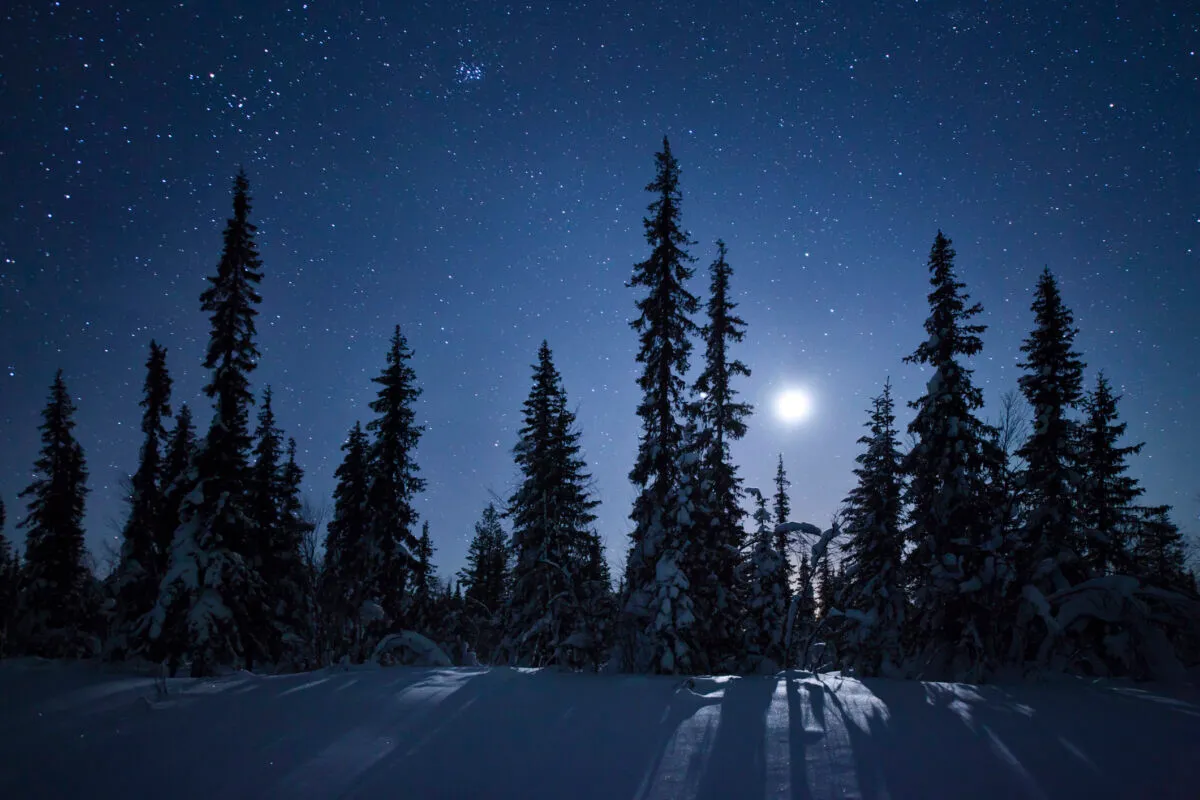
Think of it as a cosmic selection box of fascinating festive treats, sights that will make you say “Wow!” and call your family away from the TV – as they munch their way through another box of chocolates – to come outside and share the view.
This tour is split into two sessions, so you can enjoy the first half early in the evening (from around 6pm), then head inside to warm up before going back outside at around 9pm to see the rest.
And you can do it any night over Christmas week; just be aware the Moon will change position and get brighter.
Ready? Then let’s get started. We’ll begin with the easiest targets, the sights you’ll see if you look to the south after the sky darkens on Christmas Day…
PART ONE
Start at around 6pm…
1. The Moon

The Moon is the easiest celestial object to find in the night sky because it’s so bright. You’ve seen it countless times, but tonight your new telescope will reveal it as never before.
On Christmas night, it will be a beautiful silvery crescent to the naked eye, shining brightly above the southern horizon.
But once you’ve found it with your telescope, and centred it in your lowest-magnification eyepiece (denoted by a large number with ‘mm’ after it), it will be transformed into a spectacular alien world.
You’ll see its surface has flat, dark areas and brighter, more rugged regions. The dark areas are the ‘seas’, but they’re seas of frozen ancient lava, not water.
The brighter areas are the battered and beaten highlands, covered with craters and mountain ranges.
Using a higher-magnification eyepiece (a smaller number with ‘mm’ after it), you’ll see amazing detail, with craters overlapping so thickly they’re impossible to count.
For more advice, read our guide on how to observe the Moon.
2. Saturn, the Ringed Planet

You’ve probably been looking forward to this for years – in fact, Saturn might even be why you bought your new telescope.
On Christmas night, the famously ringed planet will be easy to find, close to the Moon, shining like a yellow-white star to its upper left.
It might take a few tries to find it with your scope, but don’t worry – it will be worth the frustration! Start with your lowest-power eyepiece again.
Once you’ve found the planet, use higher magnification until the famous rings are clearly visible.
Your first view of the rings might be a little disappointing – right now, they aren’t open very wide.
Their angle changes slowly over time as Saturn moves around the Sun, so they appear to open and close across the years.
Even so, you will see them and even at this angle they’re still a stunning sight.
For more advice, read our guide on how to observe Saturn.
3. M31, the Andromeda Galaxy
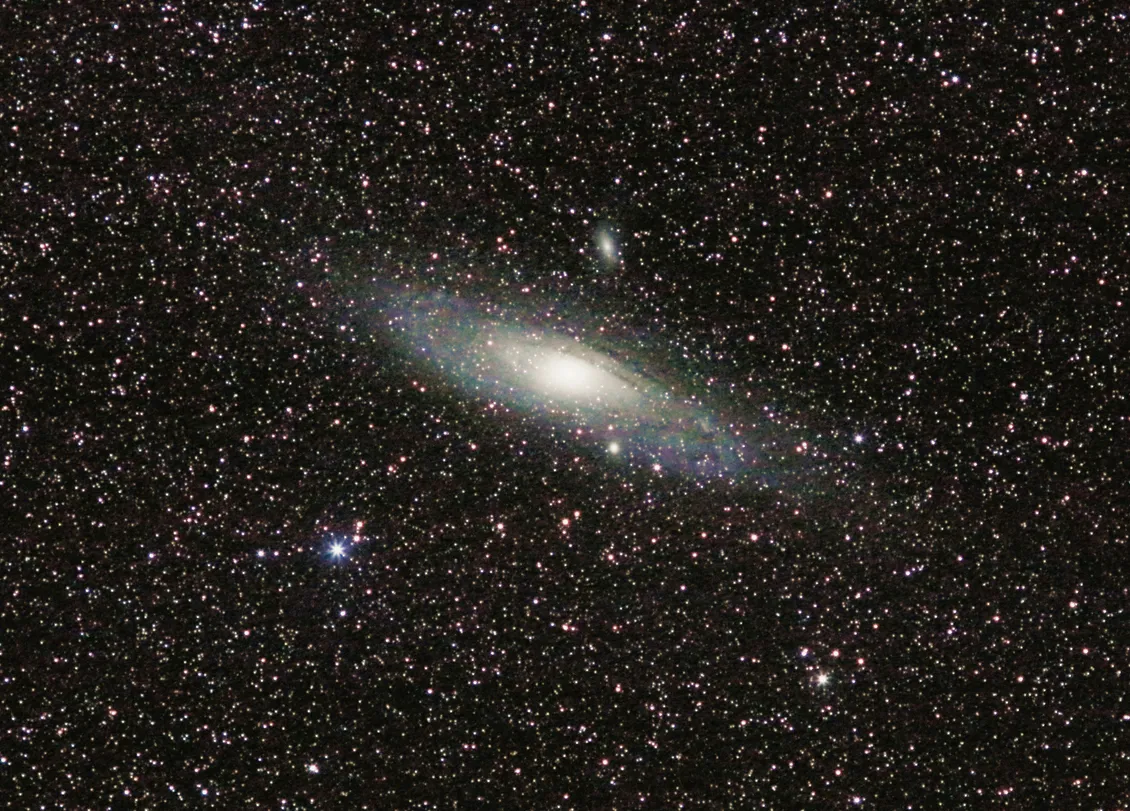
After Saturn, turn your gaze to the upper left of it – specifically, to the left of a large square of stars known, fittingly, as the Great Square of Pegasus.
If your sky isn’t spoiled by light pollution, with the naked eye you may spot what looks like a small, misty smudge. This is M31, the Andromeda Galaxy.
Slowly and carefully move your telescope over and up towards it. In your lowest-power eyepiece, it will appear as a large, misty grey-white oval.
This is actually the best view you’ll get, because increasing the magnification will only dim the image.
This ‘smudge’ is a huge spiral galaxy – bigger than our own Milky Way – containing billions of stars.
And it’s so far away that the light reaching your new telescope tonight set off more than two million years ago.
4. The Double Cluster
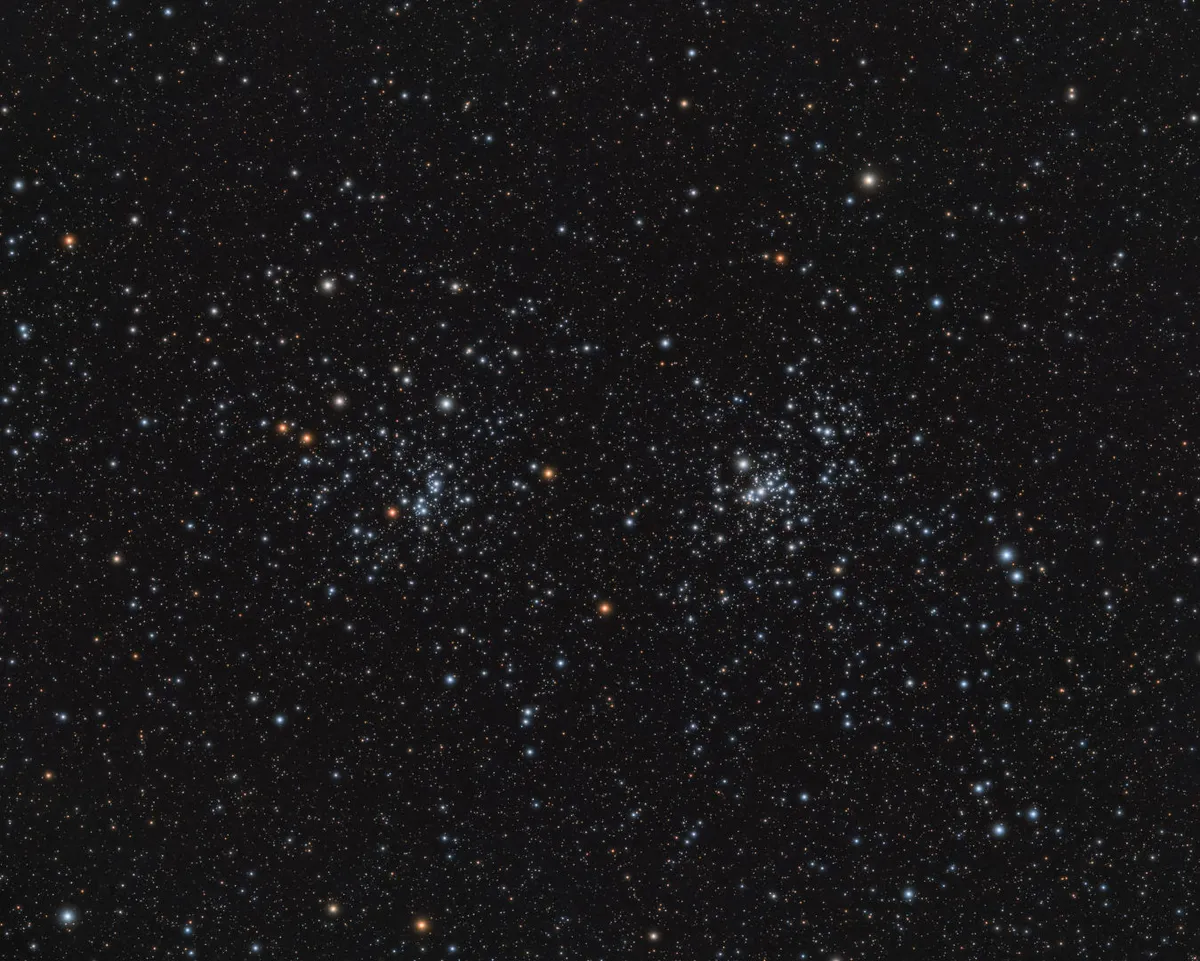
Look directly to the left of M31, halfway between a very distinctive ‘W’ of stars and a less distinctive upside-down ‘Y’ of stars.
There you’ll see another ‘smudge’ out of the corner of your eye.
This is the very famous Double Cluster and, as its name suggests, it’s not a lone star cluster but two very close together.
Although they’re visible to the naked eye, these clusters – which lie almost 7,000 lightyears away from Earth and contain many thousands of stars – will be a truly spectacular sight in your new telescope, looking like two glittering heaps of diamond dust in its lowest-power eyepiece.
You’ll naturally be tempted to boost the magnification, but resist: if you push it too high, you’ll only be able to see a small part of the cluster, not the whole thing.
5. M45, the Pleiades or Seven Sisters

Now look down to the lower right of the Double Cluster. You’ll notice a small knot of silvery-blue stars, about the size of your thumbnail held out at arm’s length.
If you have good eyesight, and your sky isn’t impacted too much by light pollution, you might count six or possibly seven stars, arranged in roughly the same shape as the Big Dipper.
This is the famous Pleiades, or Seven Sisters, a lovely star cluster 430 lightyears away.
Once it’s centred in your telescope’s lowest-magnification eyepiece, you’ll see a lot more than seven stars twinkling away – you’ll see hundreds!
In fact, even your widest view may struggle to show the whole cluster.
And boosting the magnification will fill your view with thousands of stars, like jewels spilled on black velvet.
It really is a magical sight to savour on your first night with your new telescope.
Now go inside for a well-earned cup of tea. Come back out again in a couple of hours, when the objects in the second half of our tour have had time to rise higher in the sky…
PART TWO
Continue from 9pm…
6. Jupiter

Now that you’ve warmed up, take a look towards the southeast and you’ll see a strikingly bright blue-white ‘star’ blazing almost halfway up in the sky.
This is another planet: mighty Jupiter, the biggest planet in our Solar System.
It’s so huge, it could swallow up a thousand Earths, with room to spare. Unlike our own rocky planet, Jupiter is a gas giant, an enormous bloated ball of gases and liquids with no solid surface, 630 million km (391 million miles) away!
Once you’ve found it in your telescope’s lowest-power eyepiece, push the magnification until you can see the planet’s pale, creamy disc is flattened at its poles and that several dark, horizontal bands of cloud cross its disc.
You might even catch a glimpse of its famous Great Red Spot, a hurricane larger than Earth, close to the edge of its disc.
Get more advice with our guide on how to observe Jupiter.
7. M44, the Beehive Cluster
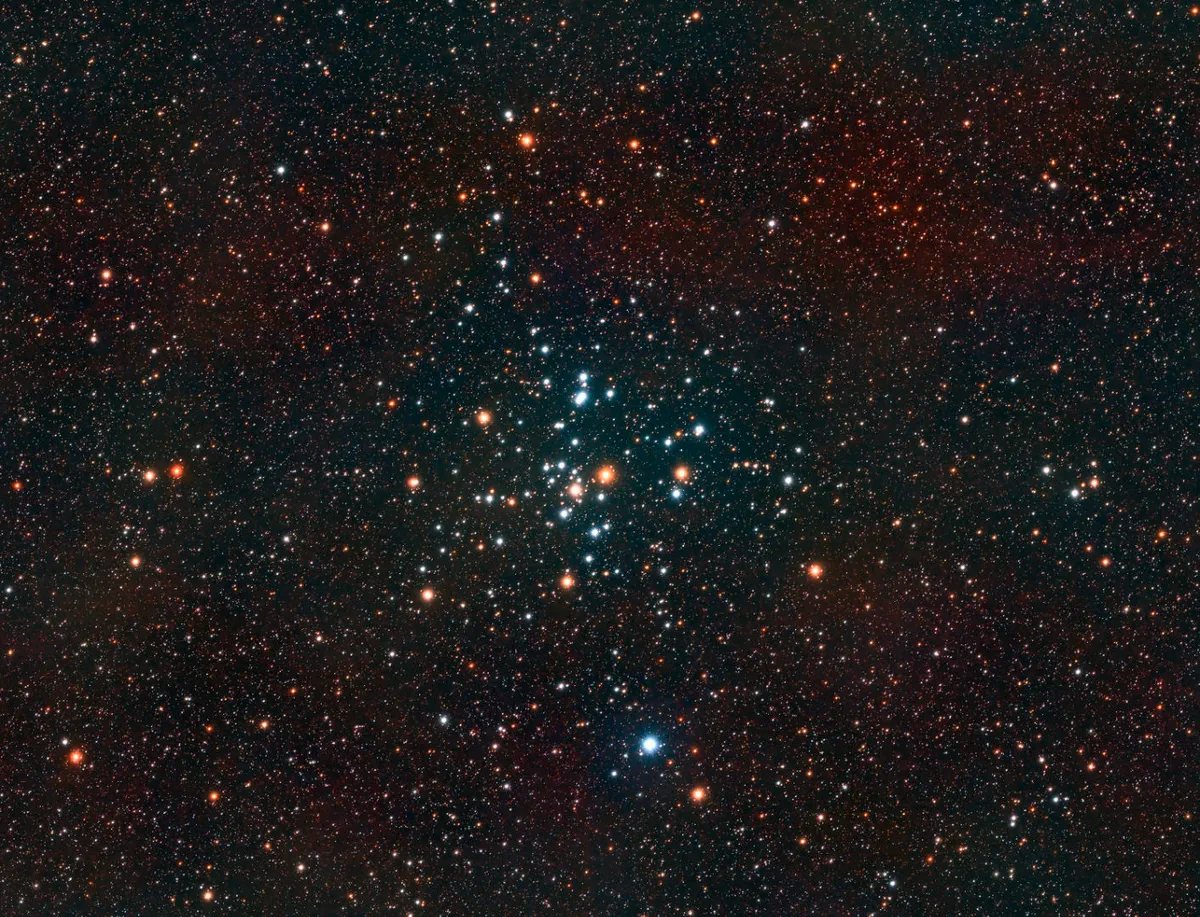
This next object might be a little tricky, so don’t be too hard on yourself if it takes a few attempts to find it, or even if you have to give up and try again another night.
Look to the lower left of Jupiter, around the ‘7 o’clock’ position, and you’ll see another fuzzy smudge out of the corner of your eye.
This is another star cluster, the Beehive Cluster, also known as Praesepe.
Located 610 lightyears away, it’s a lot fainter and more spread out than the Pleiades cluster you saw earlier, but it’s still very pretty in a low-magnification eyepiece and definitely worth a look on Christmas night.
If you boost the magnification with a more powerful eyepiece, you’ll see more stars.
However, unlike stars in the Pleiades, the Beehive’s members are all quite dim, so low magnifications will give you the best view.
8. M35
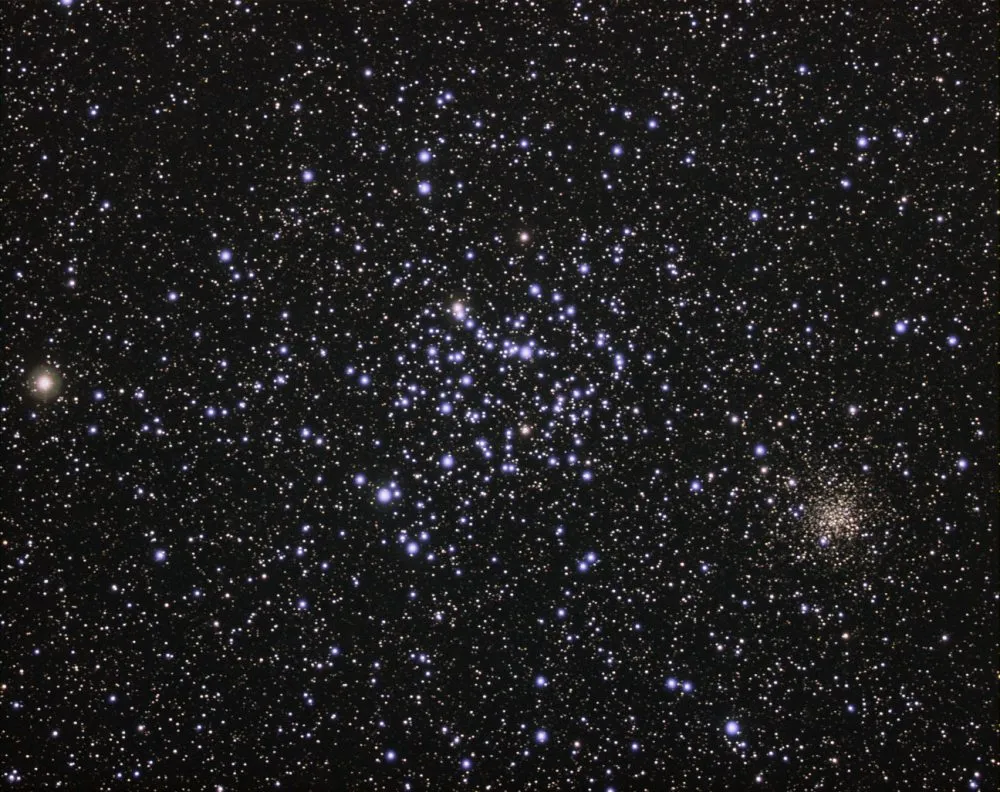
Next, look to the upper right of Jupiter, not too far away from the planet, and there in the constellation of Gemini is another very pretty star cluster: M35.
For most people, it’s on the borderline of naked-eye visibility, so don’t worry if it takes some finding on your first night.
To track it down, start from Castor and Pollux, the two brightest stars in Gemini, and star-hop to a line of three stars of roughly the same brightness (as shown on the chart).
Just above those stars lies M35, a star cluster more than 3,000 lightyears from Earth.
In your low-power eyepiece, M35 will look like a smaller, denser version of M44, the Beehive Cluster you saw earlier.
Higher magnification will make it easier to spot by increasing the contrast between the cluster and the surrounding dark sky.
9. M42, the Orion Nebula

Now, look to the right of Jupiter and you’ll see an hourglass-shaped pattern of stars, with a line of three blue-white stars across its centre.
These stars are Orion’s Belt – so, obviously, we’re now in the constellation of Orion, the Hunter, the most famous constellation in the northern winter sky.
Looking just below Orion’s Belt, on the left you’ll see Orion’s Sword, a shorter line of three much fainter stars.
Aim your telescope at the middle ‘star’ and you’ll discover it’s no star at all, but a beautiful, hazy cloud.
This is the famous Orion Nebula, a vast cloud of gas and dust 1,400 lightyears away, where stars are being born.
You’ll have seen its spectacular red, green and purple colour on photographs, but you’ll only see it as a very pale grey-green colour through your telescope.
Use low magnification for the full sweep, but boost the magnification to see baby stars shining in the heart of the nebula.
10. Sirius

You’ve arrived at the final stop on our Christmas night tour, and it’s a fitting finale: Sirius, the brightest star in the entire night sky.
It might seem a puzzling pick: it’s a star, and amateur telescopes can’t make stars look any bigger, right?
That’s true, but this star through a telescope is simply amazing – and that’s a good enough reason!
Sirius is only nine lightyears away from us, and you’ll find it blazing away low in the southeast with a fierce silvery-blue light, just above the trees or rooftops.
Find it by following the line of Orion’s Belt down to the left.
Through a low-magnification eyepiece, Sirius will be strikingly bright, but switch to a higher magnification and it will be dazzling, shimmering and dancing like a diamond turning in the sunshine.
Share your Christmas Night adventures and images with us by emailing contactus@skyatnightmagazine.com