Ever seen something odd in night sky and wondered what it’s all about?
Maybe a transitory flash that made you question whether or not you were seeing things, or perhaps something so odd it made you question reality.
Read more

Transient flashes are surprisingly common across the night sky.
If you've seen something in the night sky you can’t explain, this guide is for you. Here, we'll take you through what lies behind those odd lights.

Tumbler satellites
The most typical source of a transient flash is the reflective flat panel on a satellite, sending a glint of sunlight in your direction.
A tumbler is a satellite that spins as it orbits and this often creates such flashes.
If it’s a tumbler, keep watching as there may be additional flashes along the satellite’s sky track.
These craft often create the dashed or dotted trails that you see on wide-angle night-sky photographs.
While tumblers describe satellites flashing as they move across the sky, flashes can also occur from apparently static sources.

Geosynchronous satellites
The larger a satellite’s orbit around Earth, the slower it moves.
A typical low-Earth-orbit satellite takes around 90 minutes to go around. However, a satellite positioned far enough out – 35,786km (22,236 miles) out, to be precise – will match Earth’s rotation.
That makes the satellite appear stationary over the same location on Earth.
From the ground, these geosynchronous satellites appear scattered along a band running parallel with the celestial equator (the projection of Earth’s equatorial plane into space).
From the UK, you’ll see this band about 7.5° to the south. It’s known as the Clarke Belt after the science-fiction author Arthur C Clarke, who is credited with the idea of using geostationary satellites for communications.
In images of star trails (long exposures taken with a fixed camera), geosynchronous satellites appear as fixed dots, while tracked long exposures show them as trails.
On rare occasions, you can see them with the unaided eye, glinting as they reflect sunlight.
The best time to see them is around the equinoxes, in the early hours of the morning, when they may appear as a small, faint, fixed-position flash in the sky.

Satellite trains and the Space Station
While we’re talking artificial satellites, it’s worth mentioning another weird effect to look out for.
Satellite trains, where numerous satellites are released for service at the same time, creating a string of dots moving across the sky.
The International Space Station can also appear as a very bright, fast-moving and steady point of white light, often exceeding the brightness of Venus, typically taking 2–7 minutes to cross the sky.

Fuel dumps and meteors
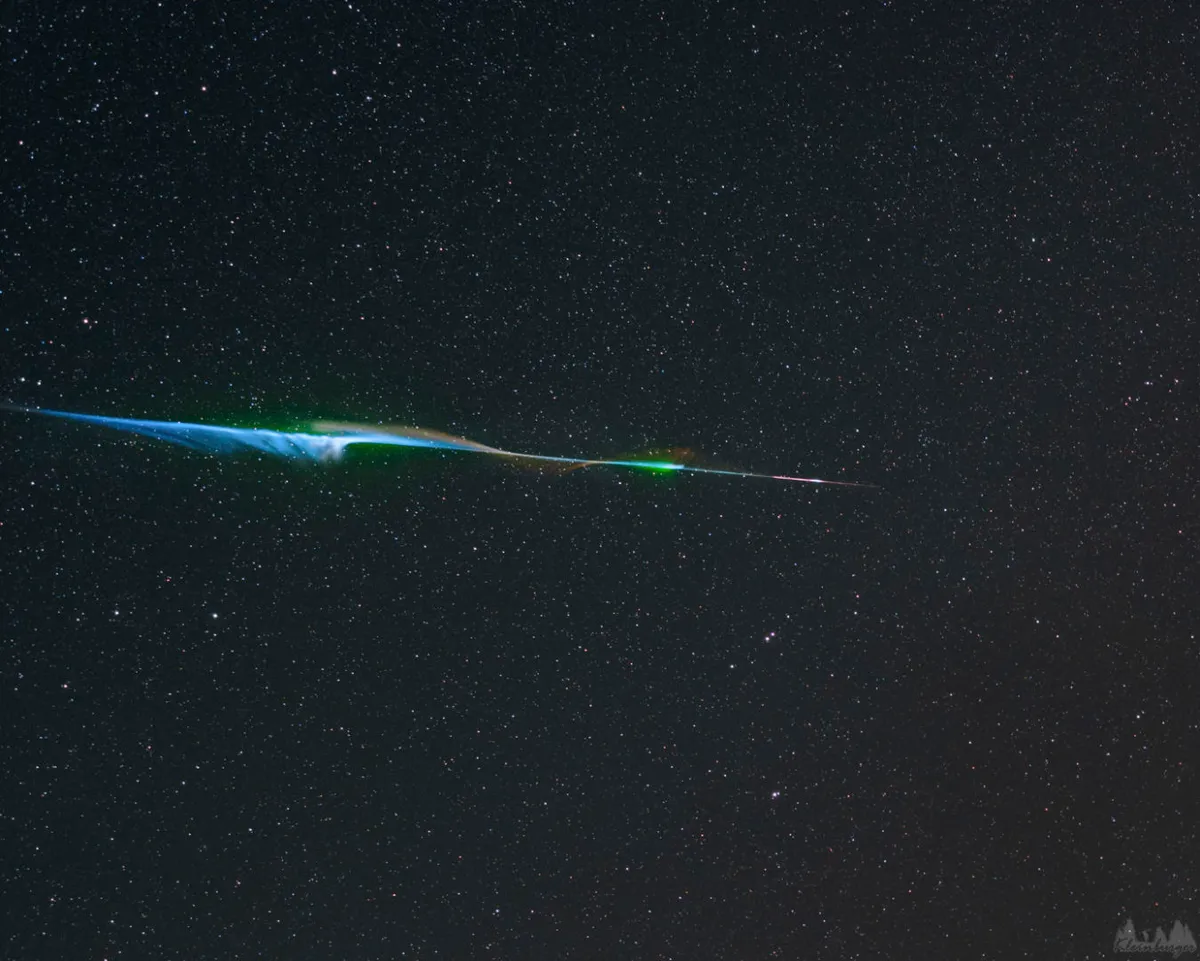
Then there’s the short-lived and really odd effect caused when a lifting craft, commonly a SpaceX Falcon 9, performs a fuel dump after a launch.
The cloud of released fuel forms a small, expanding ice cloud in the atmosphere, often shaped by the host craft’s rotation.
This can appear as a large, fast-moving, expanding spiral glow in the sky. It really looks extremely other-worldly, like a portal into another dimension.

Blue satellites
Blue satellites recently started appearing on widefield images of the night sky and look like intensely blue trails.
The cause is an anti-reflective, dielectric coating on later Version 2 Starlink satellites, applied to mitigate light-pollution effects.

Meteors
Although satellites are the most common cause of flashes (after aircraft, which most people will easily identify), there are natural causes too.
For example, meteors typically travel at an angle to your line of sight, creating a streak of light known as a meteor trail.
If a meteor shower is active, its trail appears to emanate from a small patch of sky called the shower radiant – an effect caused by perspective.
However, occasionally a meteor will be on a trajectory that’s exactly on your line of sight – then it looks like a point of light, and sometimes rather bright.
This is a pin-point meteor and if the one you’re seeing starts to get outrageously bright, the best advice is to run!
Of course, a regular fireball can look pretty impressive as well, especially if it ends with what’s known as a terminal burst, the meteor exhibiting an explosive flash at the end of its track.

Sprites and superflares
Although astronomers tend to avoid bad weather, distant storms can also produce weird flashes.
As well as the obvious flash of a lightning strike, short-lived, high-altitude electrical discharges can sometimes be seen on top of storm clouds.
Known as Transient Luminous Events or TLEs, these include exotic phenomena such as sprites, blue jets and elves.
Another, more sci-fi-sounding mechanism is a stellar superflare.
They have been seen on other stars and, intriguingly, occurred relatively recently on our nearest stellar neighbour, Proxima Centauri.
The event, on 18 March 2016, was significant enough to be seen with the unaided eye.
If you’re wondering whether our Sun can produce them, the jury’s still out.
Some believe they occur every 1,500 years or so, while others think the Sun’s activity is too low.
If one does occur, we’ll certainly know about it, as it will have the potential to wreak absolute havoc.