
A lunar eclipse will be visible on March 3, 2026 over North and Central America, East Asia and Australia.
This event is known as a 'blood Moon' lunar eclipse and occurs when the Moon is full.
Get key locations and timings for the March 2026 blood Moon.
More on lunar eclipses

If you're a complete beginner wondering what all the fuss is about and how you can see it for yourself, read on.
Here are our top tips for beginners wanting to see the March 2026 blood Moon lunar eclipse.

For weekly stargazing advice delivered to your email inbox, sign up to receive the BBC Sky at Night Magazine e-newsletter.
Mark your calendar
The total lunar eclipse will take place on March 3, 2026.
This 'blood Moon' occurs during the March full Moon, which is also known as the Worm Moon, as a reference to the first full Moon of spring, when earthworms become active once again.
Last chance to see a blood Moon until 2028
This is the only total lunar eclipse of 2026. If you miss it, you’ll have to wait until New Year’s Eve 2028 to see another one.
There will be partial lunar eclipses visible in 2027, but there won't be a total lunar eclipse visible anywhere on Earth again until 31 December 2028.

Why it’s called a ‘Blood Moon’
During the eclipse, the Moon turns a dark, rusty red or orange colour.
This happens because the Moon is on the opposite side of Earth from the Sun.
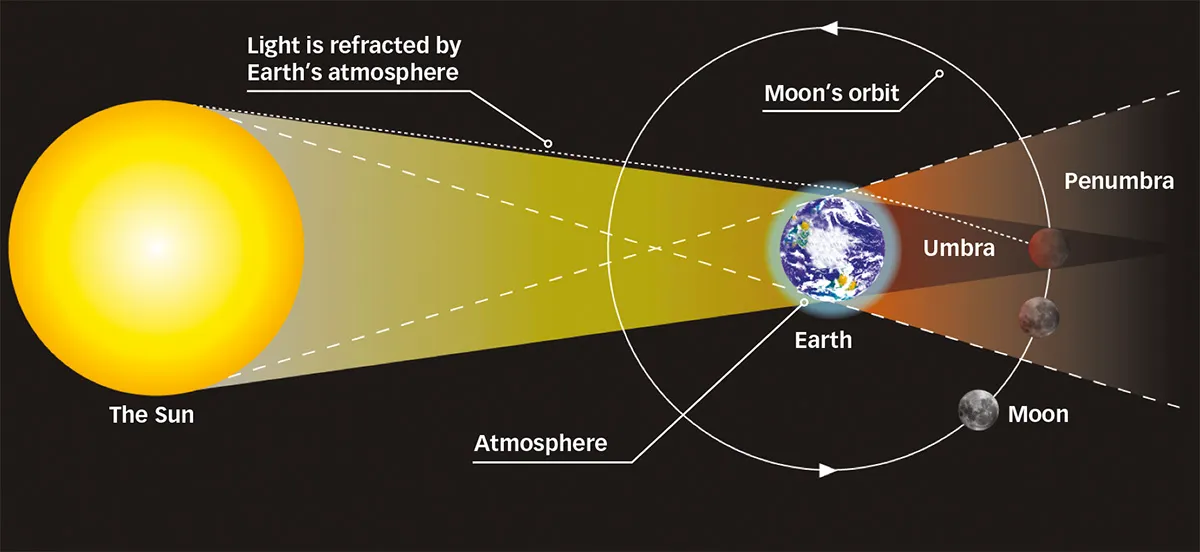
On its way to the Moon, sunlight passes through Earth’s atmosphere, which filters out blue light and bends longer red wavelengths towards the lunar surface.
Location is key
The best places to see the eclipse are North America, the Pacific, Australia and East Asia. The lunar eclipse will not be visible to observers in Europe or Africa.
In North America, the further west you are, the better. In states like California, for example, the whole lunar eclipse will be visible, beginning shortly after midnight on March 3.
In the eastern parts of the world, the further east you are the better, with eastern Australia getting to see the lunar eclipse after sunset on March 3.

Perfectly safe – no special equipment needed
Unlike a solar eclipse, you don't need eclipse glasses to watch a lunar eclipse.
Eclipse glasses are required when observing a solar eclipse because that involves directly observing the Sun, which you should never do with the naked eye.
Observing a lunar eclipse involves observing sunlight bouncing off the Moon, which is perfectly safe.
You can observe a lunar eclipse with the naked eye. It's safe for adults and children alike.
Why lunar eclipses happen
A total lunar eclipse occurs when the Sun, Earth and the Moon align exactly.
You are essentially seeing Earth’s shadow cast onto the surface of the Moon, as our planet passes between the Moon and the Sun.
Timing for North America
If you're in North or Central America, you will need to be up in the early morning on March 3 to see the lunar eclipse. For those in the Northern Hemisphere, look to the west.
The further west you're located, the earlier after midnight you'll need to look, but the more of the eclipse you'll see before the Moon sets.
That's because a lunar eclipse occurs at full Moon, when the Moon is opposite the Sun in the sky, and therefore sets around sunrise.
Timing for East Asia, Australia
Unlike North America’s early morning viewing, viewers in East Asia and Australia will see the Blood Moon during the evening of March 3.
And in contrast to North America, in this part of the world you'll get to see more of the eclipse the further east you are.
So viewers in India, for example, will need a flat eastern horizon to see the already-eclipsed Moon rise.
In eastern Australia and Japan, on the other hand, the entire event is visible from start to finish.

When to start watching
The eclipse begins at 09:50 UTC (04:50 EST) as Earth’s shadow creeps across the Moon.
Totality, when the Moon turns red, begins at 11:04 UTC (06:04 EST).
Peak blood Moon
To see the red 'blood Moon' at its peak intensity on March 3, aim to be looking at the sky at 11:33 UTC (06:33 EST).
This is the prime time to witness the deepest red colour.

Use your phone or tablet to help
To make sure you're looking in the right direction from your specific location, use a stargazing app.
This will help you pinpoint the Moon’s position ahead of time so you can find a clear viewing spot.
Missing out? Watch online
If you're located in Europe or Africa, or if the weather is poor, you can still watch the event via live-streams from institutions like NASA, Griffith Observatory, TimeAndDate.com or the Virtual Telescope Project.
An added bonus – the Lion's Heart
During the March 3, 2026 lunar eclipse, the Moon will be located in the constellation Leo.
Keep an eye out for a bright star nearby. That’s Regulus, the brightest star in Leo, and known as the Lion's Heart.
It forms the bottom of the Sickle star pattern, which looks like a backwards question mark.
Regulus which will be much easier to see as the Moon dims and turns red.
If you observe or photograph the March 3, 2026 lunar eclipse, get in touch by emailing contactus@skyatnightmagazine.com

