In 2025, astronomers detected a strange signal of data – a 'blast' from space – that lasted for a total of seven hours.
Now, a science team believe they've worked out what it was. It could have been an unusually long example of an intense source of energy known as a gamma-ray bust.
Gamma-ray bursts are bursts of high-energy radiation that scientists detect using instruments on Earth in the form of gamma rays.
The mystery of these strange signals from deep space goes all the way back to the 1960s, when US military satellites first detected them.
More amazing space science

At the height of the Cold War, the US military was searching for nuclear detonations on Earth, when they picked up ferocious bursts of gamma rays coming from the sky.
They didn’t know what they were, but gave these strange signals the name 'gamma-ray burst', since that's what they were.
Much later, astronomers were able to fill in some of the missing pieces of the puzzle and begin to understand the physical processes that cause them.
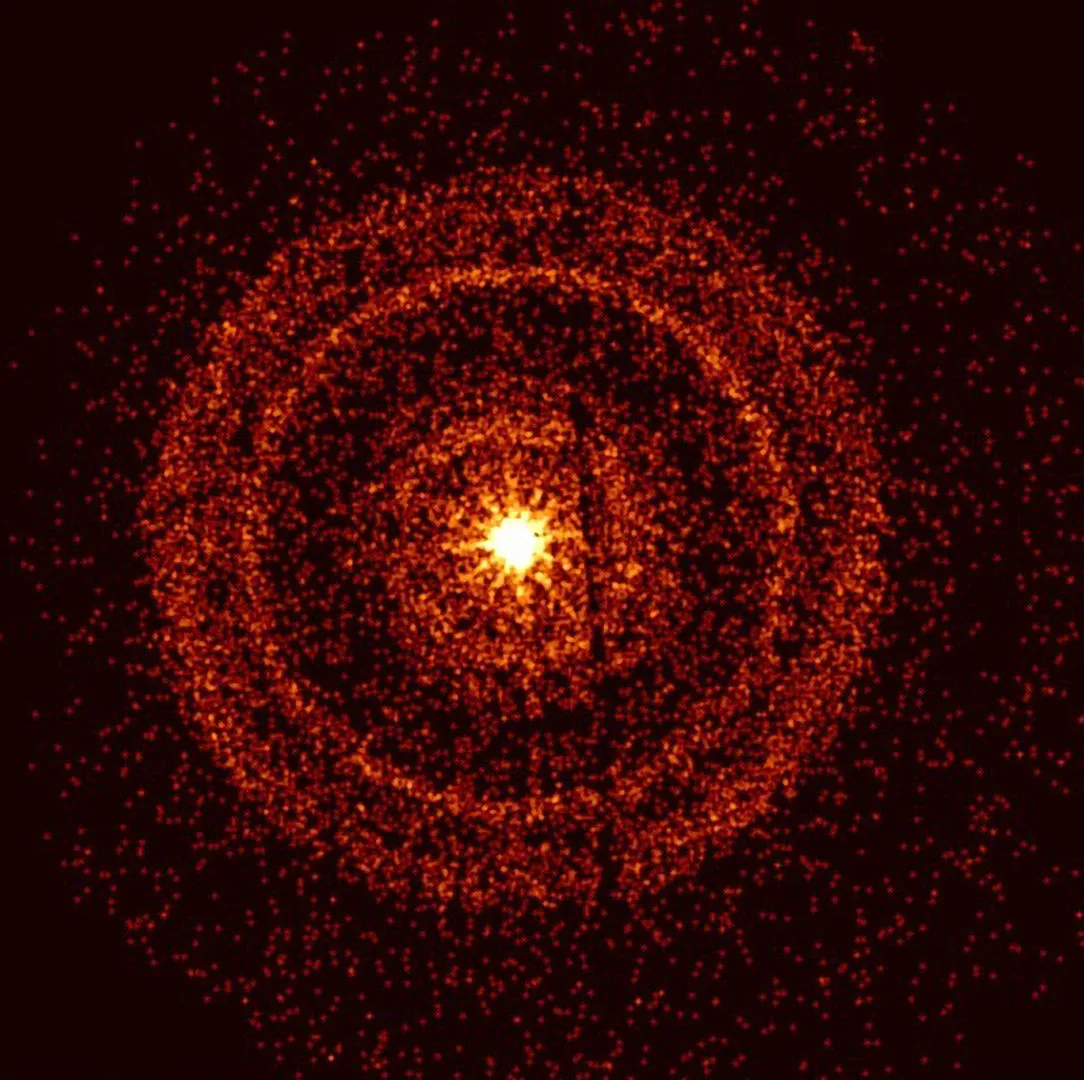
In 2025, astronomers detected a blast lasting seven hours, which has been given the name GRB 250702B.
Now, a team have uncovered the unusual processes behind the unprecedented outburst.
Eliza Neights is a researcher at NASA Goddard Space Flight Center who studies the science behind gamma-ray bursts and what causes them
We spoke to her to find out more about this incredible signal and what it tells us about the mysteries of the Universe.

How do scientists detect gamma-ray bursts?
Primarily we use widefield, high-energy monitoring, typically with space telescopes that see a very large part of the sky at a time.
They scan everything at once and pick up anything that looks like a bright pulse compared to the background noise.
I’m what’s called a ‘burst advocate’ for the Gamma-ray Burst Monitor on NASA’s Fermi Space Telescope.
That means I take six or so shifts a month and any time the telescope sees something that looks like a bright flash of gamma rays, it automatically sends the data to whoever’s on duty.
It’s up to us to determine the nature of the event and alert the scientific community.
What did you discover?
Earlier this year, we detected a gamma-ray burst named GRB 250702B.
I was on duty at the time the instrument detected its very unusual pattern: three gamma-ray bursts that appeared to be coming from the same place in the sky.

What was so special about GRB 250702B?
It’s the longest-lasting GRB ever recorded. By combining data from five high-energy telescopes,
we figured out that it lasted around seven hours, or 25,000 seconds. That’s an extreme duration.
For context, average GRBs last no more than several minutes, and the last record holder was around 15,000 seconds. GRB 250702B’s duration cannot be explained by the known origins of GRBs – it needs a novel physical explanation.
What usually causes GRBs?
There are two processes that are known to lead to GRBs.
Most originate from the collapse of a rapidly rotating, massive star. These stars collapse into compact objects, probably black holes, which form powerful jets.
We detect these jets as gamma-ray bursts when they happen to point towards us.
Some other GRBs occur when two neutron stars – very dense stellar remnants – are orbiting each other and then merge.
Once again, a compact object forms that produces jets which we can detect.

What else could have caused GRB 250702B?
It’s most naturally explained by a ‘helium merger’. This is where you have a black hole with a mass about that of a star and it’s in orbit with a helium star.
These stars have had their outer layers of hydrogen stripped away, leaving a dense core of helium, and they’re thought to go through phases of expansion.
When they expand, the orbiting black hole will end up inside the stellar envelope and consume the star rapidly.
Suddenly, you have all of this angular momentum being transferred into the black hole, which can give rise to a jet which lasts a long time.
Why have so few of these long bursts been seen? Are they rare?
They may be less common than other GRB progenitors, but also GRBs with extreme durations are harder to spot for telescopes that are looking for short, bright signals.
They’re also dimmer, which limits the distance we can detect them over.
What’s next?
I’m involved with the Compton Spectrometer and Imager (COSI) telescope, a gamma-ray survey telescope due to be launched in 2027.
I’m preparing it for the detection and analysis of GRBs and I’d like to make sure it’s equipped to detect GRBs with extreme durations.
Hopefully, this will help us to observe more of them and fully understand the physical processes behind them.
This interview appeared in the February 2026 issue of BBC Sky at Night Magazine