
If you're out looking at the lunar eclipse this morning – or tonight, depending on where you're observing from – here are some quick tips to help you make the most of it.
The total lunar eclipse of March 3, 2026 is your last chance to see a 'blood Moon' until New Year's Eve 2028, and it's only visible in North America, East Asia, Australia and New Zealand.
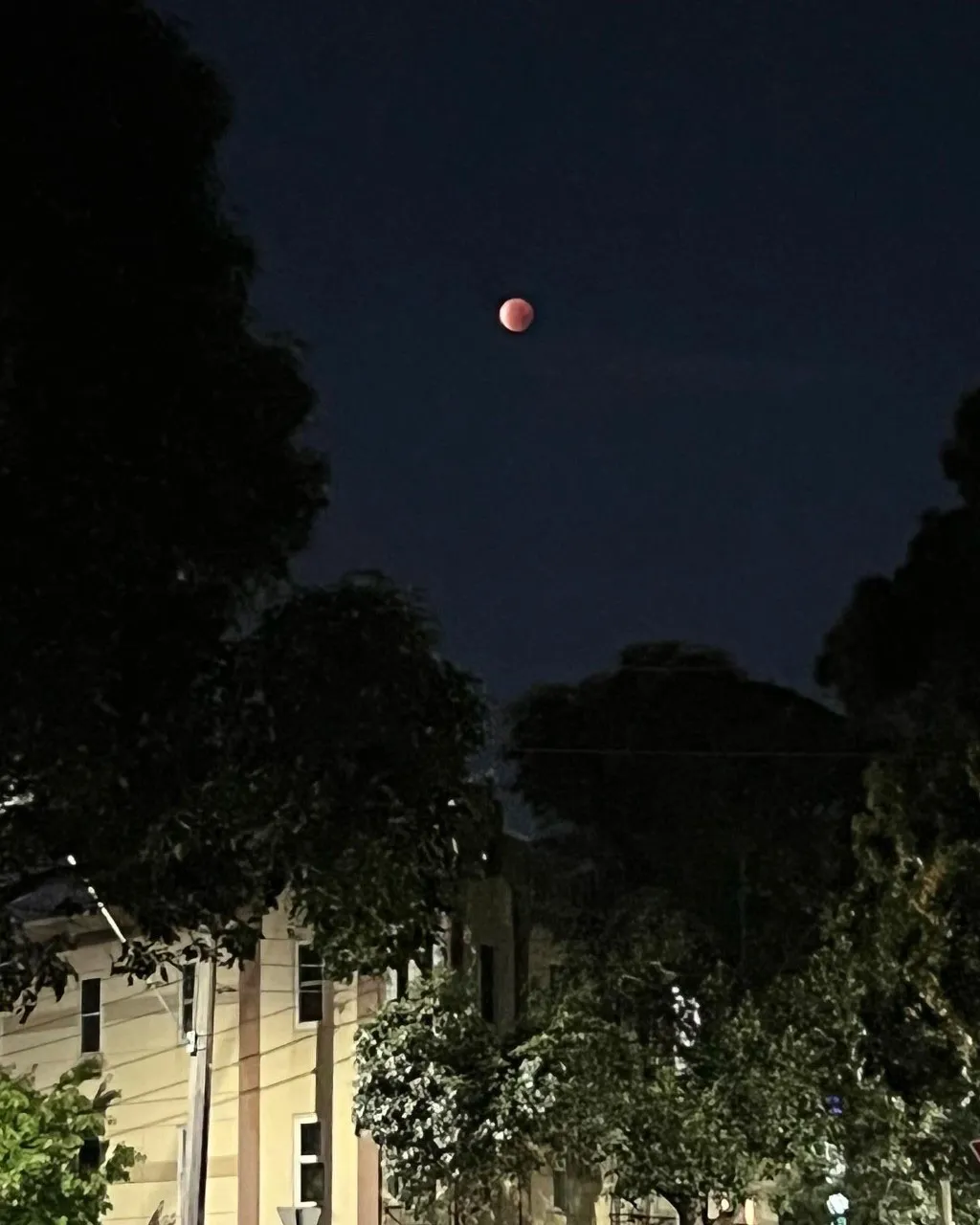
That makes this lunar eclipse pretty special. The full Moon will pass into Earth’s shadow, turning a deep copper red during the totality phase.
Here we'll reveal a quick 'cheat sheet' for catching the lunar eclipse, with some tips on how to capture a photograph of it with your smartphone.
More on the lunar eclipse

When to look
Here are the timings in UTC for the lunar eclipse, from the moment Earth's shadow touches the edge of the Moon, through totality – the key 'blood Moon' bit – and up until the moment the eclipse ends.
UTC is 'Co-ordinated Universal Time', so you'll need to adjust the timings accordingly, depending on what time zone you're viewing from.
- Penumbral eclipse begins: 08:44
- Partial lunar eclipse begins: 09:50
- Totality begins: 11:04
- Peak totality: 11:33
- Totality ends: 12:03
- Partial ends: 13:17
- Penumbral ends: 14:23
Here's a calculator to help you convert the UTC times into your own time zone.
- NZDT: UTC +13
- AEDT: UTC +11
- JST/KST: UTC +9
- CST/AWST: UTC +8
- ICT/WIB: UTC +7
- PST: UTC -8
- MST: UTC -7
- CST: UTC -6
- EST: UTC -5
Where to look
If you're in the western part of the world, such as North America, you'll need to look to the west in the early morning, and potentially not long after midnight.
If you're in the eastern part of the world, like in Australia or Japan, you'll need to look to the east in the evening.
And if you're viewing on the east coast of North America, you might be able to catch a phenomenon called 'selenelion', also known as the 'impossible' eclipse, because it describes the moment when the Sun and the lunar eclipse are visible at the same time.

The Sun will be rising in the east just as the eclipsed Moon is low in the west. This is 'impossible' because the full Moon should be below the horizon when the Sun is above the horizon.
But the distorting effects of Earth's atmosphere cause a refraction – a bending – of light from the Moon, making the Moon appear higher in the sky than it really is.
If you're located in the Eastern Time Zone, you're in a good spot. Find yourself a clear horizon and see if you can catch the Sun and lunar eclipse at the same (making sure not to observe the Sun directly with the naked eye).
Get full locations and timings for the March 2026 blood Moon.
Photograph it with your smartphone
Are you mere minutes away from the lunar eclipse starting? You could decide to capture an image of the lunar eclipse with your smartphone.
Doing so is a bit of a double-edged sword. On the one hand, you've captured an image of the blood Moon you can share online or with family and friends.
On the other hand, you could end up spending the peak of the event looking down at your phone rather than up at the Moon.
If you do want to try, here are some tips to help.

Make the most of your phone's camera modes
Your phone's auto settings are unlikely to be of much help here. Does your phone have a 'night mode' or 'astrophotography mode' that's better suited? If not, put your phone into manual or 'pro' mode and you'll be able to tweak the exposure time, ISO, white balance and other settings.
Stabilise your phone
If you don't have a smartphone tripod, see if you can prop it up against a wall or any other stable object: anything that will get your phone sitting steady and avoid moontrailing caused by a shaky hand.
Use magnification, if you have it
Did you bring a telescope or a pair of binoculars to observe the lunar eclipse? You could attempt 'afocal photography', which is a fancy way of saying 'pointing your phone's camera down the eyepiece'. This is tricky, though, and ideally you would use a smartphone telescope adapter.

Lock the focus
Get the Moon centred in your smartphone's screen, tap on it and hold to lock the focus.
Tweak your exposure and ISO
One of the biggest issues in photographing the Moon with a smartphone is over-exposure, when the Moon ends up looking like a featureless white blob.
At the start of the eclipse, you'll need a low ISO to get the best shot, but as the Moon dims during totality, you should be able to push the ISO up a bit more.
Don't pinch and zoom
Unless you're using binoculars or a telescope, the Moon will look tiny in your screen. Resist pinching the screen to zoom in. It's better to capture the image and then crop and zoom later on your computer, using picture-editing software like Photoshop (paid-for) or GIMP (free).
For more info, read our guide on how to photograph the Moon with a smartphone.
Clouded out? Watch online
If you've got up early or are staying up late to watch the lunar eclipse, it will be disappointing if it's cloudy where you are.
You could stick with it, in the hope that the cloud clears by the time the Moon turns red. Or you could watch online.
If you decide to head back indoors to watch a live-stream of the event instead, read our guide to watching the March 2026 blood Moon online.
Share your eclipse adventures and images with us by emailing contactus@skyatnightmagazine.com

