
The discovery of a black hole in one of the oldest objects in the Universe could mark the beginning of astronomers finally solving a cosmic mystery that's lasted decades.
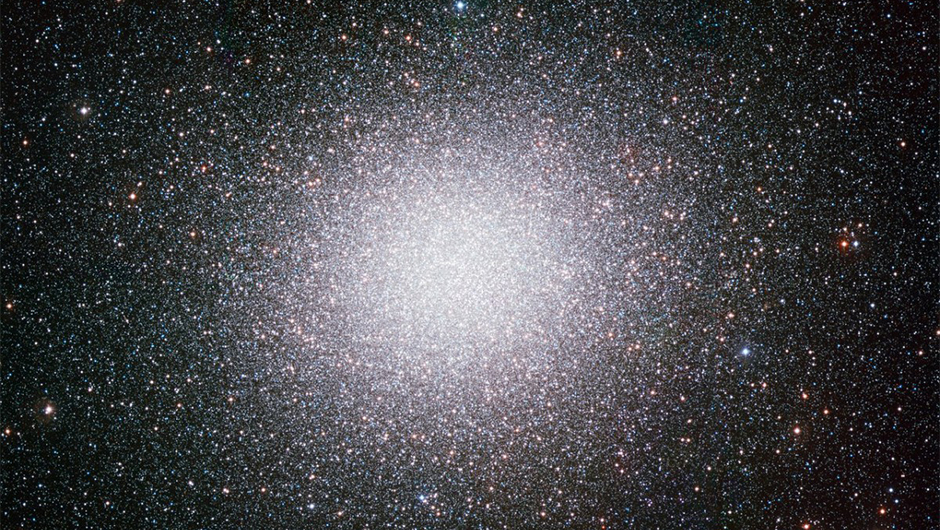
Omega Centauri is a massive globular star cluster, which are densely-packed pockets of stars held together by gravity – and among the oldest cosmic objects.
Astronomers say Omega Centauri should be filled with black holes formed from exploding stars, but none had ever been detected – until now.
More Hubble science
Back to the archives
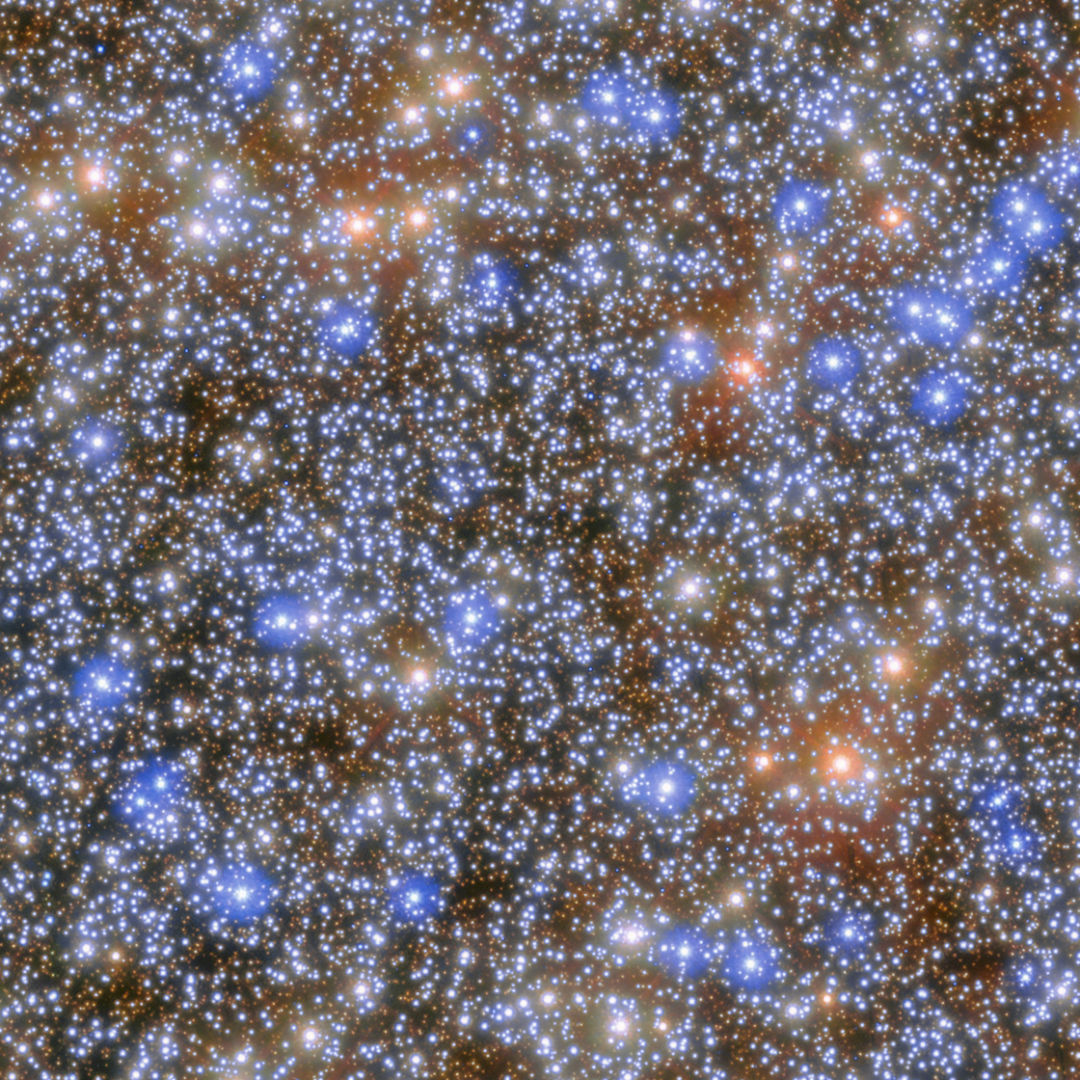
Omega Centauri is made up of about 10 million stars, all bound together by gravity.
And although astronomers had previously found evidence of an intermediate-mass black hole at the centre of Omega Centauri, they had been unable to locate any of the 10,000 smaller, stellar-mass black holes the globular cluster was predicted to contain.
Astronomers have used archive data from the Hubble Space Telescope and observations by the James Webb Space Telescope to locate the first ever discovered stellar-mass black hole in the cluster.
They say the find will help refine theories on black hole formation within environments like Omega Centauri.
Strange stellar movements lead the way
The team used a technique known as astrometry, which focuses on the movement of stars over time.
They looked back over more than 20 years of Hubble archival data and used more recent Webb data to refine their astrometric measurements.
The result was the discovery of a single star within the cluster that's orbiting an invisible object so massive it must, the team say, be a black hole.
Named oMEGACat BH-2, it's the first stellar-mass black hole detected within Omega Centauri.
The team say oMEGACat BH-2 has a lower-than-expected mass and has the longest orbital period of any black hole binary system known to date.
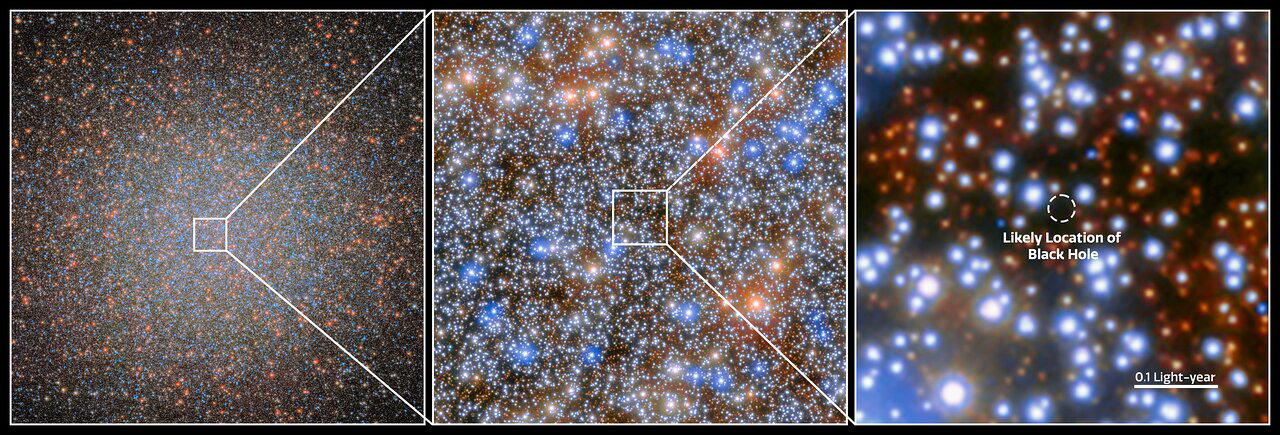
"With the Hubble and Webb data, we were able to see the motion of the visible main sequence star that is part of this binary, which is about 18,000 lightyears away in the dense environment of Omega Centauri," says the lead author Matthew Whitaker of the University of Utah, Salt Lake City, in the USA.
"The precision of these measurements is incredible, down to a fraction of a pixel on Hubble and Webb’s detectors. It would not have been possible to find this black hole without these two space telescopes."
The team’s findings also a refine a previous, different study suggesting the binary system consisted of a star and a neutron star, as opposed to a star and a black hole.
"While we already knew that the star was 0.78 solar masses, we can now calculate the black hole’s mass, which is 4.46 solar masses and therefore too heavy to be a neutron star," says Anil Seth of the University of Utah, a coauthor of the study.
"However, its mass is actually much lower than would be expected in a metal-poor environment like Omega Centauri. This is surprising and exciting.
"We now know that a metal-poor star should be able to form a black hole like this, and we need to figure out how that happens. This detection is providing some data to those who do that kind of modelling."
Looking back in time
The data also enabled the team to chart the star’s path over 20-plus years, determining that the visible star orbits the black hole once every 94 years.
That makes it the longest period black hole binary ever known.
The team also say the black hole and the star probably didn't form together, but formed separately and came together within the cluster.
They say oMEGACat BH-2 will survive for less than a billion years before it 's torn apart by encounters with nearby stars.
"It’s important to understand black hole populations in globular clusters because there’s uncertainty about their physics and formation," says Seth.
"More specifically, understanding the process of forming black holes and then dynamically forming binaries is vital, because it affects our ability to interpret and understand gravitational wave events.
"Environments like Omega Centauri are the primary places where we think binaries are merging and creating these waves."
Read the full paper at the Astrophysical Journal Letters

