
One of the first major astronomical events of 2026 is the annular solar eclipse taking place this week, 17 February.
The only catch, however, is that you're statistically very unlikely to see it.
This annular solar eclipse – also known as a 'ring of fire' eclipse, is only fully visible from Antarctica, but there are other regions of the world where a partial solar eclipse will be visible.
Here are some of the key facts to know about the 17 February 2026 annular solar eclipse.
This eclipse will be a ring of fire

Solar eclipses happen when the Moon passes in front of the Sun, from our perspective on Earth.
By a sheer coincidence of nature, the Sun and the Moon appear to be the same size in Earth's sky, because the Sun is about 400 times the size of the Moon, but also 400 times further away.
That means that, when the Moon passes directly in front of the Sun, it covers the Sun exactly, and we call this a total solar eclipse.
However, sometimes when the Moon passes in front of the Sun, the Moon is slightly further from Earth, and doesn't cover the Sun exactly.
That leaves a thin ring of sunlight visible around the Moon. This is known as an annular solar eclipse, or a 'ring of fire' because it looks like a ring of bright light surrounding the darkened Moon.
That's what's happening on 17 February 2026. The begins at 09:56 UTC and ends 14:28 UTC.
96% of the Sun will be covered

Sources say that up to 96% of the Sun will be covered by the Moon, during the full annular solar eclipse.
That may not sound like much, but it's enough to mean the sky won't go fully dark, as happens during a total solar eclipse.
And it means solar eclipse glasses will need to be worn for the whole event, regardless of where you're observing from.
More on that below.
Only a small number of people will see the full effect

You'll only get to see the full 'ring of fire' annular solar eclipse if you're located in Antarctica, or on a boat in the Antarctic Ocean!
For every solar eclipse, there's a path across a section of the Earth where, if you're standing within that region, you'll get to see the full eclipse.
In the case of a total solar eclipse, this is known as the path of totality. In the case of an annular solar eclipse, this is known as the path of annularity.
The crew of the Concordia Research Station in Antarctica, for example, are among those likely to see the full eclipse.
So too, the crew of the Russian Mirny Research Station, also in Antarctica.
That makes this particular ring of fire one of the hardest to see in recent memory.
Others will see a partial solar eclipse

While the full annular solar eclipse is out of the reach of most of us, some observers will get to see a partial solar eclipse.
That means that, if you're just outside the path of annularity, you'll see the Moon pass over a portion of the Sun, but not see the full 'ring of fire' effect.
On 17 February 2026, a partial solar eclipse will be visible in South Africa, Argentina, Chile, Madagascar, Mauritius and other parts of southern Africa, among other regions.
A full list of countries and territories that will see the eclipse is available via TimeAndDate.com, who report that around 176,000,000 people will get to see the partial eclipse.
You'll need eclipse glasses

Whether you're observing the partial solar eclipse or the full annular solar eclipse this week, you'll need to wear solar eclipse glasses.
During a total solar eclipse, at the point of maximum totality – when the Moon is fully covering the Sun – solar eclipse glasses may be removed temporarily.
But during an annular solar eclipse, the Moon doesn't completely block out the Sun, and so eclipse glasses must be worn for the whole event.
Eclipse glasses filter out the vast majority of harmful rays from the Sun, making it safe to look at the Sun directly.
That means you can observe all stages of a solar eclipse, provided you're wearing eclipse glasses.
You must make sure, however, that you're wearing proper, certified eclipse glasses bought from a reputable supplier.
And whether they're brand new or have been sitting in a drawer since the last solar eclipse, examine them for tears or scratches that could compromise their safety.
For more info, read our guide to making sure your solar eclipse glasses are safe.
It will be followed by a lunar eclipse

The annular solar eclipse of 17 February 2026 will be followed less than a month later by a lunar eclipse, occurring on 2/3 March 2026.
You might think this a coincidence, but if you're an experienced eclipse chaser, you'll likely know that eclipses often come in pairs.
That means that a lunar eclipse and a solar eclipse often occur within weeks of each other.
This is to do with the mechanics of the Sun-Earth-Moon system that cause an eclipse to happen in the first place.
A solar eclipse occurs when the Moon is between Earth and the Sun.
But the Moon orbits Earth once every 27.3 days, which means the Moon is between Earth and the Sun every four weeks, so why don't we get solar eclipses every month?
The Moon does pass between the Sun and Earth once every 27.3 days, and it's called new Moon.
But it doesn't always pass directly in front of the Sun, from our perspective.
Sometimes the Moon passes above the Sun, and sometimes below. It's only when the Sun, Moon and Earth line up perfectly that we get to see a total solar eclipse.
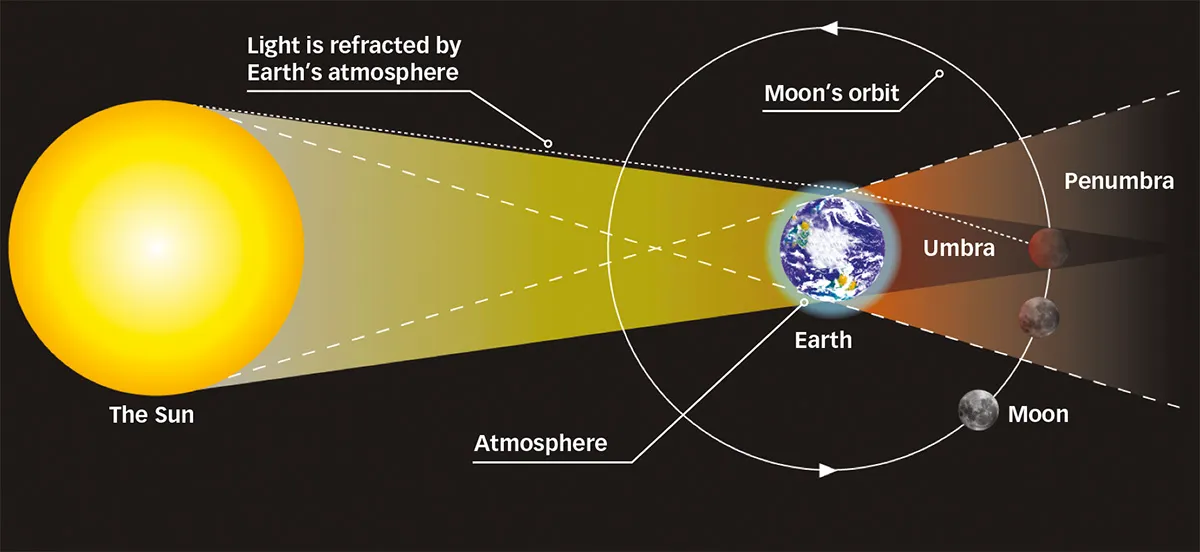
A lunar eclipse, on the other hand occurs at full Moon, when the Moon is on the other side of Earth from the Sun.
And just as not every new Moon is a solar eclipse, it's also the case that not every full Moon is a lunar eclipse.
But when conditions are right for a solar eclipse, when the plane of the Sun-Moon-Earth configuration is lined up to allow for a solar eclipse to be visible from Earth, that means that two weeks later, conditions are likely to be right for a lunar eclipse to occur.
The 2/3 March 2026 lunar eclipse will be visible from North and South America, parts of Asia, Australia and New Zealand.
So if you don't happen to live in Antarctica and won't be able to see this week's ring of fire eclipse, mark you calendars for the upcoming lunar eclipse in March 2026 instead.
If you do manage to observe the 17 February 2026 annular solar eclipse, send us your observations and images by emailing contactus@skyatnightmagazine.com

