Two of the largest objects in the asteroid belt, Vesta and Pallas, reach opposition (opposite the Sun in the sky) in October 2026.
Both are located in a similar part of the sky, in the constellation of Cetus.
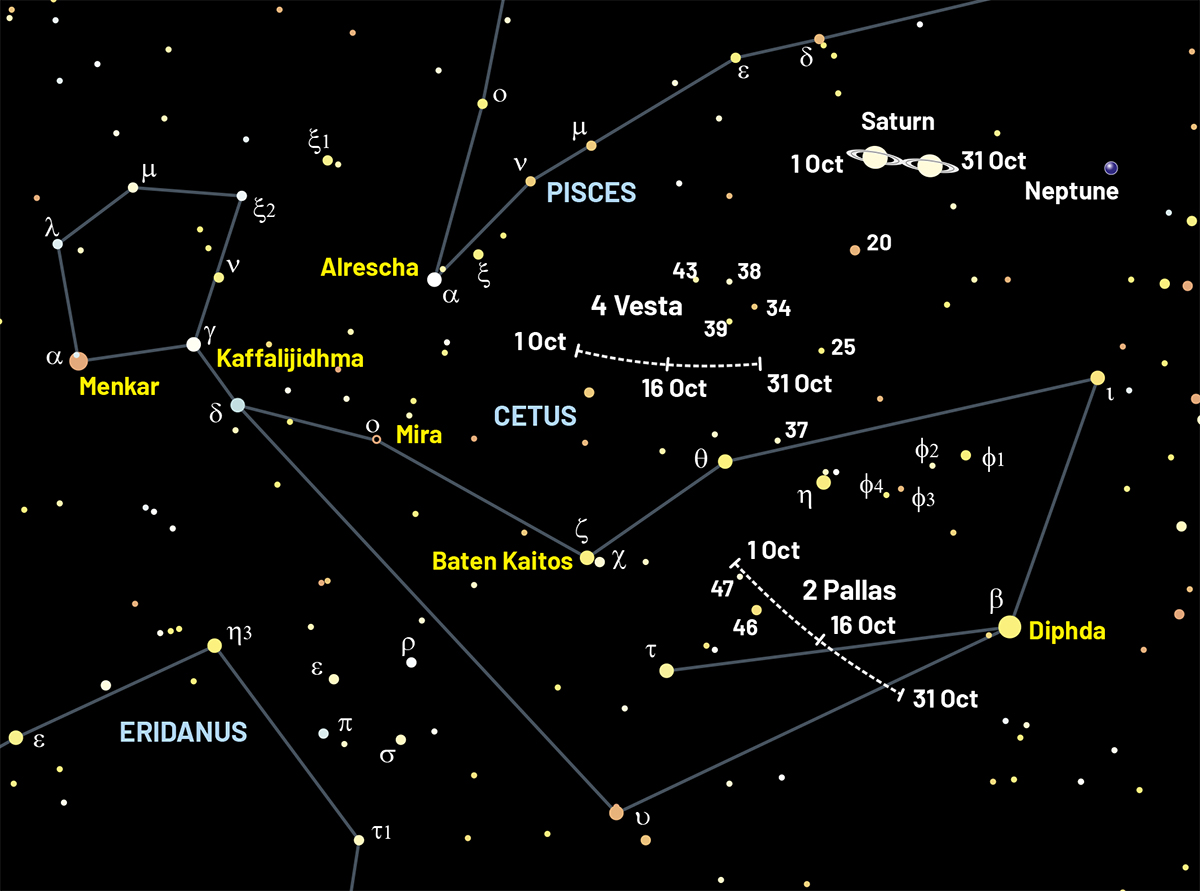
Pallas begins the month immediately north of mag. +5.2 47 Ceti. It then tracks southwest, passing the mid-point between mag. +3.5 Tau (τ) Ceti and Diphda (Beta (β) Ceti) on 20 October.
Throughout this period, Pallas remains small-telescope bright, appearing at mag. +8.2 on 1 October and only fading to mag. +8.5 by the end of the month.
Vesta can be found farther to the north and is bright enough to be seen through binoculars.
More stargazing

On a single evening, Vesta – and Pallas for that matter – will look just like unmoving stars, so the way to reveal that you’ve actually seen them is to record their positions either in a sketch or photographically and compare your results over several nights.
If you have the right objects, they will appear to move against the fixed starry background.
At this time, Vesta will appear at mag. +6.8. Unlike Pallas’s movement across the reasonably easy to identify body of Cetus, Vesta is moving along a nondescript region between Cetus and Pisces.
Fortunately, its movement isn’t too large, this bright asteroid only travelling 7.2° throughout the entire month, a fraction less than Pallas, which moves 8.7°.
With these two asteroids sitting relatively near one another in the sky, there’s an interesting opportunity to photograph them both in the same field of view.
For this you’ll need a regular camera with a lens of around 65mm focal length or lower.
Exposures don’t need to be too deep, just allowing stars of around ninth magnitude to be shown. If you can achieve this, both asteroids should be relatively easy to record.
If you observe or photograph the asteroids in the sky this month, get in touch and let us know by emailing contactus@skyatnightmagazine.com