
Why does anything exist at all?
It might sound like a purely philosophical question, but there is a key problem relating to the Big Bang and the formation of the Universe that's been nagging scientists for a long time.
Theoretically, the energy of the Big Bang should have been converted into equal amounts of matter – all the stuff that we see around us – and something called antimatter.
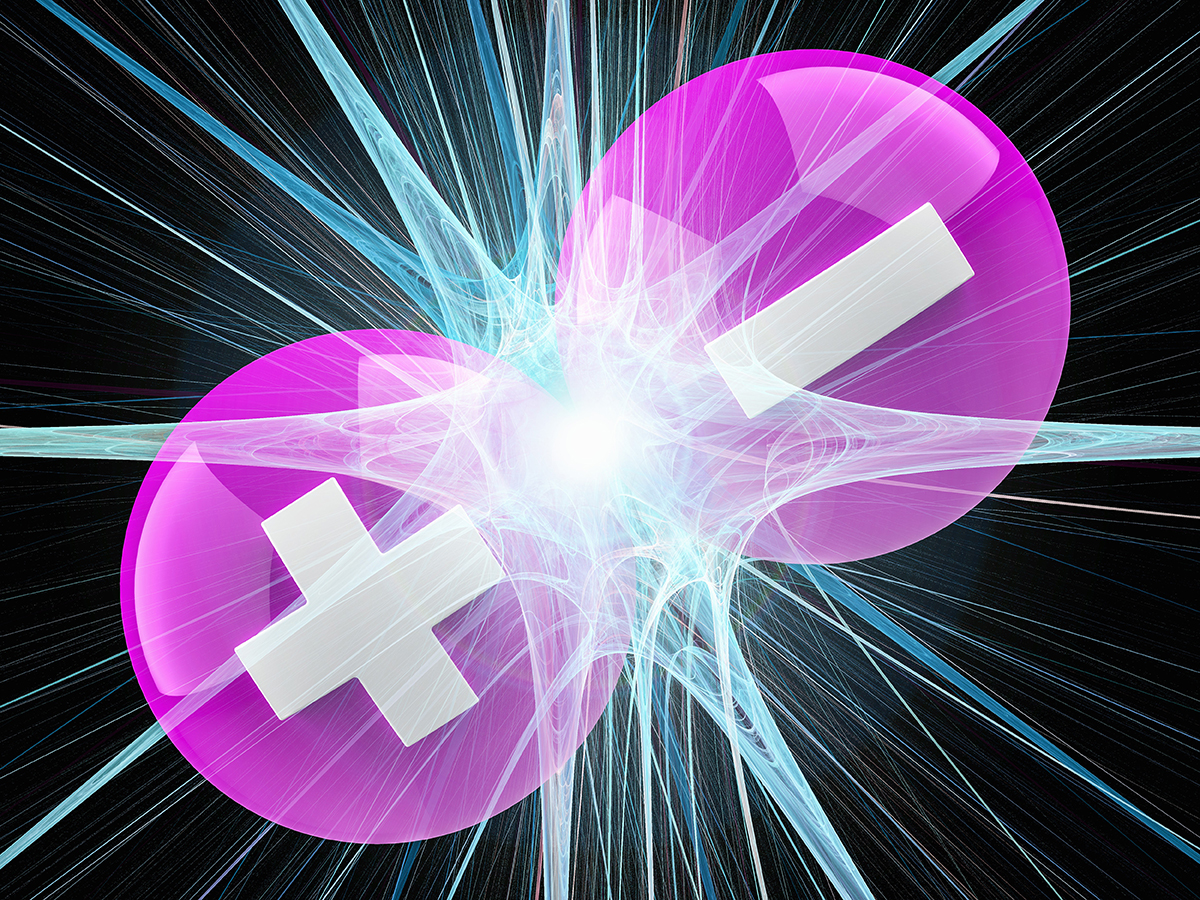
The concept of antimatter describes how every kind of elementary particle in nature has its own anti-particle.
But rather than the Big Bang producing equal amounts of matter and antimatter – and the two cancelling each other out – matter seems to have won.
More amazing science
As a result, you are reading this right now, surrounded by planet Earth, our Solar System and all the stars and galaxies in the Universe.
Scientists think that, at the birth of the Universe, there must have been a one-part-in-a-billion asymmetry, with more ‘normal’ matter than antimatter.
So what's going on?
Could one single particle have saved the Universe?
A team of scientists say they may have an answer. They've revealed a new theory about the birth of the cosmos, suggesting the early Universe was shaped by an ancient particle.
The team from the University of Southampton in the UK and the Indian Institute of Technology Kanpur say the neutrino – one of the lightest particles in the Universe and often referred to as the 'ghost particle' – could be the solution.
They've discovered that an oft-ignored relative of neutrinos, known as a 'decoupled' heavy neutrino, could have helped matter dominate over antimatter at the birth of the cosmos.
"This decoupled heavy neutrino has long been dismissed as an irrelevant background detail in particle physics," says study author Dr Rishav Roshan from Southampton.
"However, it decays incredibly slowly. As the cosmos cooled after the Big Bang, the particle lived long enough that it temporarily took over the energy density of the universe and triggered a matter-dominated period."
Roshan says most theories on why matter triumphed have neglected to consider a decoupled heavy particle because it was thought too weak to have had any impact.
But the team say the forgotten particle could influence the particle–antiparticle asymmetry, enabling the existence of everything in the Universe.
"The fact that we are here at all proves that an asymmetry between matter and antimatter occurred," says Roshan.
"The decoupled neutrino shifted the temperature in the early Universe at which fundamental particles – like electrons and other leptons – interacted with their anti-particles with the help of Standard Model Higgs boson.
"This temperature acts like a switch that shapes how the matter-antimatter imbalance was built up."
"It offers us a new explanation for how matter won," says study co-author Dr Sudipta Show from Kanpur.
Show says the results provide a new understanding of how the early Universe expanded so quickly after the Big Bang.
"The dramatic shift in the early expansion of the cosmos leaves distinct but detectable imprints of changes, for example on primordial gravitational waves.
"These gravitational wave signatures open up new avenues for us to unravel the evolution of the early Universe after the Big Bang."
Read the full paper at Physical Review Letters

