
The Blue Micromoon rises this weekend, Saturday 30 and Sunday 31 May. But despite terms 'blue' and 'micro' being attached to the full Moon, in reality you're more likely to see an enormous red Moon.
That's because the low-down full Moon will be close to the horizon, creating two amazing optical effects that will be visible at the same time, provided you know when and where to look.
And luckily, that's exactly what we'll reveal in this beginner's guide to the Blue Micromoon.
More on the Moon

If you step outside and observe the full Moon rising in the southeastern sky after sunset this weekend and expect to see a tiny blue Moon, you're going to be disappointed!
Instead, the rising full Moon will more likely look huge, it certainly won't appear blue, and may appear orangey-red instead.
Here's a breakdown of what we might expect to see, versus the science of what we'll really see.
Why it's a Blue Moon

The term 'Blue Moon' is an informal nickname given to the second full Moon in a calendar month.
Because there was a full Moon on 1st May 2026, then another on 31st May 2026, that makes this weekend's full Moon a 'monthly' Blue Moon.
But that's not even the proper astronomical definition.
If we're following the true astronomical definition, a 'Blue Moon' is the third full Moon in an astronomical season that contains four full Moons. And a season is the period of time between an equinox and a solstice.
But whichever definition you're faithful to, a 'Blue Moon' is not actually blue – the term is simply a nickname reflecting the fact that this is a rare full Moon.
Why the Blue Moon will really appear red

Because we're now entering late spring, this weekend's full Moon will not rise high above the horizon. That's because the full Moon always mirrors the path of the Sun.
In winter months, while the Sun remains low in the sky, the full Moons rise to their highest point in the sky for the year.
In spring and summer months, conversely, the Sun is higher in the sky and the full Moons remain lower.
And because the 31st May 2026 full Moon is a late-spring full Moon, it will remain low in the sky – and is therefore likely to appear orangey-red.

That's because when the Moon is low and close to the horizon, sunlight reflecting off the lunar surface has to travel through more of Earth's thick atmosphere to reach our eyes.
That thick atmosphere acts like a filter, scattering blue light and letting rich red and orange light through. It's the same reason sunsets are red (and also, conversely, why the sky is blue).
So rather than being a 'blue' Moon, this weekend's full Moon will probably appear slighly orange, or even rusty red.
Why it's a micromoon
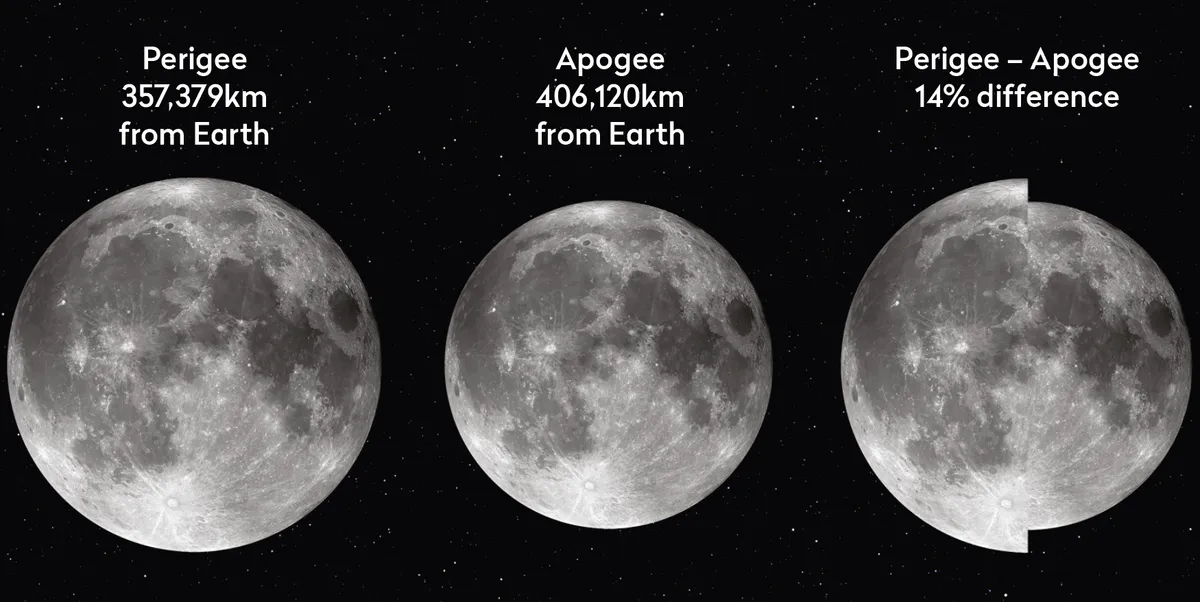
Although we may not notice it, not every full Moon is the same apparent size in the sky.
There are a few reasons why this can be the case, but one of the most cast-iron reasons is because the Moon doesn't orbit Earth in a perfect circle.
Instead, the Moon's orbit around Earth is slightly squashed, i.e. an oval or egg shape.
This is known as an elliptical orbit, and means sometimes the Moon is closer to Earth than at other times.
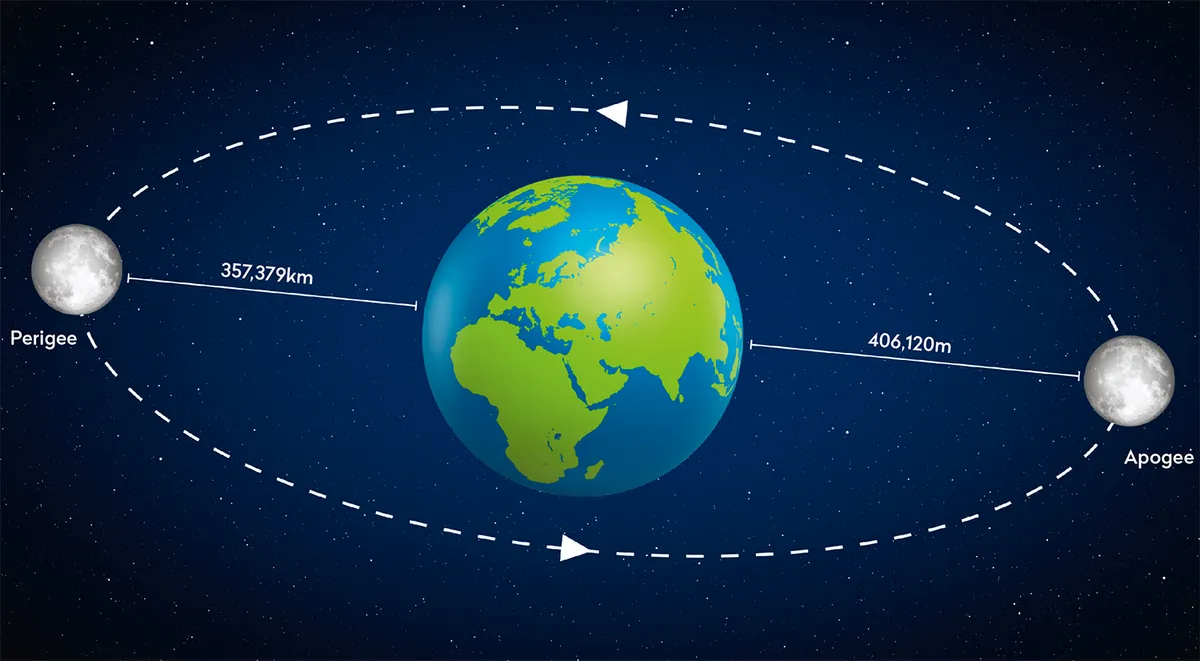
When the Moon is at its closest point to Earth in its orbit, it's known as perigee. When it's furthest, it's known as apogee.
And when the Moon is both full and at perigee, it's informally known as a Supermoon. When the full Moon is at apogee, it's a micromoon.
And that's what's happening this weekend. The Moon is full just a day before it reaches apogee, meaning it should technically appear smaller – i.e. further away – in the sky.
However, in reality the difference in apparent size from one full Moon to the next is not really noticeable with the naked eye, so you shouldn't expect it to appear tiny.
In fact...
The micromoon may actually appear larger than usual

Another reason the Moon's apparent size may change is down to an optical effect called the Moon illusion.
This is the name given to the phenomena by which the full Moon looks enormous when it's close to the horizon.
There's no definitive, confirmed reason as to why the Moon illusion occurs, but it does happen when the Moon is low in the sky, either rising or setting. It is only an optical illusion, however; the Moon isn't really bigger.
For that reason, if you observe the 31st May 2026 full Moon rising, rather than noticing this 'micromoon' is tiny, you may actually instead see an enormous Moon poking above the horizon.
How to see the trick for yourself

To see the 31st May 2026 full Moon rise – and catch both the red Moon and the Moon illusion – you'll need a flat, clear southeastern horizon.
If you're observing from the Northern Hemisphere, the full Moon will rise in the southeast around sunset – i.e. mirroring what the Sun is doing – and will skim along the southern horizon before setting in the southwest the following morning at dawn.
If you're observing from the Southern Hemisphere, the Moon will rise in the southeast but will climb high – because that part of the world is transitioning from autumn to winter – and will travel along the northern part of the sky.
Wherever you're observing from, catch the Moon as it rises above the horizon. Does it look orange or even slightly red?
You're experiencing the scattering effects of Earth's atmosphere on sunlight reflecting off the lunar surface.

Does it look bigger than usual? You're experiencing the Moon illusion. Hold out your thumb at arm's length and you'll see it's easily big enough to cover the Moon.
And if you notice a reddish star close to the full Moon, you're likely looking at Antares, the brightest star in the constellation Scorpius.
But Antares isn't red because it's low-down in the sky – like the Moon is – it's red because it's a type of star known as a red supergiant.
If you're based in the Southern Hemisphere, you may even see a lunar occultation of Antares, when the star disappears behind the full Moon and reappears out the other side.
If you've managed to see a large, red full Moon this weekend, congratulations! You've dispelled two Moon myths at once and instead witnessed the beautiful mechanics of our Solar System at play.
Share your Moon memories and photos with us by emailing contactus@skyatnightmagazine.com

