
Those lucky enough to be in the right locations on Earth were able to see a total lunar eclipse in the early morning – or early evening of 3 March 2026.
And while those of us in the UK, Europe and Africa may have missed out on seeing the 'blood Moon', tonight we'll get to see a beautiful full Moon rising above the horizon.
More full Moon advice

This is the Worm Moon, the first full Moon of spring, marking one of the last high-altitude full Moons until autumn 2026.
Here are some key facts about the 2026 Worm Moon, plus tips and techniques for making the most of it in the evening sky.
Why Worm Moon?

The Worm Moon is so-called as a reference to it being the March full Moon and the first full Moon of springtime.
As the earth begins to warm up following the cold months of winter, nature is awake once again, and earthworms become more active in the soil.
'Worm Moon' is one of many nicknames given to each full Moon throughout the year, which reference key events in nature occurring during the month in question.
Where and when to see it

A good tip to remember, if you want to catch the full Moon rising above the horizon, is that a full Moon is opposite the Sun in the sky.
That's why it's a full Moon: Earth is between the Sun and the Moon, and so the whole of the Earth-facing side of the Moon is basked in sunlight.
Sometimes, as was seen this week in North America, East Asia and Australia, this results in a lunar eclipse, as Earth's shadow is cast on the surface of the Moon.
But most of the time this results in a regular full Moon.
As a result of this Moon-Earth-Sun alignment during full Moon, you can remember that the Moon mirrors the Sun in the sky.
So as the Sun is setting in the west, the full Moon will be rising in the east. It will track across the sky and set in the east just as dawn is breaking.
See Leo, the Sickle and Regulus

The Worm Moon will rise in the east around sunset. Above it you may be able to see the Sickle star pattern in the constellation Leo, although the bright lunar glare will make fainter stars harder to see.
The Sickle star pattern – also known as an asterism – looks like a backwards question mark, with its brightest star Regulus at the bottom.
The Moon illusion

Ever seen the Moon look absolutely enormous? The Moon illusion is a term that describes how the full Moon appears enormous when it's low down and close to the horizon.
There doesn't seem to be a definitive scientific consensus on why it happens, but it could be a result of the bright full Moon dwarfing foreground objects like buildings and trees, making the Moon simply appear larger.
But it is indeed just an illusion. Hold your arm out at length you can still cover the Moon with your thumb.
The Moon isn't actually any bigger than it would be if it were higher in the sky.
Lunar halo

Sometimes during a full Moon you might see a bright ring, or halo around it.
These Moon halos happen because bright moonlight is shining through the surrounding clouds, which can cause the appearance of haloes and other atmospheric phenomena.
If you're observing the Worm Moon, see if you can observe any tricks of light caused by the bright lunar glare.
Observe, sketch, photograph and marvel
Many astronomers will tell you to avoid a full Moon.
The reason is because the best time to observe features on the Moon like craters and lunar mountains is during its crescent and gibbous phases.
During these non-full phases, the terminator - the line dividing the lit and unlit portions of the Moon - throws shadows that accentuate craters and other surface features.
But a full Moon is a great target for beginners and young astronomers, and one of the most arresting sights in nature.
You can still head out and look up at the bright full Moon and get to know its various features.
Binoculars will help you explore the lunar surface, including its craters and the lunar maria - or seas.
You could also try locating the Apollo landing sites on the Moon.
And have a go at sketching the lunar surface, then compare your sketchings with family and friends. Find out more in our guide on how to sketch the Moon.
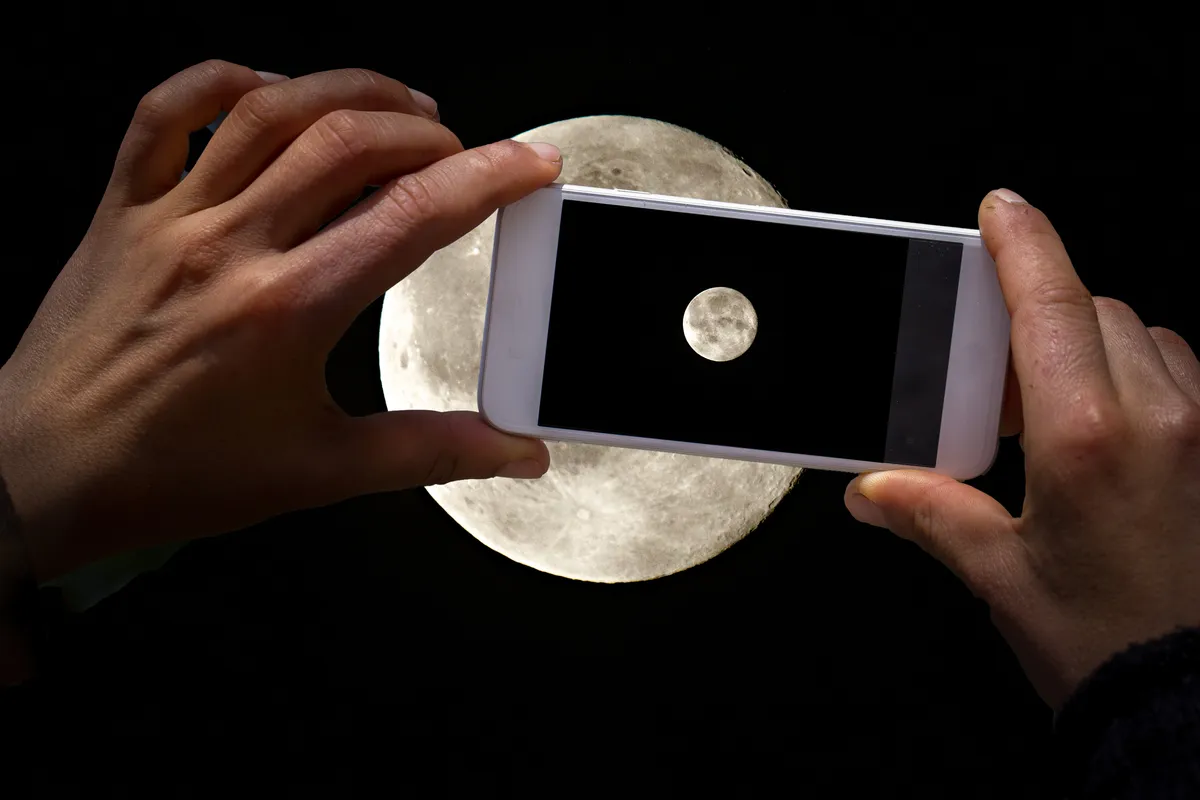
Or you could photograph the Moon. If you have a smartphone tripod and if your phone has a 'pro' photography mode, you can change the ISO, white balance and exposure time to capture an image of the Moon.
Read our guide on how to photograph the Moon with a smartphone for more advice.
And if you do capture an image of the Worm Moon or the blood Moon lunar eclipse, don't forget to send us your images.

