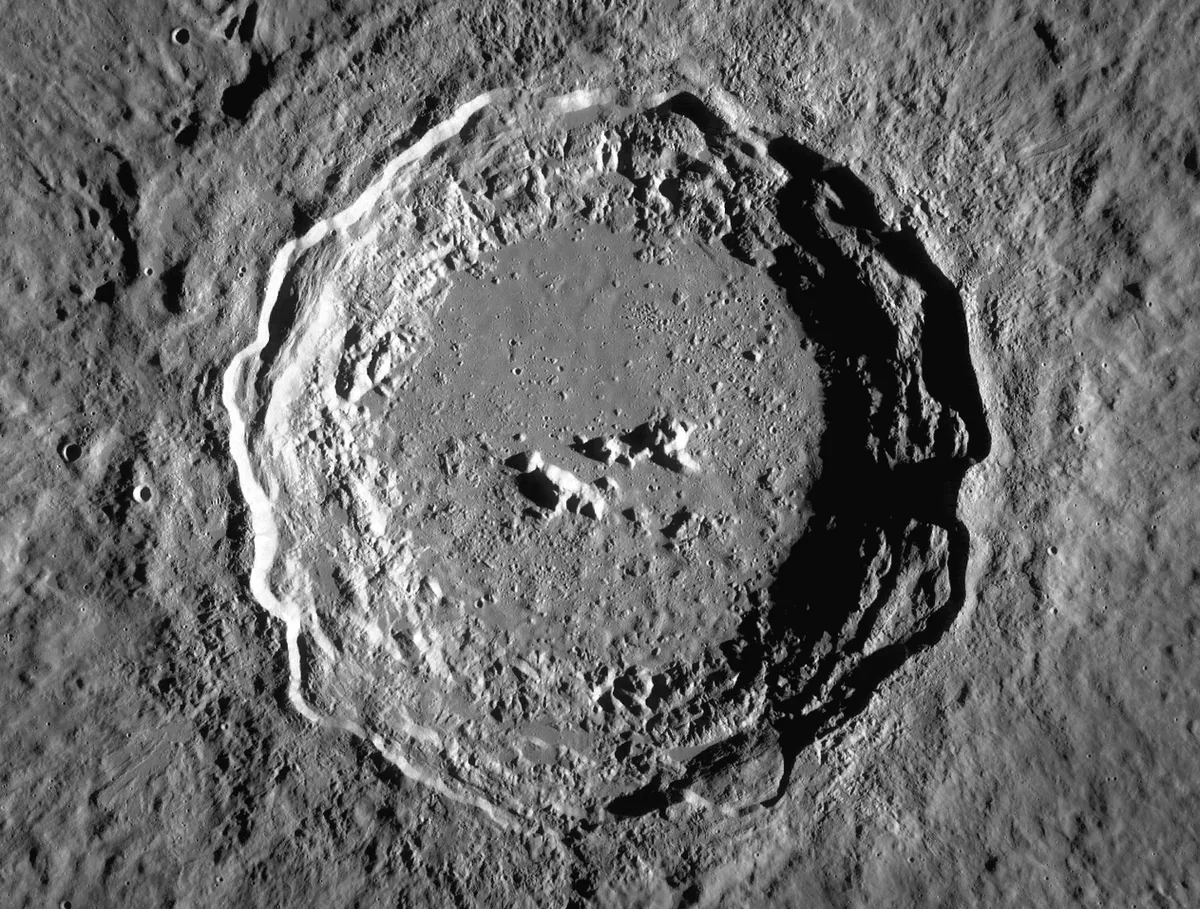
The handsome 48km lunar crater Reinhold is a strong and well-defined feature.
Formed in a recent era in lunar geology – the Eratosthenian period, 3.2–1.1 billion years ago – Reinhold has managed to keep its good looks and appears like a perfect specimen.
It has a circular form, with a sharp rim and detailed terraces that lead down to a relatively flat floor, complete with a small peak at the centre, slightly offset towards the northeast.
More Moon observing
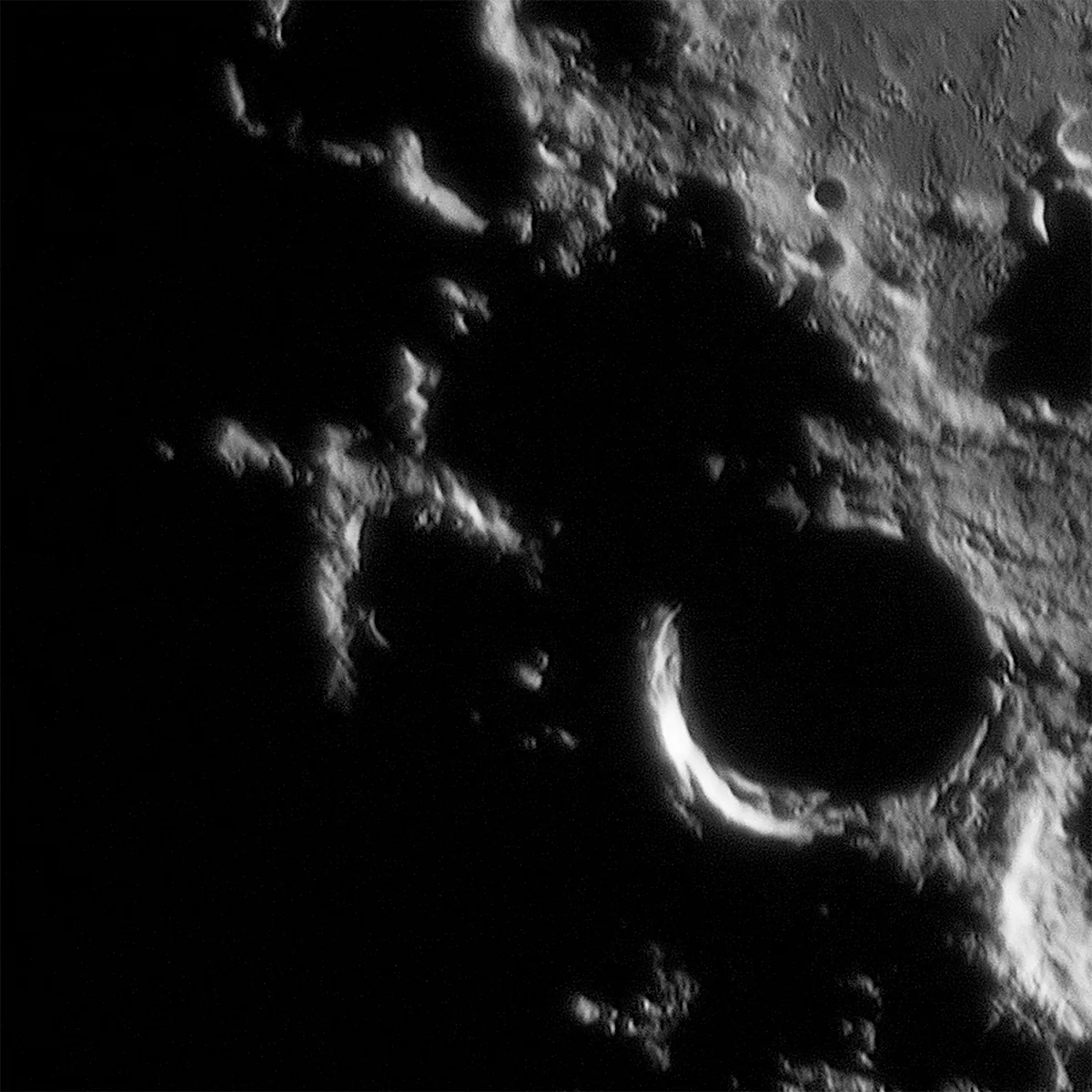

Outside the rim edge is a classic example of a crater rampart: a bumpy sloping surround that falls from the rim edge to the relatively flat floor of Oceanus Procellarum, the mare in which Reinhold is located.
In many ways, Reinhold is like a miniature version of the superb 93km ray crater Copernicus.
Unfortunately, being just 208km (centre-to-centre) south-southwest of its larger, better-known neighbour means Reinhold offer has its limelight stolen.

Reinhold crater key facts
- Type: Crater
- Size: 48km
- Longitude/latitude: 22.9° W, 3.3° N
- Age: 1.1–3.2 billion years
- Best time to see: Two days after first quarter or one day after last quarter
- Minimum equipment: 50mm refractor
Observing Reinhold
Reinhold is a beauty and well suited for telescopic observation. When the terminator lies nearby, its inner terraces are full of detail.
It’s entertaining to watch how the relatively few lumps and bumps on the floor are revealed as the lunar day advances across the crater.
The more prominent ones outside of that group, littering the eastern and southern flanks of the outer ramparts, are amazing to keep an eye on too.
They provide a sort of prelude to the main crater’s reveal a couple of days after first quarter.
To the northeast sits the slightly bell-shaped form of 26km Reinhold B, a large framing surround to the far more petite 3.7km Reinhold A, which appears where you would expect the bell’s ‘clanger’ to be.

Reinhold’s rim rises roughly 3km above the crater’s floor, slightly higher on the eastern side, where the rim’s edge matches the Moon’s zero-height surface datum – a reminder that Reinhold is located in a depressed lunar basin, the vast Oceanus Procellarum, and this has the effect of placing the whole feature below the average zero height of the lunar surface.
To the north of Reinhold are some interesting crater chains, many in the region aligned towards Copernicus.
When the impactor that created Copernicus hit the lunar surface, material was thrown from the impact site and went on to create secondary impacts.
Where the ejected material spread apart, when it finally fell, it caused the chains we see today.
As the lunar dawn creeps across Oceanus Procellarum in the period after Reinhold has been revealed, keep a look out for the wonderful ghost crater 15km Hortensius E which lies to the northwest.
This appears as an almost unbroken ring surrounding a completely lava-flooded flat inner floor.
Finally, another worthwhile target is 40km Lansberg which lies 160km (centre-to-centre) southwest of Reinhold.
This is an impressively sharp crater with inner terraces surrounding a perfectly formed central mountain complex.
Share your Moon observations and images with us by emailling contactus@skyatnightmagazine.com