It used to be the farthest planet from the Sun in our Solar System, until it was declassified.
It's an icy relic in the Kuiper Belt on the edge of our Solar SYystem, and has only been visited once, by NASA's New Horizons spacecraft.
Perhaps unsurprisingly, planetary scientists are still teasing out the details when it comes to Pluto, but we have learned a lot since it was first discovered.
Here are some of the best and most interesting facts about Pluto.
More Solar System facts
Pluto used to be a planet
More on all of this below, but in a nutshell… astronomers were looking for a so-called Planet X, discovered Pluto and thought they’d found it.
But as the years went by and technology improved, they realised Pluto was a lot smaller than they’d previously assumed – around 500 times smaller, in fact – and just one of thousands of similar objects. And so Pluto was officially downgraded by the International Astronomy Union in 2006.
It can be described in a number of ways
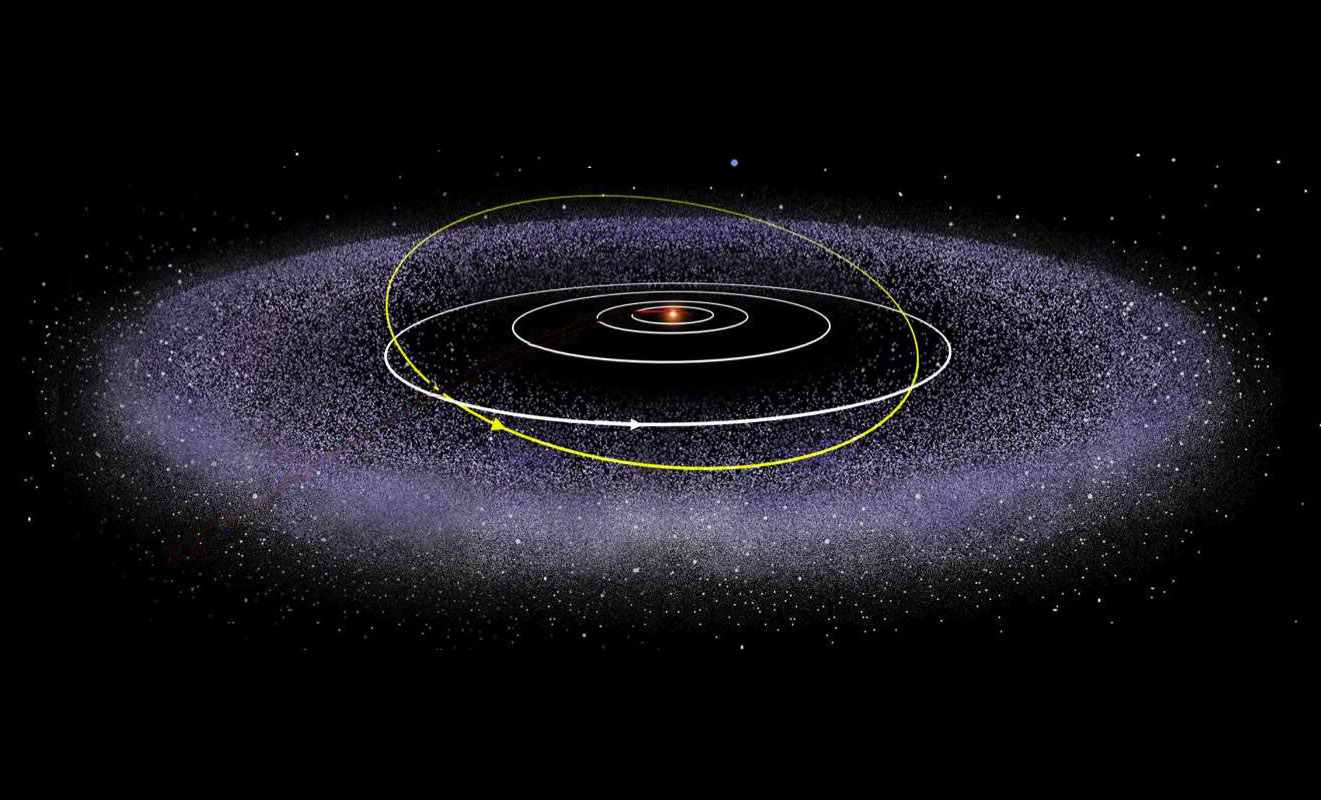
If Pluto isn’t a planet, what is it? Well, it’s a dwarf planet, for starters – but there are a few of those. It’s also classed as a trans-Neptunian object, or TNO, because it lies beyond the orbit of Neptune (unlike the giant asteroid Ceres, which is also a dwarf planet but doesn’t).
More specifically, it’s a Kuiper Belt object – all TNOs are either Kuiper belt objects (KBOs) or scattered disc objects. It can further be categorised as two other types of object: it’s both a plutoid and a plutino! But that’s enough names for now, so we’ll come back to those.
Pluto is the largest trans-Neptunian object
Today we know of over 5,500 TNOs, and it’s believed there are tens of thousands more waiting to be discovered. But most of them are tiny: Pluto, with a mean radius of 1,188km (738mi), is the largest.
It is, however, only the second most massive: Eris, with a mean radius of 1,163km (723mi), weighs in at 0.0027 Earth masses, compared to Pluto’s 0.00218.
It’s smaller than the Moon
Pluto’s volume is 0.00651 times that of Earth, making it just under one-third the volume of Earth’s Moon, with its 0.02 Earth volumes.
However, as Pluto contains a lot of ice while the Moon is made of rock, the dwarf planet is considerably less massive, weighing in at 1.3 x 10²² kg, or just over one-sixth of the Moon’s 7.346 x 10²²kg.
It’s smaller than quite a few moons
No fewer than seven of the Solar System’s natural satellites can beat out Pluto in the size stakes: take a bow Ganymede, Titan, Callisto, Io, the Moon, Europa and Triton.
Pluto is a long way from the Sun
Pluto’s orbit is eccentric, which means it's not a perfect circle, and therefore Pluto's distance from the Sun varies as it orbits.
But on average, it’s about 39 times further from the Sun than Earth is – it takes sunlight 5.5 hours to reach Pluto, whereas light reaches Earth from the Sun in just over eight minutes.
Its orbit is both eccentric and inclined
The planets’ orbits are roughly circular but Pluto’s is elliptical, which means the Sun-Pluto distance can range from 29.568 AU (where 1 AU = the distance from Earth to the Sun) at perihelion to 49.305 AU at aphelion.
Pluto also spins more or less on its side: its axis is tilted by 60° relative to its orbital path (or 120° the other way, depending how you look at it).
It has extreme seasons
Pluto’s steeply inclined orbit means it experiences a high degree of seasonal variation, with its solstices ushering in long periods of either continuous darkness or continuous daylight for around half of its surface.
Pluto has long years
Solar System years – the length of time it takes a given object to orbit the Sun – get longer the further out you get.
Mercury’s year is just 88 days long, while Neptune’s lasts 60,190 days, or nearly 165 Earth years. But even that pales in comparison to Pluto, whose year lasts 248 Earth years. 247.94, if you want to get all precise about it.
Its days are longer than Earth's
Pluto rotates on its axis once every 6.387 Earth days. It’s hardly an outlier in this regard, though: the length of a ‘day’ on any given Solar System body can range from less than 10 hours (in the case of Jupiter) to 243 Earth days (if you happen to be standing on Venus).
It is never a naked-eye object
Nearby rocky planets like Mars, Venus and Mercury can quite often be spotted with the naked eye. But in the case of Pluto, which is rated at mag. +13.65-15.1, you’re going to need a large (at least 8-inch) telescope and very dark skies.
Even then, it will be case of capturing images over successive nights and comparing them: Pluto’s quite small, and a long way away!

We didn’t know Pluto existed until 1930
In 1929, a 23-year-old American astronomer called Clyde W Tombaugh took on a new job at the Lowell Observatory in Arizona. His job was to capture images of a particular region of space on consecutive nights, then use a device called a ‘blink comparator’ to examine them in rapid succession, as described above.
In February 1930 he spotted an apparent anomaly in images captured on 21, 23 and 29 January, and on 13 March his discovery of Pluto was announced.
That particular region of space had been chosen because it was where Percival Lowell, founder of the observatory, had predicted there should be a putative ‘Planet X’, based on perturbations detected in the orbit of Uranus. But that’s something else we’re going to need to come back to…
It was named by an 11-year-old British girl
Well, sort of! Once Pluto was discovered, over 1,000 different names for the new ‘planet’ were suggested: by astronomers, by the press and by the general public. Minerva, Pluto and Cronus were the most popular, and obviously in the end Pluto was chosen – partly because the name began with Lowell’s initials, PL.
Of the 150-plus letters that the Lowell Observatory had received suggesting that name, the earliest date was on a telegram sent by astronomer Herbert Hall Turner. But Turner was merely passing on a proposal from his friend Falconer Madan, librarian at Oxford University’s Bodleian Library, based on a suggestion made by Madan’s 11-year-old granddaughter Venetia Burney.
Pluto was the Greek god of the underworld
He was originally known as Hades, but over time that name came to be used more commonly to mean the underworld itself. In Ancient Rome, the god of the underworld was known variously as Dis Pater, as Orcus or, again, as Pluto – though the precise relationships and equivalences between these deities can vary depending on which classical scholar you speak to.
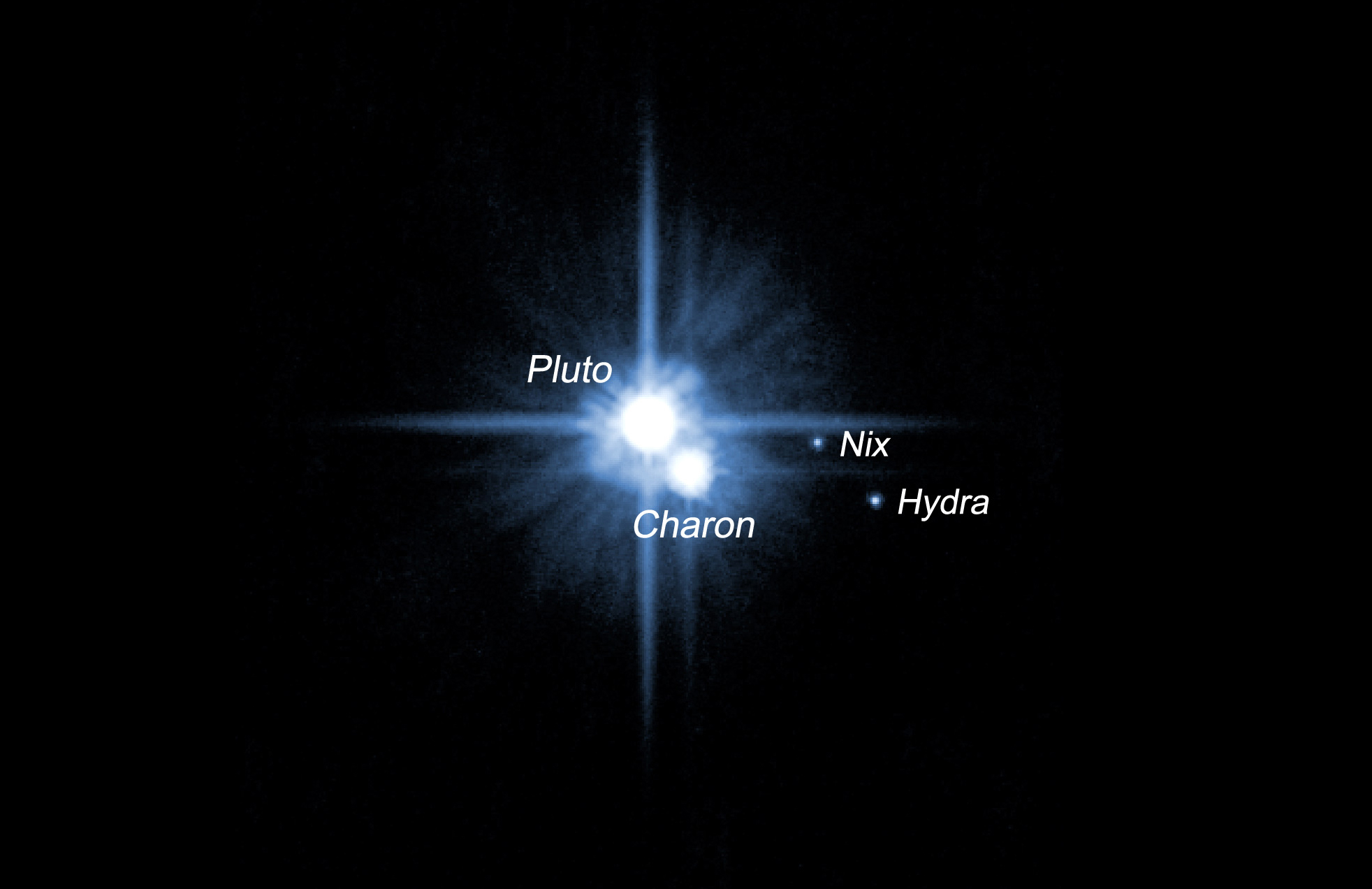
Pluto has five known moons
The five natural satellites of Pluto are Charon, Styx, Nix, Kerberos and Hydra. All five are believed to consist of debris left over from giant impacts early in Pluto’s life.
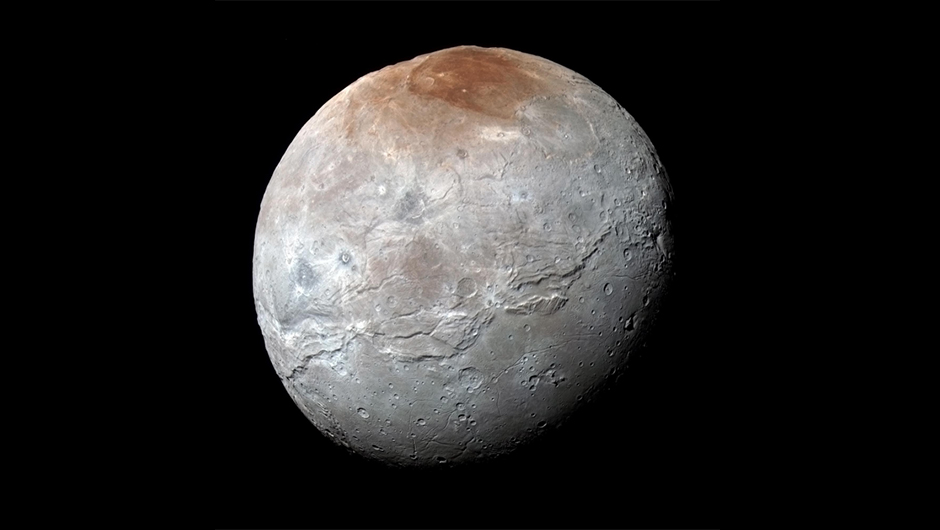
Charon, the largest, is around half the size of Pluto itself. It is regular in shape (ie, spherical), and Pluto and Charon are mutually tidally locked, meaning they always present the same face to each other. Some astronomers regard Pluto-Charon as a binary system.
The smaller moons, all with diameters below 160km (100 miles), are irregular in shape and are not tidally locked.
Its moons also have underworld-derived names
The Styx was the river that separated the worlds of the living and the dead, Charon was the boatman who carried the recently deceased across it, Nix was the goddess of darkness (and Charon’s mother), and Kerberos and the Hydra were the three-headed dog and nine-headed serpent (respectively) that guarded the gates of the underworld.
It’s mostly made of rock and ice
Pluto is thought to have a rocky core surrounded by a mantle of water ice, with the crust and regolith consisting of ices of water, nitrogen, methane and CO2. Many scientists believe it may also have a subsurface ocean of liquid water, though this remains unproven.
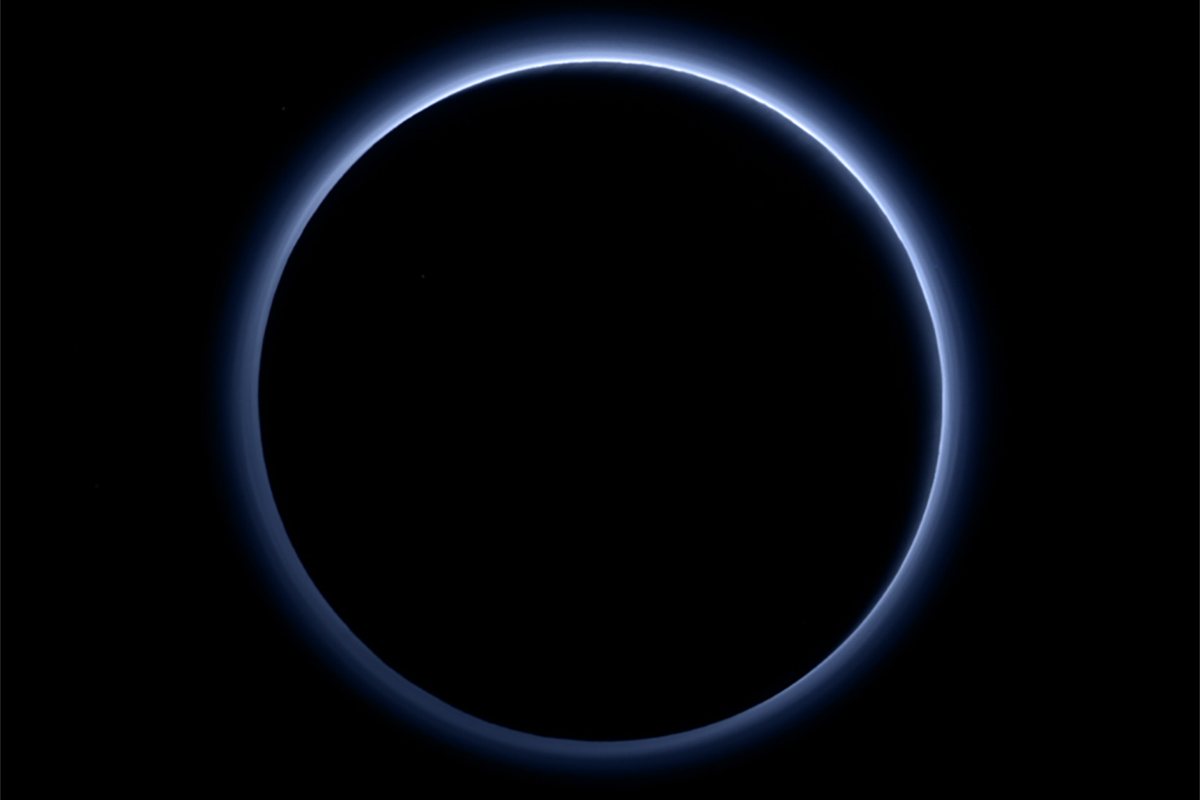
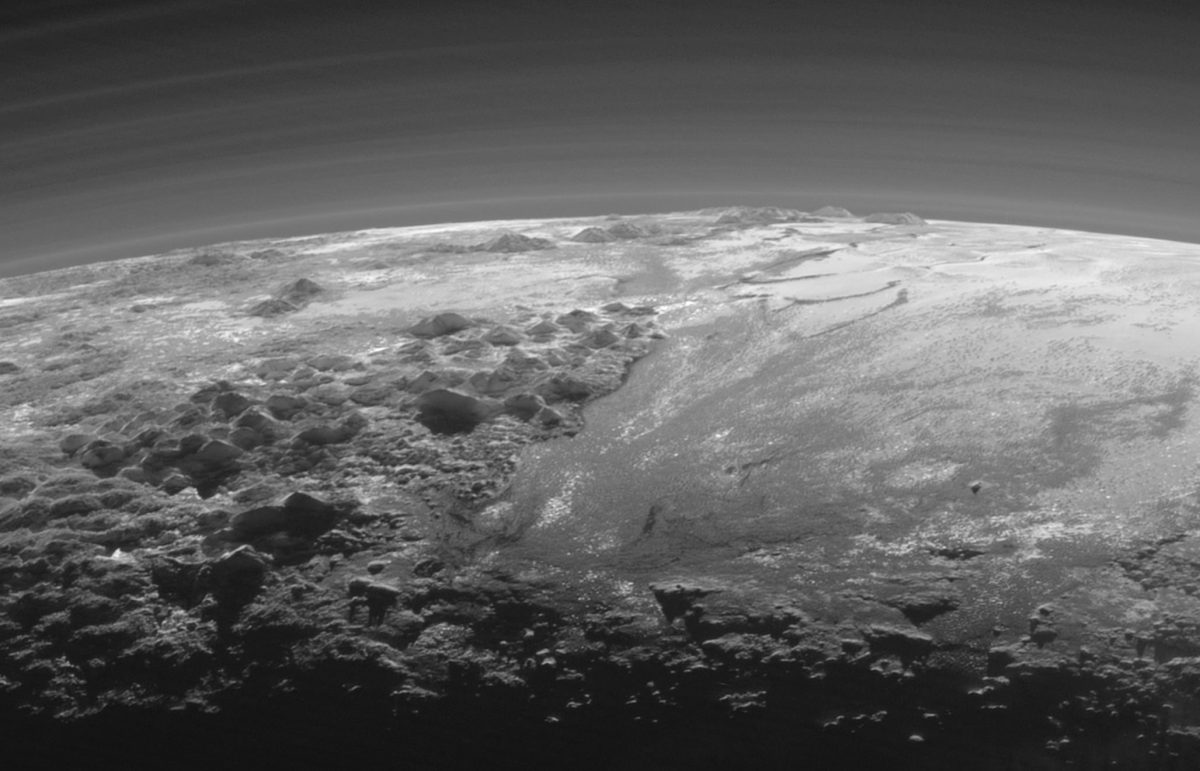
Pluto's atmosphere is mostly nitrogen
Pluto’s atmosphere is about 99% nitrogen. The other one per cent is mostly made up of methane (around 0.25%) and carbon monoxide (roughly 0.05%), with traces of acetylene, ethylene, hydrogen cyanide and other compounds.
Its atmosphere varies in size
Like other trans-Neptunian objects, Pluto shares some of its characteristics with comets.
One of these is that its atmosphere varies in size/volume depending on how close Pluto is to the Sun at any given moment: it expands as Pluto nears our star, and contracts as it gets further away. Which is one reason it took us a while to figure out Pluto’s actual physical size…
Once we found it, Pluto's mass kept shrinking!
The ‘Planet X’ that Lowell was looking for was estimated to have seven times Earth’s mass, based on his calculations regarding Uranus’s orbit, but when Tombaugh found Pluto, he estimated it to have only around the same mass as Earth. But a lot of that was due to albedo effects – Pluto shines brightly because of all the methane ice on its surface, which makes it look bigger than it is.
By 1948, estimates of Pluto’s mass had been reduced to around 10 per cent that of Earth, by 1976 it was calculated at less than 1 per cent of Earth’s and by 2006, when Pluto was finally downgraded, it was known to have only a little over one-fifth of 1 per cent of Earth’s mass.
Pluto isn’t Lowell’s ‘Planet X’
When Tombaugh discovered Pluto, he believed it to be the seven-Earth-masses ‘Planet X’ that Lowell said should be there. But given that it has turned out to be so much smaller, it clearly wasn’t. In fact, it turns out we never “needed” a Planet X in the first place!
In 1992, astronomer Myles Standish recalculated the mass of Neptune, based on data sent back by Voyager 2. He calculated that Neptune’s mass had been overestimated by around 0.5% – and on the basis of Neptune’s revised mass, the irregularities perceived in the orbit of Uranus ceased to be irregularities at all.
The fact that Pluto was where Lowell had said Planet X should be was simply a coincidence, and nothing more.
Its surface is uneven
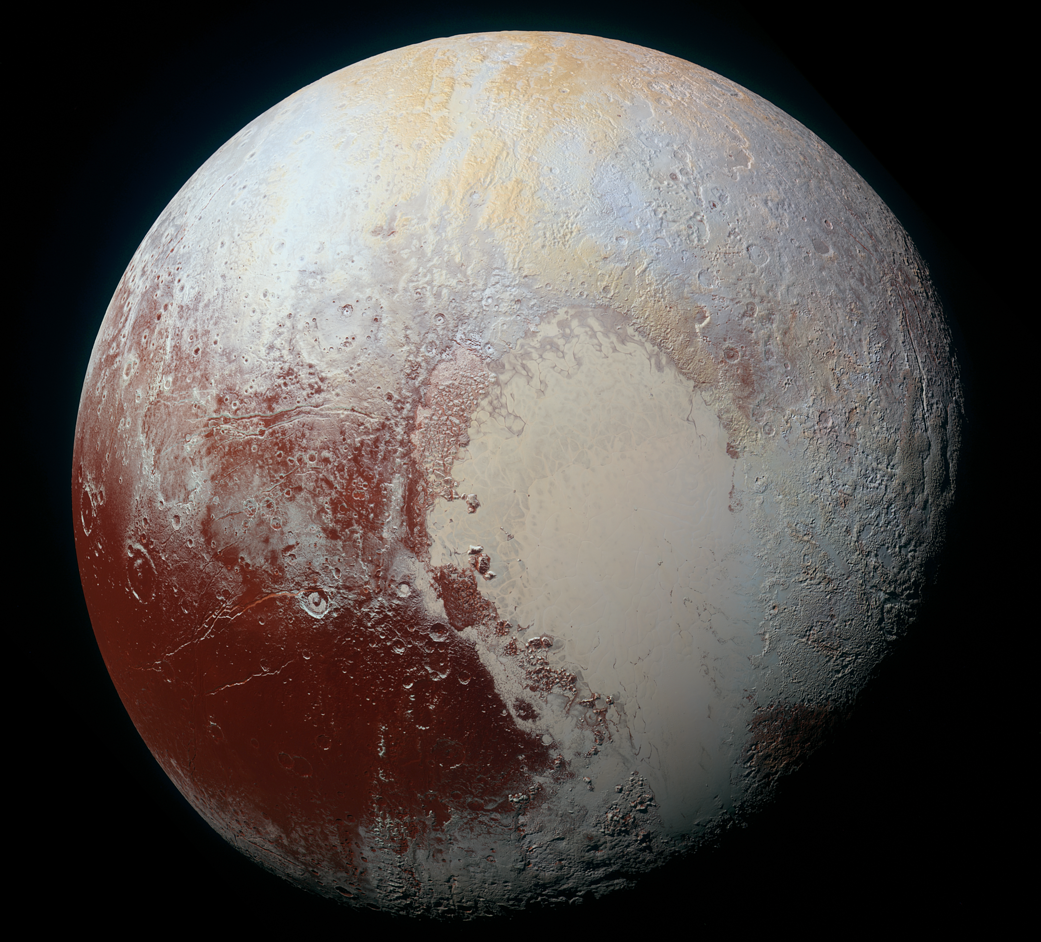
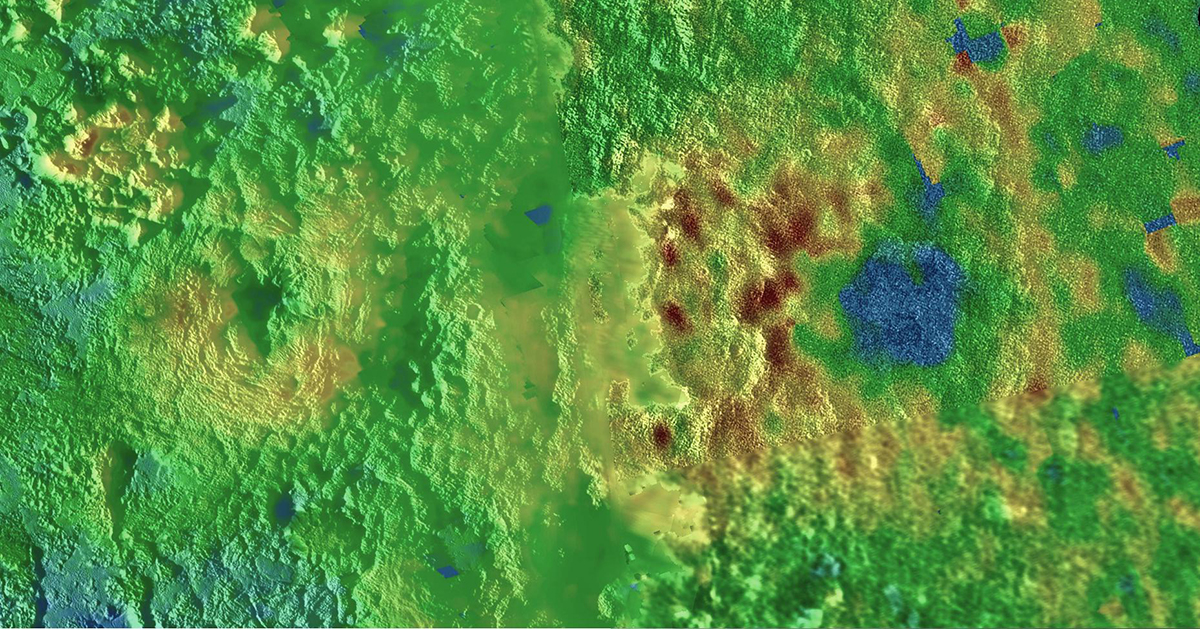
Pluto has mountains that can reach up to 3km (1.86mi) in height. By way of contrast, Mount Everest is roughly 8.8km (5.46mi) tall, while the UK’s largest mountain, Ben Nevis, stands at just 1.35km (0.83mi). It also has impact craters, deep valleys that can stretch to over 600km (350mi) in length, and large, smooth plains made up almost entirely of nitrogen ice.
Key surface features include the Heart, the Whale and the Brass Knuckles
The Heart, or Tombaugh Regio, is a large, light-coloured plain in the shape of a love heart. The Whale, or Belton Regio, lies along the Plutonian equator and is a darker region some 2,990km (1,860mi) long, while between these two landmarks lie the Brass Knuckles – a series of smaller, irregularly-shaped dark ‘blobs’, each around 480km (300mi) in diameter.

Pluto is extremely cold
Being so far from the Sun, poor little Pluto doesn’t get a huge amount of sunlight – around 1/900th as much as Earth receives – and the average surface temperature is a very, very chilly -232°C (-387°F).
Plutonium is named after it
When US chemist Glenn T. Seaborg discovered a new radioactive element in 1941, he promptly named it in Pluto’s honour. In doing so, he was following convention. Uranium (discovered in 1789) had previously been named after the planet Uranus (discovered in 1781), while neptunium (discovered in 1940) was named after Neptune (discovered in 1846).
The case of a certain Disney cartoon dog is less clear-cut! Pluto (the dog) first appeared in a Mickey Mouse cartoon in 1930, certainly. But no one seems to know for sure if Walt Disney was actually aware of Tombaugh’s (then very recent) discovery, or whether it was pure coincidence.
Only one spacecraft has ever visited it
The only spacecraft to visit Pluto so far has been NASA’s New Horizons mission, which launched in 2006 and flew by Pluto in 2015, making its closest approach on 14 July. During its six months observing Pluto, New Horizons imaged its northern hemisphere in its entirety, and the southern hemisphere down to about 30° south.
The Hubble Space Telescope had previously managed to image around 85 per cent of the surface, down to around 70° south. But Pluto’s southern polar regions have only ever been captured (in very low resolution) from Earth.
Pluto lends its name to two classes of object
As well as being a dwarf planet, a trans-Neptunian object and a KBO, Pluto is also both a plutoid and a plutino.
Plutoids are dwarf planets that are also trans-Neptunian objects (i.e. farther from the Sun than the planet neptune). So that includes Pluto, Eris, Haumea and Makemake.
Some astronomers suggest other KBOs should also be considered plutoids, including Sedna and Gonggong. Smaller KBOs are not plutoids, and neither is Ceres, which is a dwarf planet but not a TNO.
And as for plutinos? They’re a specific subset of plutoids whose orbits, like that of Pluto, are in whole-number resonances with that of Neptune. These include Orcus, Ixion and 1993 RO as well, of course, as Pluto itself.
It has failed to clear its orbit
This is the other reason (apart from sheer physical size) that Pluto was downgraded to a dwarf planet.
What the IAU actually decided in 2006 was that, to be classed as a planet, an object had to be spherical, it had to orbit the Sun, and it needed to have enough gravity for it to have emptied its immediate neighbourhood of any other objects.
All three things are true of the eight Solar System planets, but only the first two are true of Pluto, which (being small) has very little gravity – just 0.063g, compared to 1g on Earth or 0.17g on the Moon. As a result, far from having cleared its orbit as the planets have, Pluto shares its environment with literally thousands of other Kuiper belt objects.
This became particularly problematic once Eris was discovered in 2005, because Eris was thought at the time to be larger than Pluto, though this later turned out to be result of albedo effects. Hence why, 20 years ago, Pluto became officially Not A Planet.
The decision was made in August 2006, while New Horizons launched in January 2006, which means that, when New Horizons launched, it was heading to planet Pluto.
By the time it got there, Pluto was no longer classed as a planet.
What are your favourite Pluto facts? Let us know by emailing contactus@skyatnightmagazine.com