Flying a helicopter on another planet might sound like pure science fiction, yet space history has already proved otherwise.
When NASA’s Perseverance rover thundered to Mars aboard an Atlas V rocket on 30 July 2020, few imagined what its smallest passenger would eventually achieve.
Held under Perseverance’s belly was Ingenuity, a 1.8kg (4lb), 49cm-tall (19-inch) experimental helicopter.
Months after landing, the tiny craft would successfully rise into the thin Martian atmosphere to make the first powered, controlled flight on another planet.
Suddenly, the impossible wasn’t fiction at all.

What it takes to fly a helicopter on Mars
When Perseverance, NASA’s most ambitious robotic explorer, touched down in the 45km-wide (28-mile) Jezero Crater on the surface of Mars on 18 February 2021, it began to study the ancient lakebed, search for signs of past microbial life, analyse rocks and soil and collect samples for eventual return to Earth.
Its first immediate task, however, was to complete initial systems checks and find a suitable flat area for Ingenuity’s flight testing.
Only then could the rover begin the multi‑step deployment sequence to safely deposit Ingenuity onto the surface of Mars, a process that was not without its own serious challenges.

For an aircraft to take flight on Mars, the very notion of what flight can be is pushed to its limit.
Gravity on Mars is only a third of Earth’s and its atmosphere is astonishingly thin, just one per cent of the density we’re used to at sea level on our planet.
Even sunlight is in short supply: Mars receives only about half the solar energy that reaches Earth during the day.
More on Mars

And when night falls, temperatures can plunge to –90°C (–130°F), cold enough to freeze or fracture any unprotected electronics.
This means that any aircraft built to fly on Mars must be engineered very differently to aircraft that fly in Earth’s atmosphere.

Learning to fly
Firstly, the dramatically reduced aerodynamic lift had to be overcome.
Ingenuity was built with a pair of counter-rotating carbon-fibre rotors that spanned 1.2 metres (4ft) and achieved around 2,400–2,900 revolutions per minute.
This was crucial to gain sufficient lift in the thin Martian atmosphere.
What’s more, controlling Ingenuity in real time would be impossible due to the communication delay between Earth and Mars.
This meant that each flight would have to be undertaken autonomously, with Ingenuity following pre‑programmed trajectories and relying on an onboard inertial measurement unit, a downward‑facing navigation camera, laser altimetry and a suite of guidance algorithms to estimate its position and maintain stability.
To survive the crippling cold, Ingenuity’s avionics were enclosed in a compact, insulated fuselage designed to retain heat through those frigid Martian nights.

Lift-off on Mars
Between 21 March and 3 April 2021, the debris shield protecting Ingenuity was dropped by Perseverance and the helicopter was rotated and unfolded.
Then, on 3 April, the helicopter was released from the rover onto the cold surface of Mars.
Perseverance trundled approximately 100 metres (328ft) away to give Ingenuity plenty of space for its first flight and to allow it to bask in the sunlight to sufficiently charge its six lithium-ion cells via its solar panel.
Those batteries were crucial to its operation, storing energy for use during its flight and keeping it heated at night.
Now standing alone, the little helicopter spent its first sols topping up its power and performing speed rotor spin tests.
Finally, on 19 April 2021, Ingenuity successfully rose three metres (10ft) into the sky, hovering briefly for 40 seconds before settling back down.
Each flight grew more ambitious than the one before and, once engineers recognised just how capable Ingenuity truly was, its modest five‑flight, 30‑day technology-demonstrating plan evolved into something far greater.
It may have started out as a project to test new equipment for the first time, but it developed into an operational partner to Perseverance, scouting potential routes, identifying new sites to investigate and helping to map the rugged Martian terrain.
In just under three years, Ingenuity successfully completed 72 flights, beginning with its first journey across Wright Brothers Field, a small flat area in Jezero, before scouting the dune-rippled Séítah region.

On 18 January 2024, it sadly flew for the last time before communication was lost.
A crash-landing was confirmed by sombre images sent back to Earth from Perseverance, showing Ingenuity tipped on its side, a broken rotor blade lying some distance away.
Over the course of its active flight, Ingenuity didn’t cover vast distances – just 17km (10.5 miles) across the floor of Jezero Crater, climbing to heights of 24 metres (79ft).
But distance was never the point. Its primary mission was to demonstrate that powered, controlled flight on Mars could be done.
Ingenuity not only met that challenge, it surpassed every expectation.

What Ingenuity taught us
With each flight across Jezero Crater, Ingenuity became a teacher to all who watched and operated it from mission control at NASA’s Jet Propulsion Laboratory in California.
The tissue-box-sized helicopter demonstrated that lightweight, commercially available processors – the kind found in everyday smartphones – can operate reliably in the brutal Martian environment.
Scientists also learned that Mars can be challenging for aerial navigation.
When Ingenuity flew over stretches of smooth, low‑contrast terrain, its cameras struggled to lock onto visual features, making it harder for the helicopter to judge its own motion – probably the reason why it crash-landed in 2024.

This information is now shaping and inspiring the design of next‑generation aircraft destined for Mars and other planetary bodies, which will need smarter, more resilient navigation systems.
As Taryn Bailey, a NASA mechanical engineer involved with the development of Ingenuity, said at the end of the mission: "It all began with a question: can we fly on Mars?"
The answer, as Ingenuity proved, is a resounding yes.
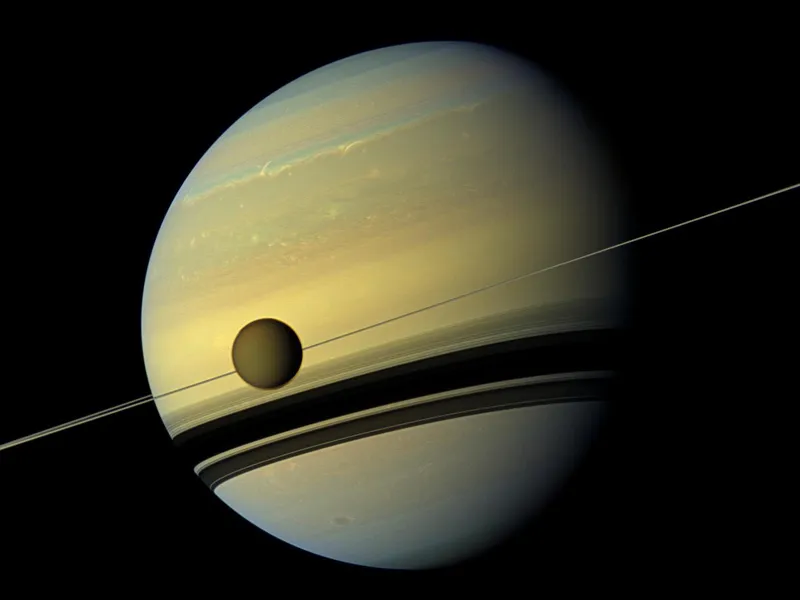
The tiny helicopter has directly informed the design of future planetary rotorcraft, such as NASA’s upcoming Dragonfly mission to Titan, Saturn’s largest moon, where it will scout scientifically intriguing sites and investigate whether the conditions for life ever existed there.
Enter the Dragonfly

Initially given conditional approval in November 2023, the Dragonfly mission now has the green light.
The nuclear-powered, eight-rotor drone will launch for Titan, Saturn's largest moon, in 2028, touching down in 2034.
Titan is an ideal location to explore. Larger in diameter than Mercury, it boasts a thick, Earth‑like, nitrogen-based atmosphere, stable lakes and seas of liquid hydrocarbons, and a rich mix of organic molecules that mirror the chemistry of early Earth.
As far as our Solar System goes, Titan is one of the most promising locations for our search for life.
Aerial flight is crucial on Titan. Unlike Mars, where wheeled rovers like Perseverance can trundle across relatively firm ground, Titan’s landscape is far more treacherous – a world of dark-grained hydrocarbon dunes, deep craters, river channels and methane lakes.

Navigating that terrain on wheels would be slow, risky and prone to failure.
Taking to the air is the only reliable way to explore the diverse and challenging surface.
As former NASA administrator Jim Bridenstine commented: "Visiting this mysterious ocean world could revolutionise what we know about life in the Universe.
"This cutting-edge mission would have been unthinkable even just a few years ago, but we’re now ready for Dragonfly’s amazing flight."

Dragonfly's flight plan on Titan
NASA’s Dragonfly mission stands ready to push the boundaries of discovery across the distant outer Solar System.
Scheduled to launch in 2028 aboard a SpaceX Falcon Heavy rocket, its destination is Saturn’s largest moon, Titan.
If everything goes to plan, six years later, in 2034 – after gravity assists from Venus and Earth – the rotorcraft will plough through the dense, hazy atmosphere of Titan, safely protected by a heat shield, and parachute then hover down to the surface.
The chosen landing site is dunes located southeast of the Selk crater that borders a dark region called Shangri-La.
Taking advantage of Titan’s thick, nitrogen-rich atmosphere and low gravity, Dragonfly will travel up to
115km (71.5 miles) during its planned 3.3-year mission.
It will be too far from the Sun to be powered by solar energy, so will entirely rely on its lithium-ion battery, charged by the Multi‑Mission Radioisotope Thermoelectric Generator (MMRTG), allowing it to operate through Titan’s long, dim days and frigid nights.
During Dragonfly’s time on Titan, it will fly to many of its diverse regions to study its atmosphere, weather patterns and subsurface, and explore locations where liquid water and complex molecules may once have interacted, giving scientists a glimpse into how life may have begun on early Earth.

Flying into the future
Dragonfly won’t be the first spacecraft to fly or even land on Titan.
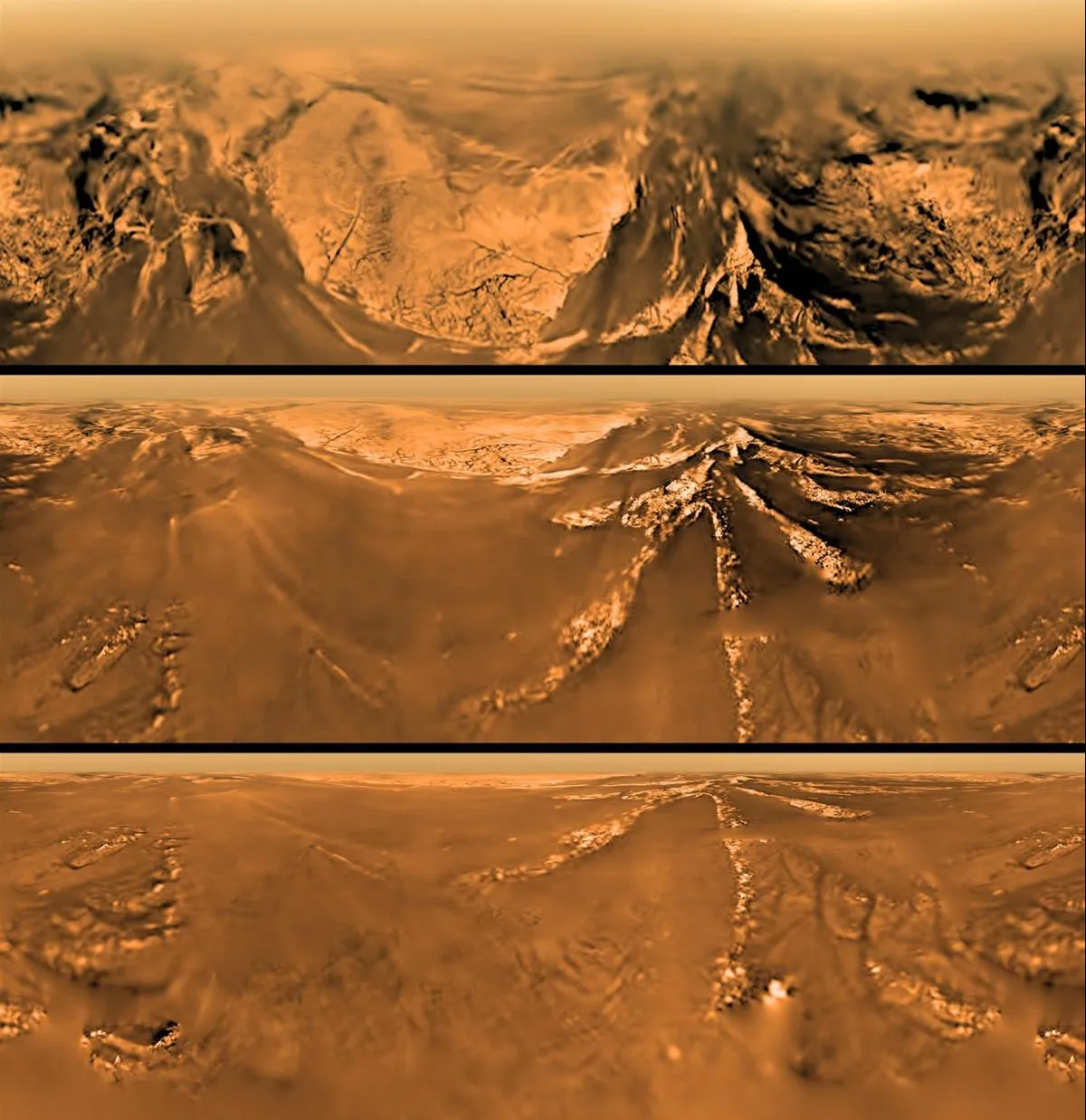
In 2005, after a seven-year ride with the Cassini orbiter, the Huygens lander parachuted through the atmosphere of Titan and landed on its surface.
During its two hours and 28 minutes of descent, Huygens took images of the moon’s sandy terrain and gathered data on temperature, air density and pressure at varying altitudes.
After touchdown, the lander’s transmissions lasted just 70 minutes before communication was lost.
But Huygens provided foundational data that now underpins Dragonfly’s design.
And after Dragonfly takes flight, missions to other planets and moons will follow in its footsteps, each demanding new aerial designs, new autonomy and new scientific ambition.
Wheels will always have their place, but the next era of exploration belongs to machines that rise above the surface – hopping, gliding and flying through environments once thought unreachable.
Through missions like Ingenuity, NASA is paving the way for future flight in our Solar System and smarter, safer human exploration to Mars and beyond.
Planetary science is entering an age where the most profound discoveries may come from robots that take to the skies – and we can certainly thank little Ingenuity for that.