
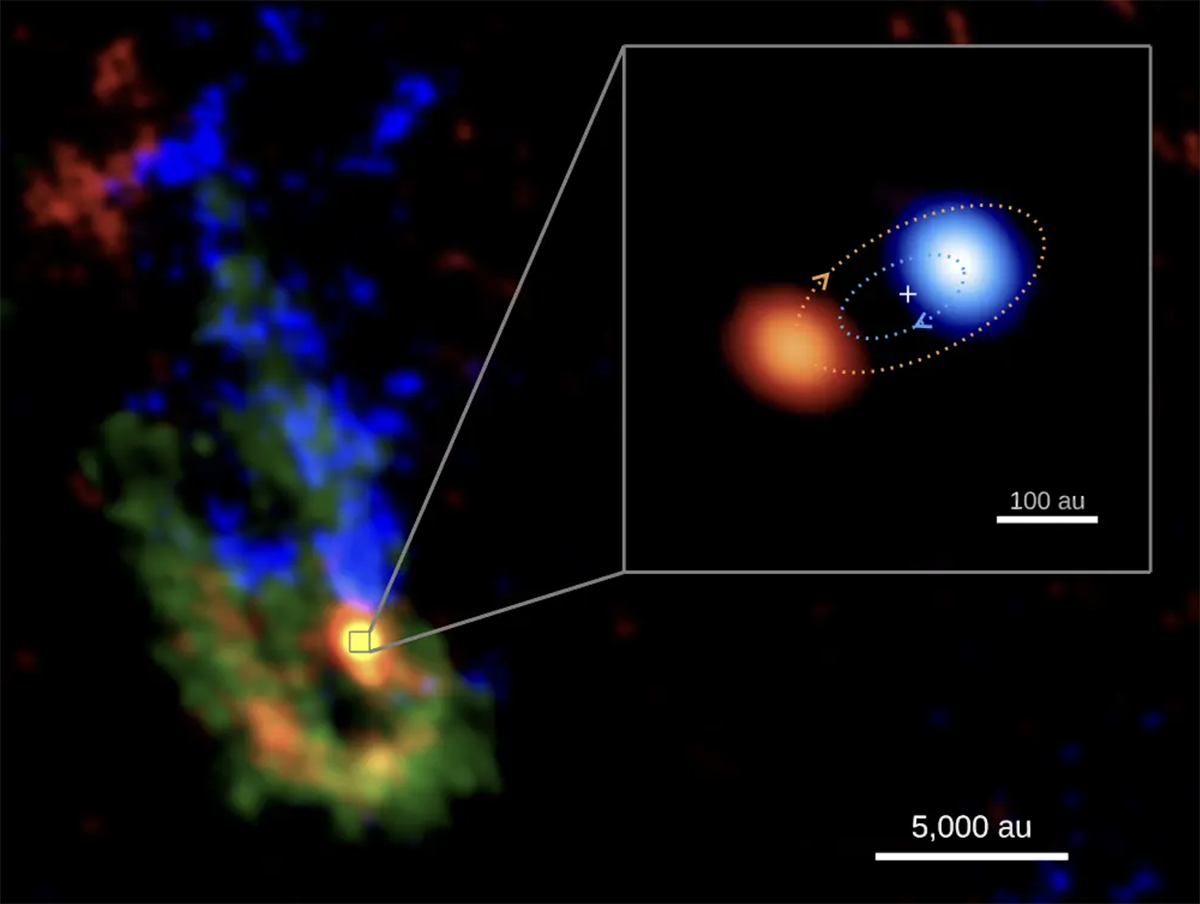
Astronomers have captured one of the most detailed 3D views ever recorded of a massive binary star system in the middle of its dynamic birth.
Binary star systems are when two stars orbit each other, in effect producing a two-star system.
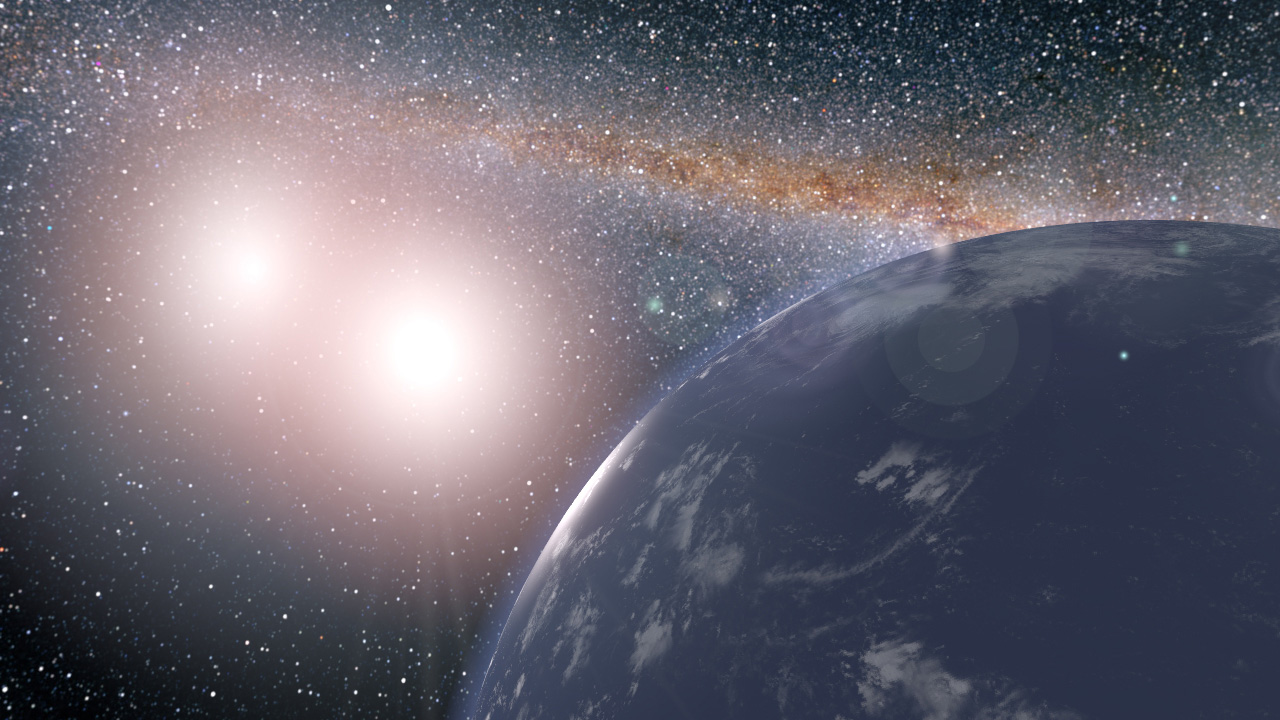
Often, any planets within the system may have two suns visible in their sky, much like Luke Skywalker's home planet Tatooine in the Star Wars franchise.
More on multi-star systems
By tracking a pair of growing stars over nearly eight years, astronomers uncovered a chaotic scene.
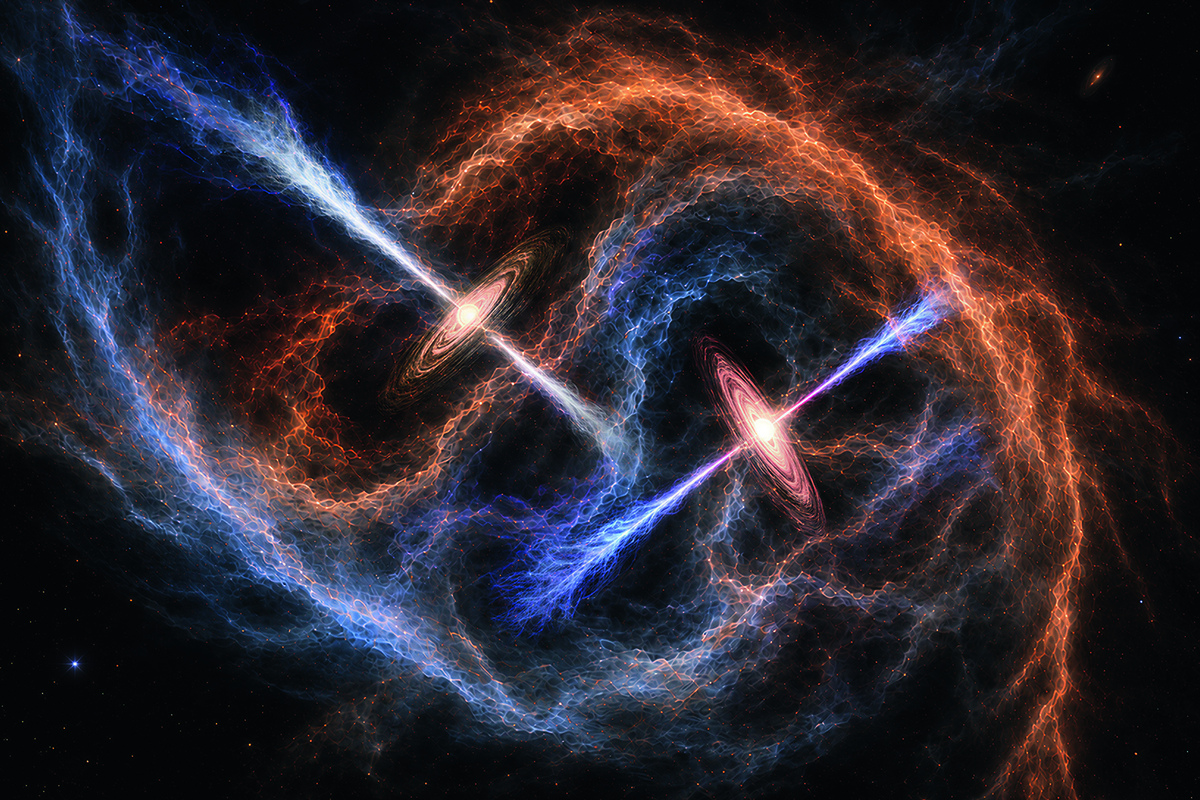
Instead of orbiting each other in a neat, orderly circle, the two stars are hurtling around each other in a stretched-out orbit, wrapped in titled disks of cosmic gas and dust.
The team behind the study say their discovery suggests that the stellar pair didn't form together from the same disk, but formed independently before being dragged into a cosmic tango.
A rare glimpse into the birth of a two-star system
Astronomers say most massive stars are born with stellar companions, with at least 90% thought to exist in binary or multiple-star systems.
Massive binary star systems shape their surroundings through supernova explosions and the production of heavy elements.
But most of the time, astronomers only detect binary star systems after they've finished forming.
It's rare that astronomers get the chance to catch the moment of assembly.
An international team led by Yichen Zhang of Shanghai Jiao Tong University turned their attention to IRAS 07299−1651, a system containing two massive 'protostars', which are young stars still growing by accumulating surrounding gas and dust.
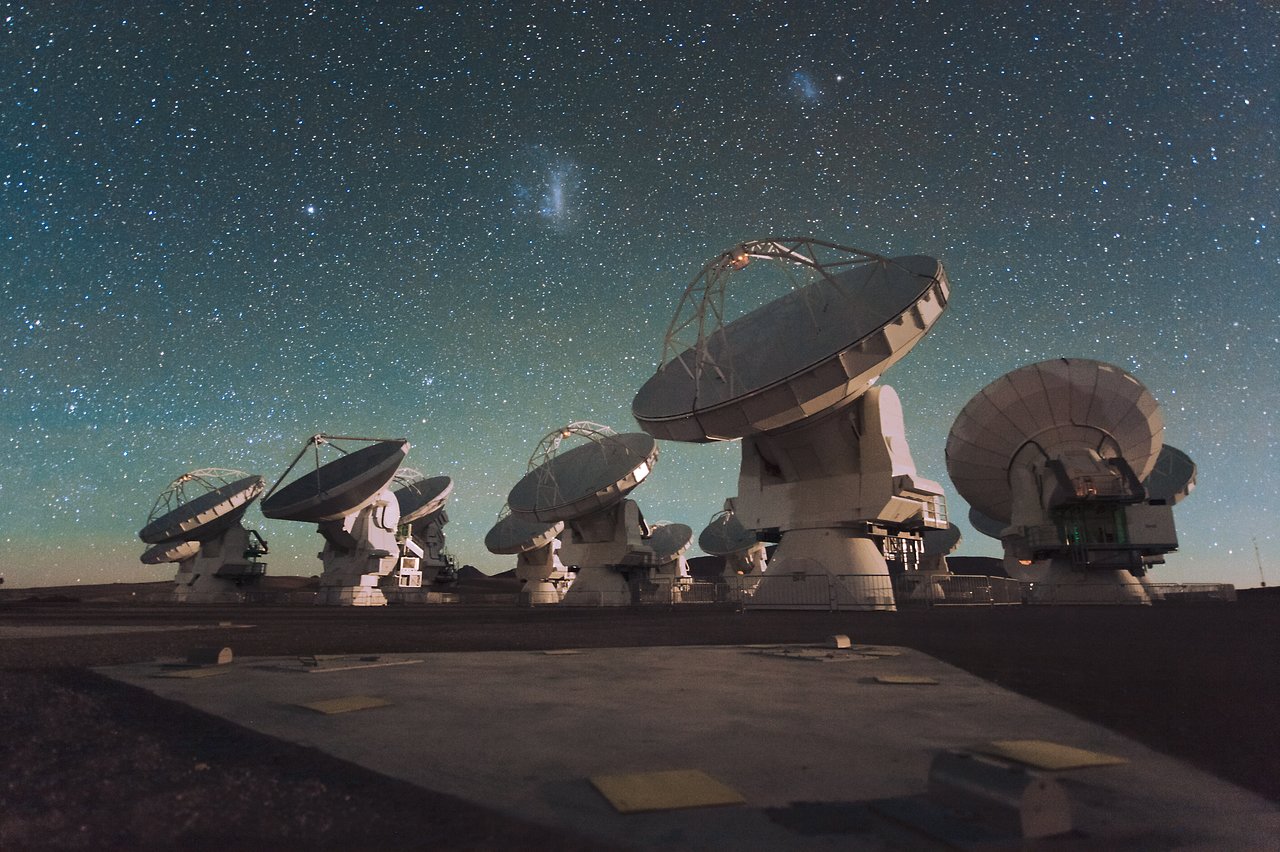
The team first looked at the system with the Atacama Large Millimeter/submillimeter Array in 2019 and found their observations seemed to tally with existing theories – two stars born together within a single large disk.
However, they did notice something odd. The tiny individual disks surrounding each star appeared oddly misaligned.
Unlocking a 3D puzzle
The team spent nearly eight years monitoring the system with ALMA to measure subtle shifts in the stars' movements.
"For the first time, we were able to watch two massive stars move around one another while they were still being born," says Yichen Zhang, corresponding author of the study.
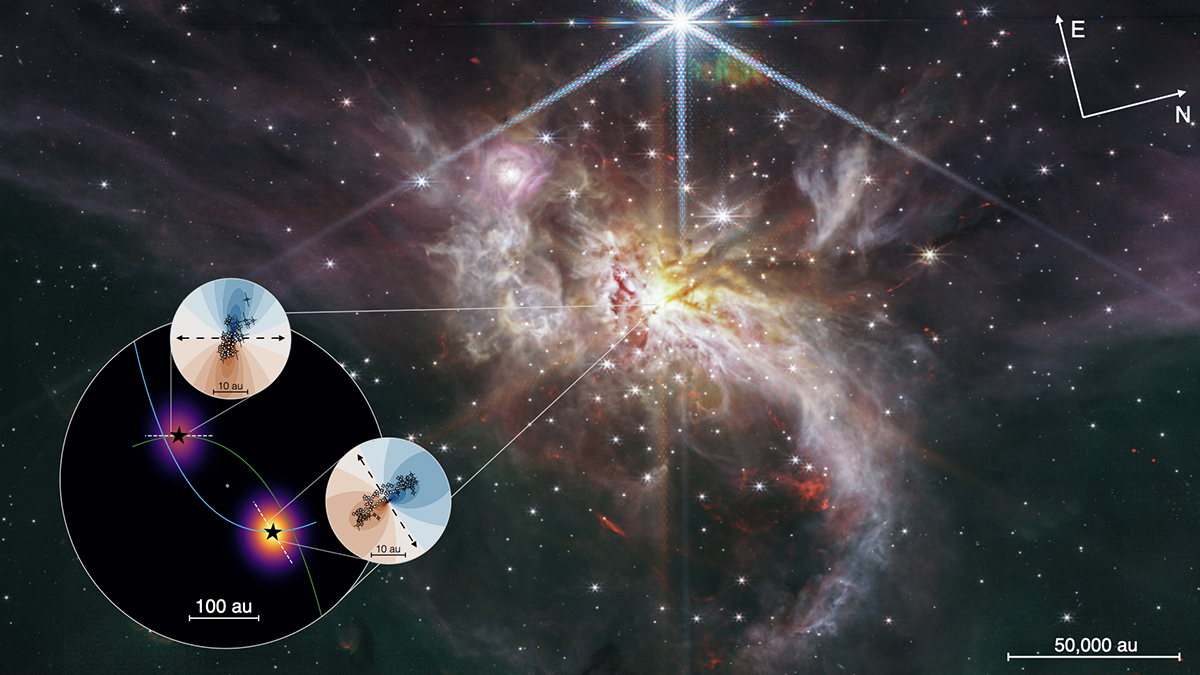
To construct a full 3D model of the system, the team combined ALMA’s tracking with observations from an array of different observatories: the Very Large Array, the Very Large Telescope and the James Webb Space Telescope.
"Each telescope revealed a different piece of the puzzle," says Rubén Fedriani, a co-author of the study.
"The combination of radio and infrared observations provides the most exquisite detail on the formation of this massive protobinary system."
"It felt like solving a three-dimensional puzzle," says Yao Wang, the study's first author.
"Each new observation added another piece, and eventually the orbit, disks, and jets all came together into a single, coherent picture."
Space ships in the night
When the 3D model was assembled, the team found that, rather than running on a smooth, circular track, the two stars are moving along a highly eccentric, stretched-out orbit.
As well as this, the gas disks feeding each star are sharply tilted relative to each other and heavily slanted against the plane of their shared orbit.
That gave the astronomers a big clue regarding the formation of the binary system.
If the pair had originated from the same disk, the two stars wouldn't be so out of sync with each other.
Instead, it's likely the two stars began forming separately in their own pockets of gas and dust. Later, a chance encounter dragged the pair together while both were still embedded in their disks.
The team calculate the stars made their closest pass to one another just 60 years ago. That's a fraction of a millisecond in cosmic terms.
Both compact star-forming disks survived the near-miss, preserving their original rotation structures intact.
"This study demonstrates that the early lives of stars can be quite chaotic, with a chance encounter leading to this gravitational dance and stellar coupling," says Jonathan C. Tan, a co-author of the study.
Will the pair keep on dancing?
The astronomers aren't certain whether the stellar pair will stay together forever.
They say the stars' current velocity sits on the edge between a permanently bound orbit and an unbound trajectory that could see them part ways over time.
Interactions with the gas will play a big role in whether or not the binary pair remains intact, but future observations will enable the team to better predict their ultimate fate.
The team plans to continue monitoring IRAS 07299−1651 while applying the same long-term 3D mapping techniques to other young, massive binary systems across our Galaxy.

