
On 10 January 2026, the Solar System’s largest planet reaches opposition.
This is the moment when Earth sits directly between Jupiter and the Sun, making the gas giant appear at its biggest and brightest for the entire year.
Jupiter is currently in the constellation Gemini and is positioned very high in the sky, lifting it above the hazy turbulence of the horizon for crystal-clear views.
What's more, the Moon is currently a thin crescent and is below the horizon for much of the night, making the sky nice and dark and perfect for stargazing.
Here are 10 top tips for observing Jupiter at its best on the weekend of 10 January 2026.
For weekly stargazing advice, sign up to our e-newsletter and subscribe to our YouTube channel

For naked-eye beginners
Look for the brightest 'star'
You don’t need equipment to find Jupiter at the moment, as it currently appears as the brightest 'star' in the sky.
Of course, it isn't really a star, but that's how it appears to the naked eye.
It will be visible all night as a brilliant, steady, whitish-orange light. If you've been out in the early evening and noticed a bright 'star' in the east, chances are you've already seen Jupiter.
Face east at sunset
At opposition, Jupiter rises in the east exactly as the Sun sets in the west. By midnight, Jupiter will be at its highest point in the south, and will set in the west at sunrise.
Get yourself a clear eastern horizon and you'll be able to see Jupiter rise as the Sun is setting.
Find the twins
Look for Jupiter in the constellation Gemini. It's positioned near the bright twin stars of Gemini, Castor and Pollux.
You may have already seen Jupiter as a bright star and wondered what those two other bright stars are to its left. Now you know!
Let your eyes adapt
For the best experience, give your eyes 20–30 minutes to adjust to the dark. Avoid looking at your smartphone or streetlights during this time to maximise what you can see.
You'll be amazed at how, even after 10 minutes in the dark, you'll begin to see more and more stars.
With binoculars
Spot the Galilean Moons
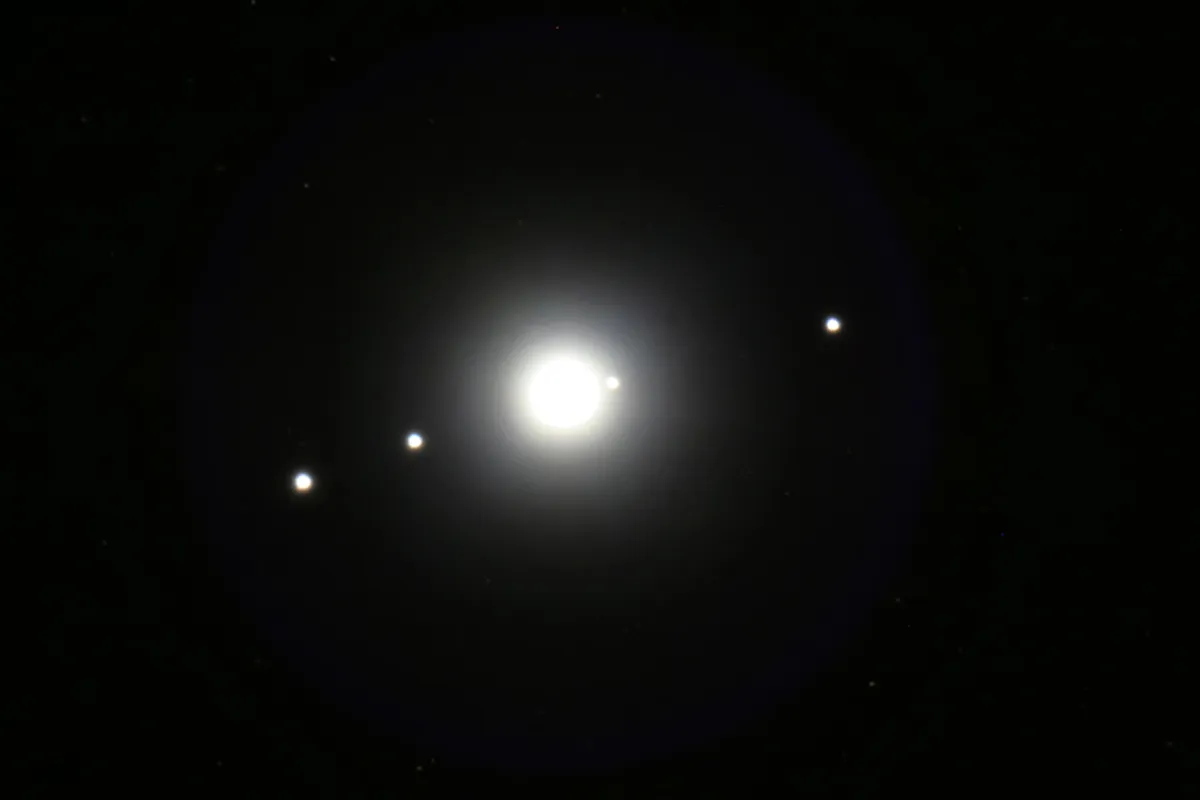
Even a standard pair of binoculars will give you a view of Jupiter's four largest moons Io, Europa, Ganymede, and Callisto.
These are known as the Galilean moons, named after the 17th century astronomer Galileo, who famously observed them through his telescope.
They look like tiny stars lined up on either side of the planet.
Steady your view
To see the moons clearly with binoculars, it's best to hold your binoculars steady. Lean against a fence or wall, or mount them on a tripod to stop the 'dancing' effect.
For more advice, read our guide on how to hold your binoculars steady.
See the 'squashed' planet
Because Jupiter rotates so fast, it isn't a perfect sphere.
In binoculars or a small telescope, you might notice its oblate shape. It looks slightly flattened at the poles and bulging at the equator.
You'll likely need a strong pair of binoculars or a small telescope to see this effect.

Through a telescope
Reveal the belts and zones
Even a modest telescope will show the stripes of Jupiter’s atmosphere.
When you first look at Jupiter through a telescope and note that it really does appear stripy, like in Hubble Space Telescope images, it's quite a revelation.
You’ll see dark belts and lighter zones caused by powerful jet streams and ice crystals in the planet's stormy atmosphere.
Hunt for the Great Red Spot
Use a telescope to look for the Solar System's most famous storm.
The Great Red Spot is an enormous cyclone within Jupiter's stormy atmosphere that's bigger than Earth, and which astronomers have been observing for hundreds of years.
But it isn't always visible from Earth. Jupiter spins incredibly fast – about once every 10 hours – so if you can't see it through your telescope, chances are it's on the other side of the planet.
A good tip is to use free software like WinJUPOS to check exactly when the spot will be facing Earth. Find out how to do this in our guide to measuring the Great Red Spot.
Watch a rare transit
When observing Jupiter through a telescope, it's possible to see its largest moons and their shadows pass in front of the gas giant. This is known as a 'transit'.
There are numerous Jupiter moon transits occurring this month. Find out when the next is happening in our guide to observing the night sky tonight.
And for more advice, read our guide on how to observe Jupiter through a telescope.
Share your Jupiter adventures and images with us by emailing contactus@skyatnightmagazine.com

