
Astronomers are saying this is the most detailed view ever captured of Pa 30, all that remains of an enormous exploded star.
This 'supernova remnant' was seen by stargazers in the year 1181, but no human eyes have ever seen it like this.
The observations show its 'firework' filaments are chains of tiny knots and are revealing more about how the central star was affected by the cosmic explosion.
More ancient astronomy
A piece of cosmic history
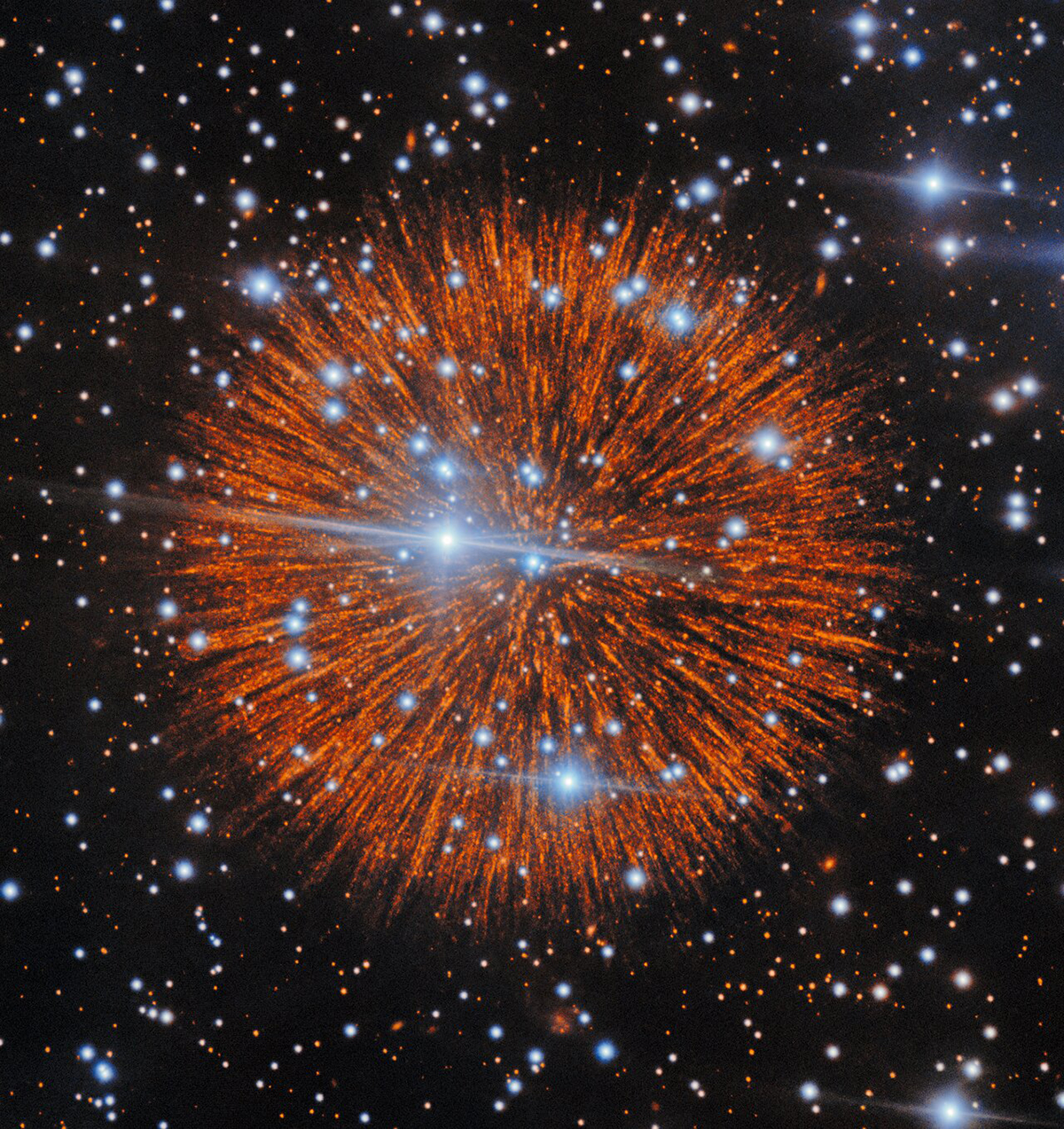
Pa 30 was captured here by the Gemini North telescope on Maunakea in Hawai‘i.
The image shows the remnant's firework-shaped ejecta forming a knot-like structure.
Named SN 1181, the supernova remnant is one of only five in the Milky Way that were seen in the sky before the invention of the telescope.
Historical texts show that Chinese, Japanese and Arabic astronomers observed the supernova between 4–6 August 1181.
It remained visible in the constellation Cassiopeia for 185 days, according to records.
Pa 30 was discovered in 2013 through a citizen science campaign searching for types of dying star known as planetary nebulae.
It was the 30th nebula found by American amateur astronomer Dana Patchick.
Astronomers then followed up the detection with professional observatories to reveal Pa 30's true structure.
What the new image shows
The new observations from Gemini North were led by Timothy Cunningham of the Center for Astrophysics, Harvard & Smithsonian and Ilaria Caiazzo of the Institute of Science and Technology Austria.
They say the image shows 10 times more filamentary structure in the supernova remnant than previously seen.
Also visible are radial filaments formed from chains of tiny knots of gas, which tells the astronomers there could have been thermal or density variations that gave the supernova the shape we see today, as ejected material streamed away from the explosion.
Astronomers say the central star left over has a temperature of about 200,000°C (360,000°F).
Stellar winds racing away from the star are zipping through space at about 10,000 miles per second (16,000 km per second).
Still standing
Astronomers say stars left over following supernova explosions are often kicked away from the supernova remnant.
But the central star of Pa 30 seems to be positioned almost exactly in the middle of the remnant.
This suggests the explosion was almost symmetrical, with no large kick having knocked the star off-centre.
This, the team say, suggests SN 1181 was a rare Type Iax supernova, making it the only known Type Iax remnant in the Milky Way.

