The outermost of Jupiter’s four giant Galilean satellites, Callisto is a fascinating world of ice, rock and mystery.
Discovered by Galileo Galilei in 1610, this massive moon holds the title of the third-largest moon in the entire Solar System and is nearly as big as the planet Mercury.
Unlike its neighbours, the other three of Jupiter's Galilean moons Io, Europa, and Ganymede, Callisto sits comfortably outside Jupiter's intense gravitational tug-of-war.
More Solar System facts

So while the other Galilean moons are influenced by so-called tidal heating as a result of their proximity to Jupiter, Callisto is largely unaffected by this process, meaning it's a sort of frozen, geological time capsule, preserving billions of years of impact history.
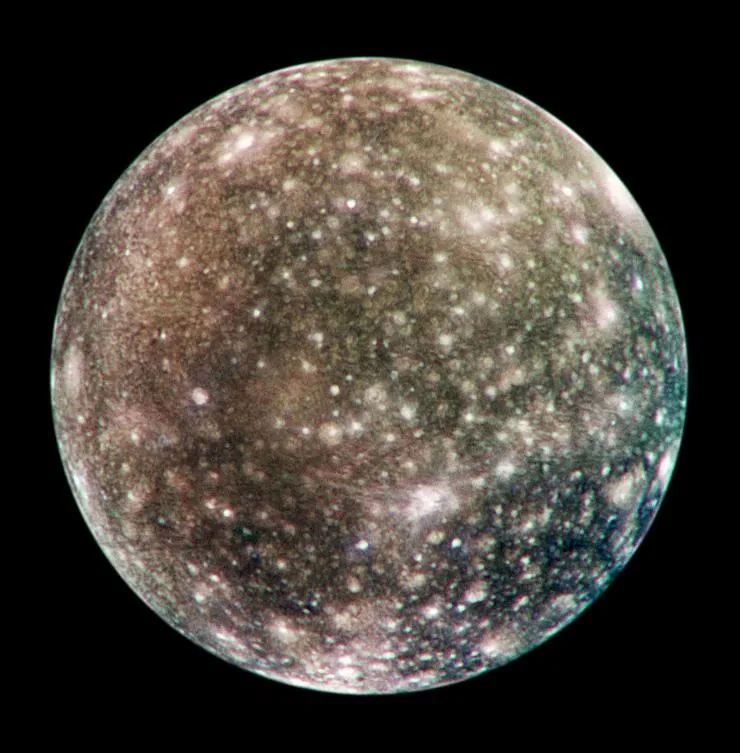
That's why Callisto is the most heavily cratered surface in the Solar System.
Here are 24 facts about Jupiter's amazing moon Callisto.

Callisto is the Solar System’s third largest moon
As Jupiter’s second-largest moon, Callisto is bettered only by Ganymede and Saturn’s moon Titan in the size stakes.
With a diameter of 4,821km, Callisto is around one-third larger than Earth’s Moon (3,475km), and only slightly smaller than Mercury (4,879km).
It’s the most remote of Jupiter’s Galilean moons
Orbiting Jupiter at a distance of 1,883,000km – just under five times the distance from Earth to the Moon, and 26.3 times the radius of Jupiter itself – Callisto is much farther out than Ganymede, Io or Europa.
Unlike the other three Galilean moons, its orbit isn’t locked in a mean-motion orbital resonance with the rest, which means it experiences no tidal heating.
It’s made of rock and ice
Rock – probably chondrites, similar to those found in meteorites – and water ice in roughly equal proportions make up the body of Callisto. Its ice content, estimated at 49-55% by mass, has remained high due to the lack of tidal heating.

Ganymede is the least dense of Jupiter’s Galilean moons
That means it also has the lowest surface gravity, at 0.126 g.
That’s quite similar to our own Moon’s 0.1654 g, and is another side-effect of Callisto’s lack of tidal heating, and its resultant high ice content.
It’s mostly covered in water ice and frost
Substances detected spectroscopically on Callisto’s surface include water ice, carbon dioxide, sulphur dioxide, and various silicates and organic compounds.
But water ice predominates, representing about 50% of the surface material by mass.
Its internal structure is not that well understood
Callisto is widely believed to have a silicate core, and possibly a subsurface ocean, but we don’t know for sure.
In fact, we don’t even know for certain if it is differentiated (layered, like the insides of the rocky planets) or not.
Callisto has a very thin atmosphere
Callisto’s atmosphere is mostly carbon dioxide and molecular oxygen. Chemically that’s not too dissimilar from Earth’s atmosphere, but you wouldn’t be able to breathe there – it has oxygen but, nowhere near enough of it!
A radiation hellhole it is not
Radiation on Callisto is 10 times the background radiation level on Earth – but that’s still less than you’d experience in low Earth orbit, or on Mars.
If it does have a subsurface ocean, it could harbour life
If there’s a subsurface ocean on Callisto, then some astrobiologists believe conditions there could be suitable to host organisms similar to the extremophile organisms found in hostile environments on Earth.
But given that said ocean’s existence is still theoretical, Europa remains the Solar System’s most likely candidate for hosting extraterrestrial life.

Callisto has the oldest surface in the Solar System
Almost the entire surface of Callisto is believe to be around 4.5 billion years old – in other words, it hasn’t changed much since it formed out of the material left behind when Jupiter emerged out of the Sun’s protoplanetary disc.
It’s absolutely covered in impact craters
Callisto has craters on craters, within even bigger craters, lying next to more craters!
On other planets and natural satellites, the craters left behind by impacts in the early days of their existence have largely been eroded by tectonics and volcanism – but Callisto doesn’t experience either.
Its topography is mostly impact-driven
Callisto’s largest surface features are multi-ringed basins – ie, giant craters that look a bit like a target or bull’s-eye.
The largest of these is Valhalla, whose outer rings stretch out over a diameter of 1,800km (1,100mi). Its smallest features are small knobs and pits that are believed to be the relics of – you guessed it! – even more craters.
Other features may result from sublimation
It’s believed that the sublimation of ice into water vapour (ie, without going through a liquid phase) is responsible for what little erosion does take place on Callisto.
As the high ice content of the surface material sublimates, it leaves the rocky content behind, causing debris avalanches down the sides of impact craters, and leaving ‘debris aprons’ (regions of loose, scattered rock) around their bases.

Callisto has no mountains
Mountains, whether on Earth or elsewhere, generally form as a result of either plate tectonics or volcanism – and as we’ve already seen, neither of these phenomena occur on Callisto. Hence: no mountains.
It’s tidally locked to Jupiter
This is true of most of the Solar System’s large natural satellites, and means that Callisto always presents the same face to Jupiter – just as here on Earth we only ever see one side of our own tidally-locked Moon.
Its two hemispheres look different
Callisto’s leading hemisphere (the side that faces in the same direction as its orbit) is darker than its trailing hemisphere (the side facing the other way).
This is the reverse situation to that found on the other three Galilean moons, whose leading hemispheres are brighter.
It’s thought to be the result of the leading hemisphere having more sulphur dioxide, whereas the trailing hemisphere is richer in carbon dioxide, though the reasons for this chemical asymmetry are not yet understood.

Callisto was first observed in 1610
Galileo and fellow telescopy pioneer Simon Marius are believed to both have spotted Callisto around the same time.
It’s named after a lover of Zeus
This naming system for Jupiter’s moons was proposed by Marius soon after their discovery in the early 17th century.
But that nomenclature wasn’t widely adopted until the mid-20th century, and so in around 300 years’ worth of astronomy literature, Callisto was more commonly known as Jupiter IV.
Its year is the same as its day
Callisto takes 16.7 Earth days to orbit Jupiter (its year). A day on Callisto – the time it takes to revolve on its axis, relative to the Sun – is also 16.7 Earth days.

Callisto was visited by Pioneer 10 and 11
These two early NASA probes flew by in 1973 and 1974, respectively, but didn’t tell us much we hadn’t already worked out from Earth-based observations.
Flybys by Voyager 1 and 2 in 1979 proved more scientifically fruitful, providing us with more accurate measurements of Callisto’s mass, size and shape.
The Galileo, Cassini and New Horizons missions have also visited
Cassini flew by Callisto en route to Saturn in 2000, as did New Horizons on its way to Pluto in 2007.
Both sent back new images and spectroscopic data, but much of what we know about Callisto is thanks to the Galileo spacecraft, which had eight close encounters with Callisto from 1994 to 2003 – the closest coming within 138km (85 miles) of the surface.
Three more missions are due to visit soon
ESA’s JUICE (Jupiter Icy Moons Explorer) mission, which launched in 2023, will conduct 21 close flybys of Callisto from 2031 to 2034. NASA’s Europa Clipper (launched 2024) is due to arrive in 2030 and will carry out nine flybys.
China’s Tianwen-4 mission, meanwhile, is due to launch in 2029 and is expected to put a probe into orbit around Callisto in 2035.
However, an alternative Tianwen-4 mission profile eschews the Callisto orbiter in favour of closer study of fellow Galilean moon Io, and the CNSA has not yet confirmed which mission profile it intends to adopt.

Callisto is the setting for a series of sci-fi novels
The Callisto series by Lin Carter is a series of eight ‘planet and sword’ (sci-fi meets fantasy) novels published by Dell Books in the1970s.
NASA has considered it as a possible space base
Those comparatively low levels of radiation that we mentioned early on? They’re the reason why NASA carried out a feasibility study called HOPE in 2003.
HOPE stood for ‘Human Outer Planets Exploration’, and the NASA researchers were looking at Callisto’s suitability for exploitation as a human ‘staging post’ en route to exploring the outer Solar System.
They concluded that a crewed mission to Callisto might be possible by the 2040s, but sadly no such plans have yet been announced.
What are your favourite Callisto facts? What have we missed? Let us know by emailing contactus@skyatnightmagazine.com