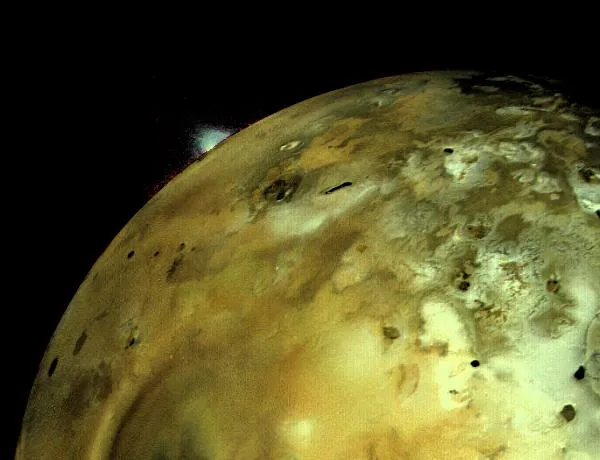
The third largest of Jupiter's four ‘Galilean’ moons, Io is a volcanic hell – a world stained with putrid hues of yellow, brown and red.
Pronounced 'EYE-oh', or sometimes 'EE-oh', the moon is in many ways the antithesis of the likes of Jupiter's moon Europa.
Yet that hasn’t stopped researchers from poring over every detail of its surface.
Io's volcanoes were confirmed in 1979 by planetary scientist Linda Morabito, who was part of NASA's Voyager team.
More Solar System facts
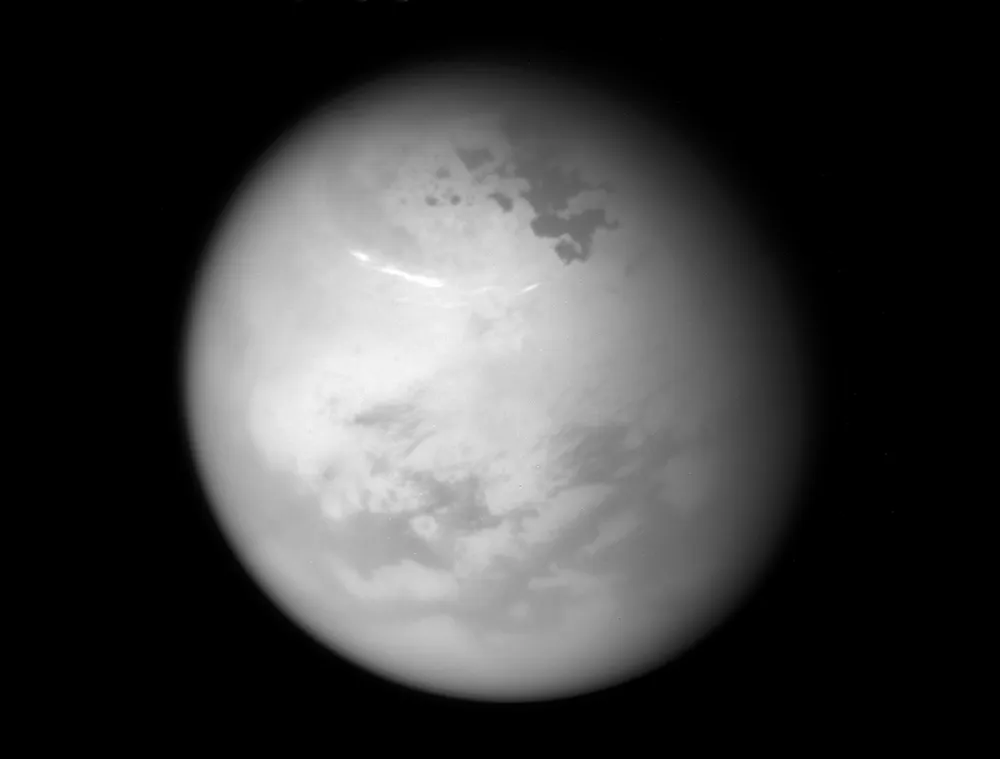
With ever improving ground-based technology and the Juno mission currently in the Jovian system, new insights into the activity of this pockmarked moon are being revealed every day.
There are even calls for a dedicated mission to explore this oddity among the outer planets.
Here are 28 facts about Io, the most volcanic body in our Solar System.

Io is the fourth-largest moon in the Solar System
That’s true whether you’re looking at diameter (3,643km, in the case of Io), volume (2.53 x 10¹⁰ km3) or mass (8.93 x 10²² kg).
In fact, the Solar System ‘Top 5’ is the same whichever of those three metrics you measure it by, with Ganymede in the No 1 slot, followed by Titan and Callisto, then Io and finally our own Moon.
It’s also the densest
With a mean density of 3.53 g/cm3, Io is denser than any other known moon.
It’s unsurprising, then, that it also has the most surface gravity – 0.183g, which means you’d weigh less on Io than you do on Earth, but wouldn’t bounce around quite as much as you would on the Moon, where surface gravity is just 0.165g.
It’s got almost no water
It’s a good job you’re NOT bouncing around on Io.
You’d get thirsty, and there’s nothing there to drink – Io has the lowest water content, by atomic ratio, of any known Solar System object (of any kind – so that’s including asteroids, comets and planets).

Io is the innermost of Jupiter’s four Galilean moons
Orbiting Jupiter at a distance of 421,700km (262,000mi) from the planetary centre and 350,000 km (217,000 mi) above the cloud tops, Io is the closest to its host of the four Galilean moons, and fifth closest-in of all 115 currently recognised Jovian satellites.
It’s tidally locked to Jupiter
Like most of the Solar System’s natural satellites (including our own Moon, and all others that are large enough to be round), Io is tidally locked to its host, meaning that the same face points towards Jupiter at all times.
It’s extremely geologically active
Over 400 active volcanoes have been identified on Io. These volcanoes are a direct result of the competing gravitational influences from two other Jovian moons, Europa and Ganymede, and from Jupiter itself.
The tug-of-war between these forces generates friction (and so heating) within Io’s interior, leading to the formation of volcanoes that shoot out umbrella-like plumes of sulphur and sulphur dioxide rising up to 500km (300mi) above the surface.

Io is mostly made of silicate rock
Io has a molten iron or iron sulphide core, which makes up around 20% of its mass, but the rest of it is mostly silicate rock – hence the satellite’s previously mentioned high density. In this respect, Io is more like the planets than it is like other Solar System satellites, which are generally composed of a mixture of silicates and water ice.
It may have a sub-surface ocean – of magma
If you’re looking for a sub-surface ocean of liquid water that could potentially support microbial life, Io’s not the place to start – try Ganymede or Titan. What Io may have, though, is a layer of molten magma, similar to that found in Earth’s mantle.
It’s home to some impressive mountains
There are around 115 named mountains on Io, some of which are taller than Mount Everest.
These mountains can be broken down into four basic types – mesas, plateaus, ridges and massifs – and the tallest of them is South Boösaule Mons, which rises to a height of 17.5km (10.8mi) above the surface.
Everest, by way of contrast, can manage a mere 8.85km, or 5.5mi.

Io is not going to win any beauty contests
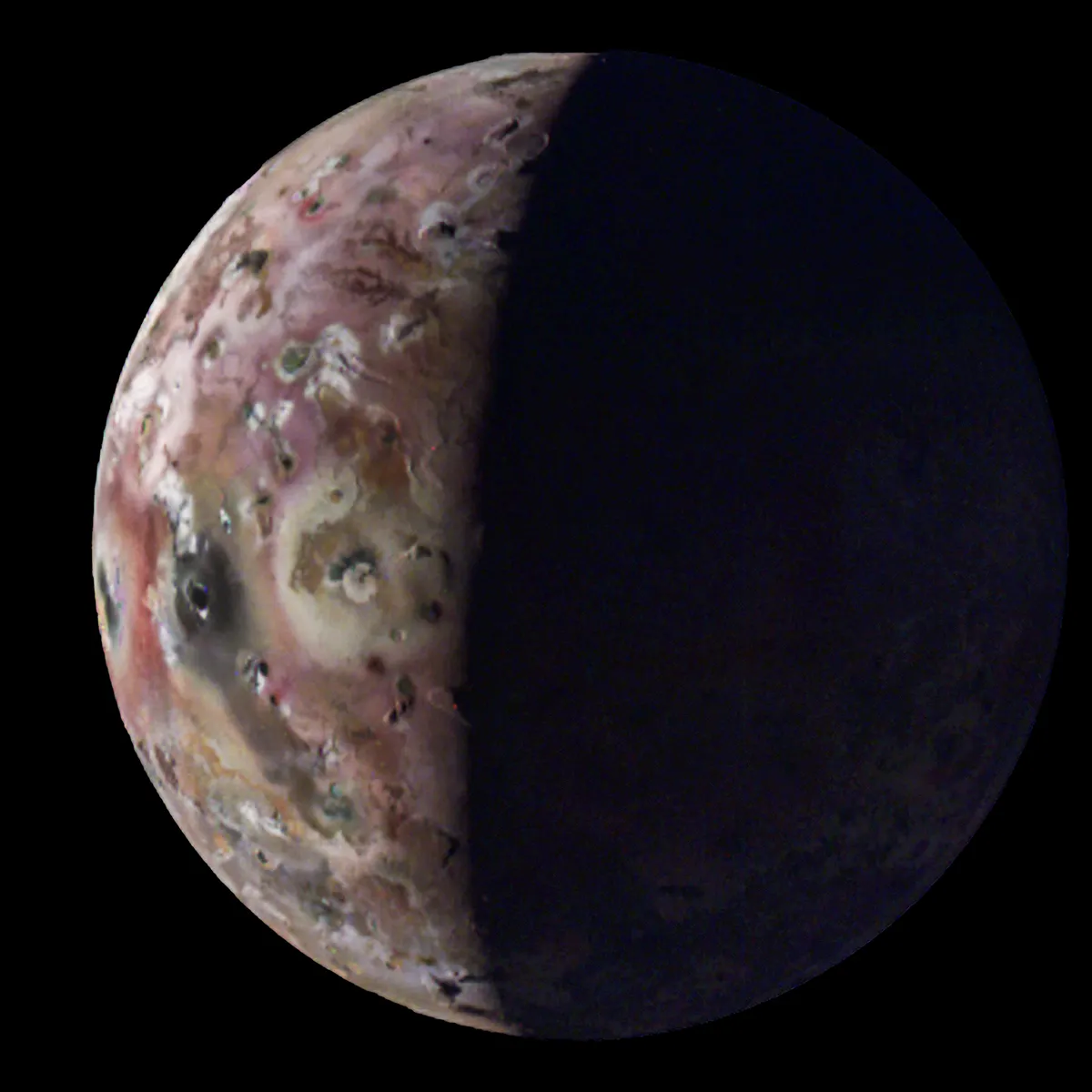
Look at an image gallery of Solar System moons and Io is the clear ugly duckling – it’s mottled green, red and yellow appearance is often likened to a pizza that’s been left out and gone mouldy.
That distinctive (and distinctly unappealing) colouration is the result of the gaseous plumes and lava flows that stream endlessly from all those active volcanoes we mentioned earlier, covering the surface in a layer of sulphur dioxide frost, and sulphur.
Its surface is remarkably smooth
Yes, there are volcanoes and mountains galore, but apart from that, the surface of Io appears to be remarkably flat – and geologically young.
Again, this is a result of vulcanism: Io would once have had impact craters, but over the aeons, lava from Io’s hundreds of volcanoes has filled them all in.
There are, however, a number of large depressions
These are called paterae, and they’re similar to the volcanic calderas found on Earth (such as the one in which Yellowstone sits, or the one that filled with water to form Crater Lake in Oregon, the deepest lake in America).
The largest of these is Loki Patera, which has a diameter of 202km (126mi) and is responsible for around a quarter of Io’s total heat output.
Io helps shape Jupiter’s magnetic field
As Io traverses the lines of magnetic force around Jupiter, it acts as a generator.
The moon can develop 400,000 volts across itself and create an electric current of 3 million amps, which contributes to the lightning seen in Jupiter’s upper atmosphere.
Were Io not there, it’s believed Jupiter’s magnetosphere would be less than half the size it is.
…and has very little atmosphere as a result
Jupiter’s magnetism strips away most of the material surrounding Io, such as the gases and dust from its volcanic plumes.
In fact, it removes around a tonne of such material every second of every day – leaving Io with a very thin atmosphere that’s mostly sulphur dioxide, with traces of sulphur monoxide, sodium chloride, atomic sulphur and oxygen.
Its atmosphere may freeze, periodically
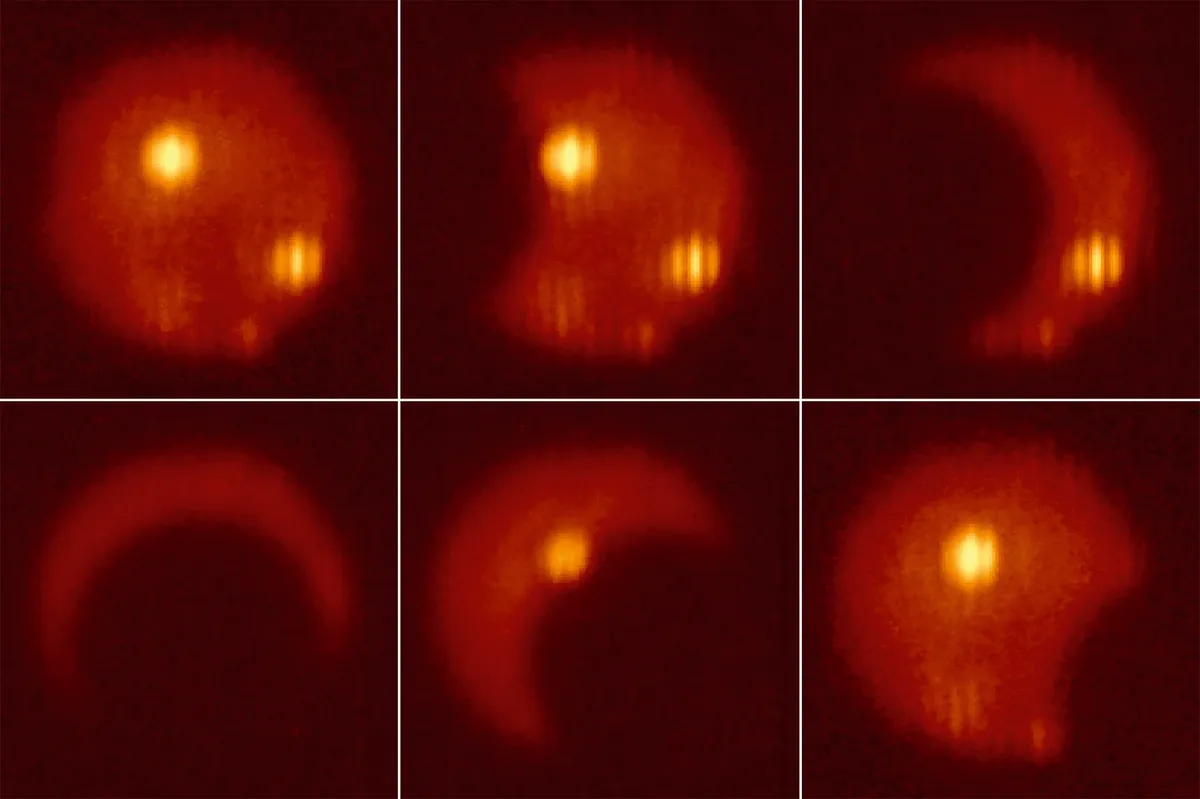
Each time that Io passes through Jupiter’s shadow – in other words, when it experiences an eclipse, just like the lunar eclipses we see when the Moon passes through Earth’s shadow – its surface appears to increase in brightness for around 15 minutes afterwards.
This is thought to be the result of its atmosphere freezing onto the surface during the eclipse, when Io is receiving far less energy from the Sun than normal.
Io is surrounded by a belt of radiation
While Io’s actual atmosphere is very thin, it’s surrounded by a much larger cloud of material – sucked out of the atmosphere by Jupiter’s magnetic field – made up of neutral sulphur, oxygen, sodium and potassium atoms.
Some of these atoms are then ionised by Jupiter’s magnetism, creating a band of intense radiation known as the Io plasma torus.
It experiences aurorae
There are aurorae on Io, but they’re not the same as those we see on Earth.
Aurorae on Earth are caused by charged particles from the Sun colliding with, and being deflected by, Earth’s magnetic field.
But Io has no magnetic field of its own – instead, the aurorae it sees are caused by charged particles travelling along Jupiter’s, and interacting with Io’s upper atmosphere as they do so.
It was first observed by Galileo in 1610
Using a refracting telescope with 20x magnification, Galileo Galilei recorded his observation of Io on 7 January 1610.
On that date he couldn’t resolve Io and Europa and the two appeared as a single object, but he first observed Io on its own the following day.
Simon Marius later claimed to have first spotted Io a week earlier than Galileo – but his observing notes were dated 29 December 1609 per the Julian Calendar, which equates to 8 January 1610 on the Gregorian Caldedar used by Galileo. Accordingly, credit for the discovery is traditionally granted to Galileo.

Io is named after a lover of Zeus
In Greek mythology, Io was a mortal princess from the ancient city state of Argos, who gave birth to Zeus’s son Epaphus and was later turned into a heifer.
Its features take their names from Greek mythology
Many features on Io are named after other characters and places that crop up in the myths and legends about Io: Prometheus, for instance, was Io’s grandson in Greek mythology, and is also the name of a 28km (17mi)-wide volcanic patera on Io.
Due to Io’s volatile, volcanic nature, other features take their name from deities of fire, the Sun, volcanoes or thunder from a variety of mythologies, as well as characters from Dante’s Inferno.
It used to be called ‘Jupiter I’
The system of naming Jovian satellites after characters from Greek mythology was first proposed by Simon Marius in 1614, but wasn’t widely used until the 20th Century. Which is why, in several centuries’ worth of astronomical literature, Io is referred to as Jupiter I.
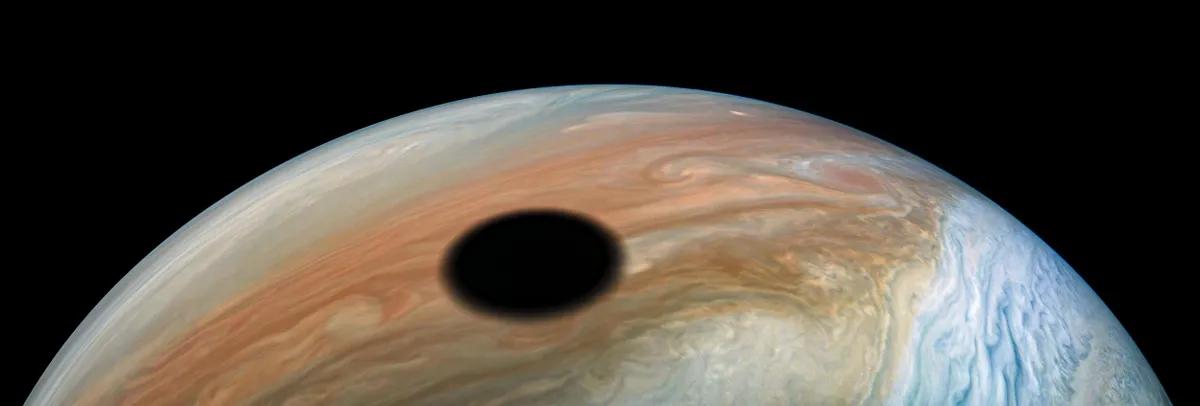
Image processing by Kevin M. Gill, CC BY 3.0
Io was instrumental in determining the speed of light
Observations of Io have been used to demonstrate or prove several important scientific concepts.
It helped established the Copernican view of the Solar System as being heliocentric rather than geocentric, was used by Kepler to demonstrate his Third Law of Motion and was a key reference point in working out the speed of light.
We used to think it was egg-shaped
Because the Ionian surface varies considerably in colour and albedo [brightness], particularly between equatorial and polar regions, some early observers suggested it may be ovoid in shape. As telescope technology improved, however, it soon became clear that such was not the case.
The first spacecraft to visit were Pioneer 10 and 11
The two probes flew by Io on 3 December 1973 and 2 December 1974, respectively. Though these two missions provided little in the way of imagery, their observations helped scientists determine Io’s mass, size, density and composition, and revealed the existence of the satellite’s radiation belt (the Io plasma torus).

Voyager 1 and 2 followed in 1979
Voyager 1 passed within 26,000km (12,800mi) of Io on 5 March 1979, sending back higher quality images than we’d ever had before and revealing the moon’s smooth, multi-hued surface and volcanic plumes.
Voyager 2 didn’t get as close, passing at a distance of 1,130,00km (700,000mi) on 9 July, but did help to confirm and refine Voyager 1’s observations.
Further fly-bys were conducted in 1995, 1997, 2000 and 2007
NASA’s Galileo mission visited in 1995, 1997 and 2000, and helped scientists understand the volcanic mechanisms at play on Io.
Cassini also passed by in 2000, en route to Saturn, while New Horizons passed Io on its way to Pluto in 2007. Again, these missions furthered our understanding of the satellite’s highly volcanic nature.
NASA’s Juno mission is still there
Launched in 2011, Juno arrived at Jupiter in 2016 and has been studying the Jovian system ever since.
Its eccentric orbit, which is designed to protect it from Jupiter’s intense radiation, means it only rarely near Io, but it has come within 1,500km (930mi) of the surface on two occasions (in December 2023 and February 2024), which has improved our knowledge of Io’s gravity.
Two future missions are planned
The European Space Agency’s JUICE (Jupiter Icy Moons Explorer) mission launched in 2023 and is due to arrive at Jupiter in 2031, while NASA’s Europa Clipper, launched 2024, should arrive in 2030.
There are no close fly-bys of Io planned for either mission (which are there to study icy moons and Europa, respectively) but both are likely to provide further observational data, particularly regarding volcanic activity.
What are your favourite facts about Io? Let us know by emailing contactus@skyatnightmagazine.com