As you’re probably aware by now, there’s a lunar eclipse coming up this week on 27/28 August (depending on where you're viewing from).
The eclipse will be visible across pretty much the whole of Europe, Africa and the Americas, although how much of it you’ll see, and how long for, will depend on your location, with observers in South and Central America and the eastern half of the USA due to get the best views.
What you may not be aware of, though, is how important lunar eclipses were in helping the earliest astronomers to realise that we live on a (roughly) spherical planet and not just a flat plane.
How did they work that out? Allow us to explain…
More debunking
Why lunar eclipses happen
Let’s start at the beginning. Just as a solar eclipse happens when the Moon passes between Earth and the Sun, a lunar eclipse happens when Earth passes between the Sun and the Moon.
In the case of a solar eclipse, the Moon blocks out the Sun’s light.
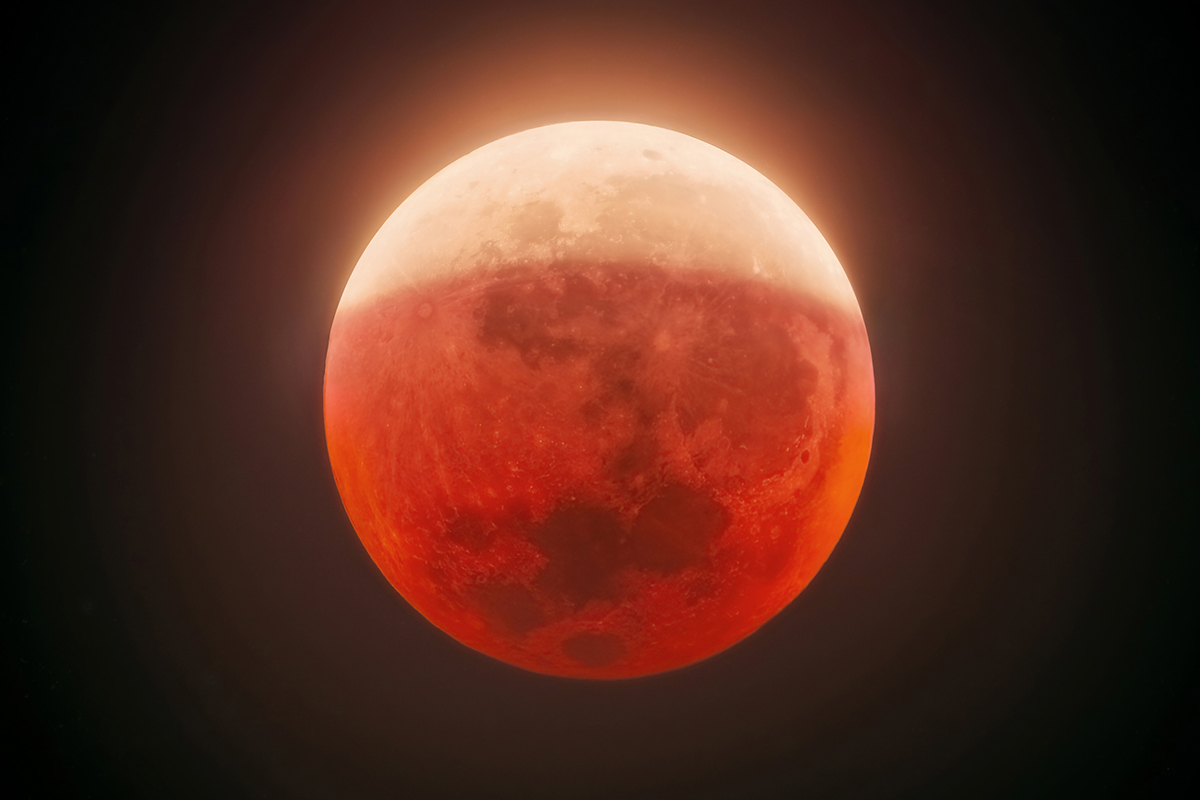
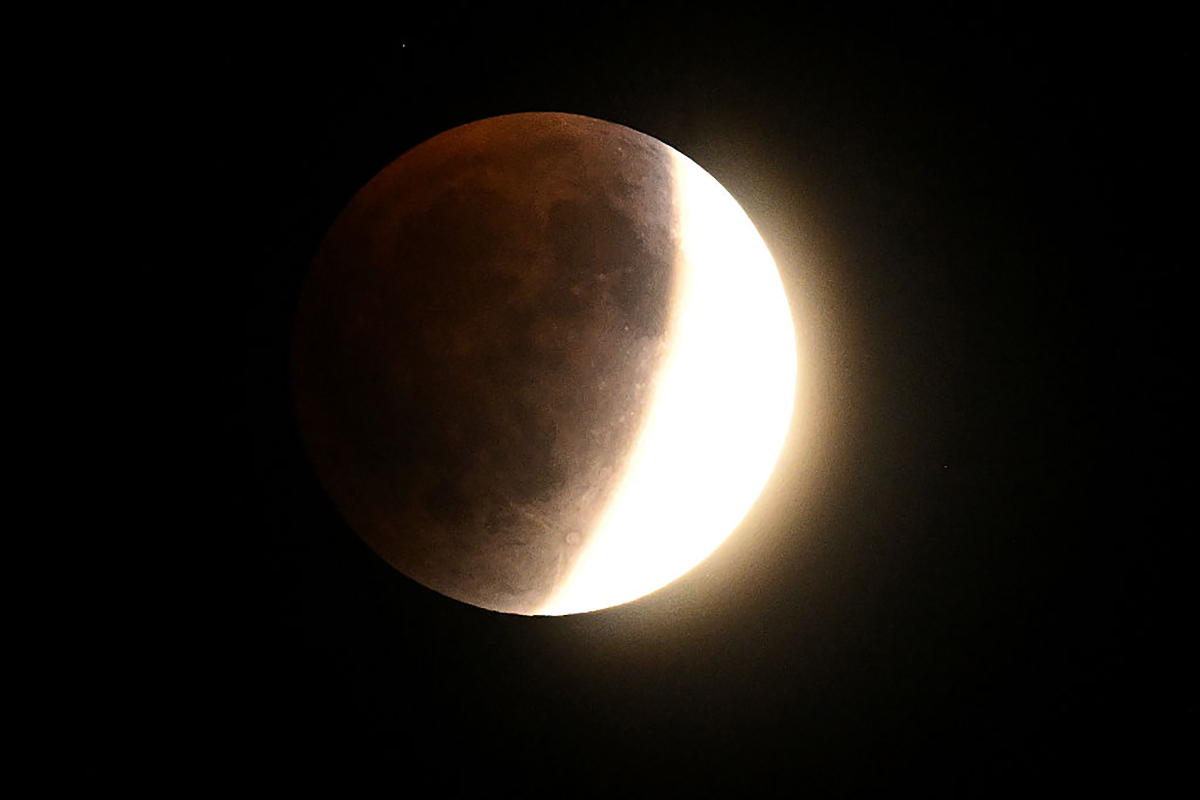
In the case of a lunar eclipse, we see dimming on the Moon due to the Moon passing through Earth’s shadow.
Earth, the Sun and the Moon line up in this way once a month during full Moon, but lunar eclipses happen only rarely.
That’s because the plane in which the Moon orbits Earth is tilted relative to the plane in which Earth orbits the Sun, by around 5°.
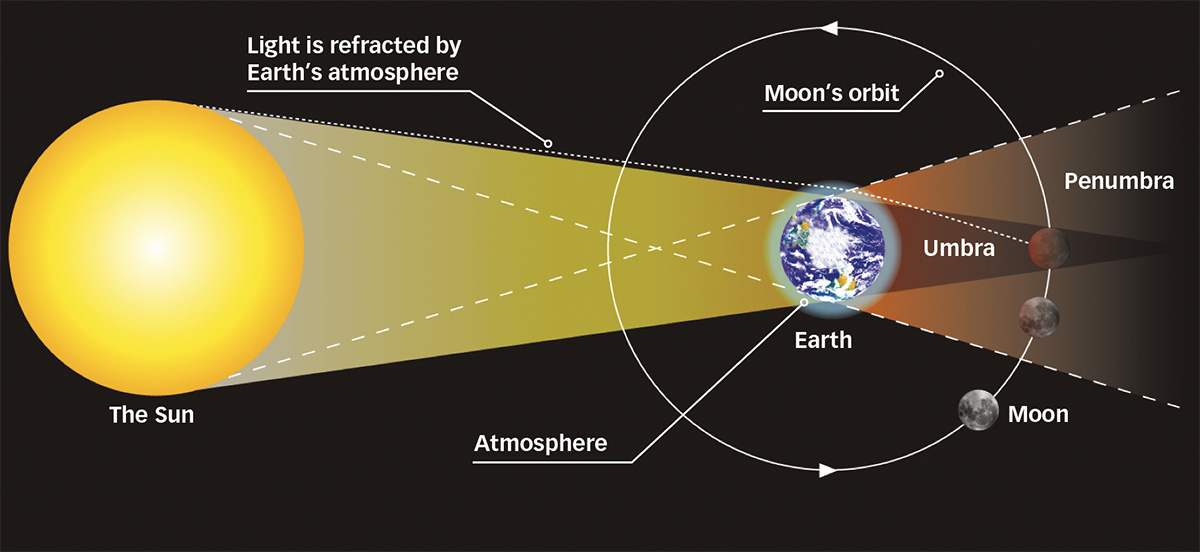
So while the three bodies line up roughly in a line relatively frequently, the Moon is usually sitting just above or below Earth’s shadow when it happens, so we don’t see a lunar eclipse.
Instead, lunar eclipses happen only on those rarer occasions when the Sun, Earth and Moon are in precise alignment.
That is, when they’re in a line and the titled orbital path of the Moon crosses Earth's orbital plane.
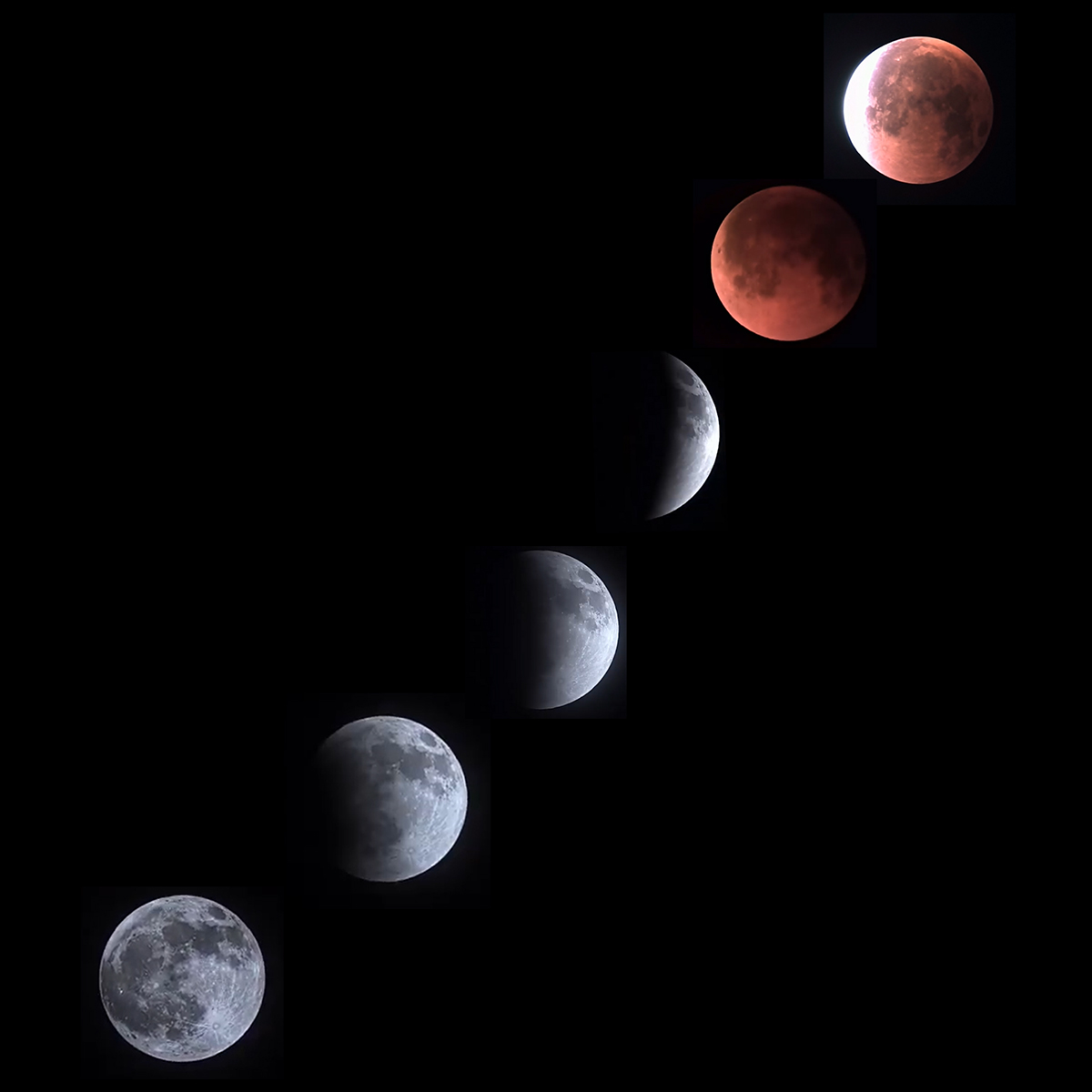
When that happens, an Earth-based observer will see Earth’s shadow encroach onto the sunlit face of the full Moon from one side, block it out almost entirely, and then slowly ‘exit’ the other side.
That’s during a full lunar eclipse, anyway. During a partial eclipse, Earth’s shadow will traverse part of the lunar surface but not block it out entirely.
During a penumbral eclipse, the Moon won’t fall into the darkest part of Earth’s shadow (the umbra) at all, but it will pass through the penumbra, with the result that an Earth-bound observer will experience a dimming of the full Moon’s light, but won’t see Earth’s shadow taking a ‘bite’ out of the lunar surface, as appears to happen during a full or partial eclipse.
Think Earth's flat? Look at its shadow!
It’s full and partial eclipses that we’re interested in, because that’s when the shadow cast on the Moon by Earth becomes visible.
And the key thing about that shadow is that it’s round, proving Earth is spherical.
But wait. Couldn't Earth be flat, circular and disc-like, but still project a round shadow onto the Moon?
Hold a CD up to the Sun and, if you get the angle right, the shadow it casts onto the ground is perfectly round.
But the thing with Earth's shadow on the Moon during a lunar eclipse is that it's always round, regardless of where on Earth you're viewing it from.
And whether you catch only the early stage of an eclipse, when Earth’s shadow is nibbling out a tiny crescent from one edge of the Moon, the middle stage when it’s casting the full Moon into darkness, or the end of an eclipse when the Moon is re-emerging into sunlight, Earth’s shadow is always round.
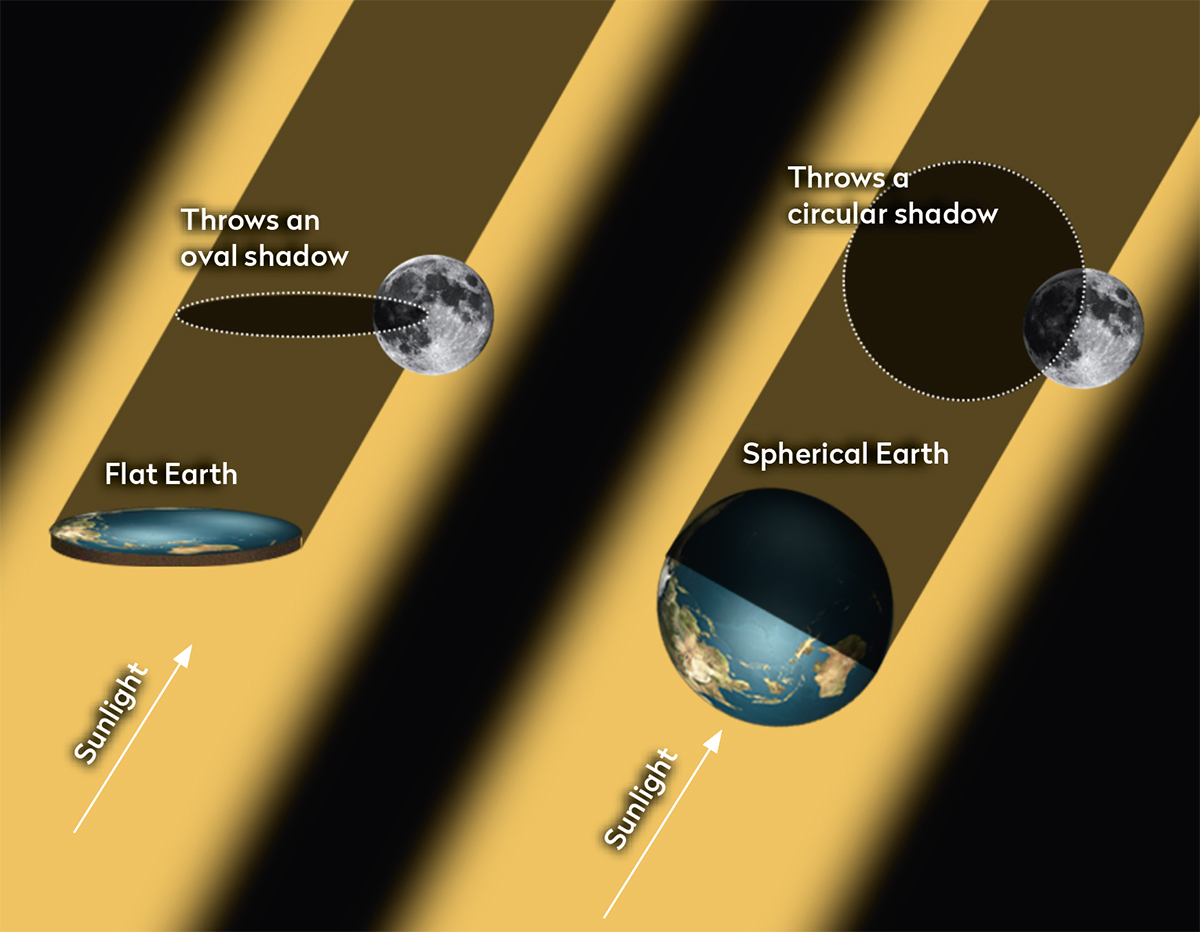
A disc- or coin-shaped object COULD throw a round shadow, yes – if the light source was directly above it and perpendicular to the surface on which the shadow was being cast.
But if the light was coming from any other angle, or if the surface was tilted in any way, then the object’s shadow would no longer be round: it would be elliptical, or even just a straight line (depending on the angle of the light and the tilt of the surface).
Test the theory yourself
If you don’t believe us, you can test this out for yourself at home with a torch, a frisbee and a blank wall.
You’ll find that getting the frisbee to cast a round shadow requires a very specific alignment and that even the slightest deviation from that alignment causes the shadow to be a different shape.
As we’re talking about enormous great objects that are hurtling through space at mind-boggling speeds, the shadow of a 'flat Earth' would also change shape significantly over the course of an eclipse as the angle and tilt changed.
But that doesn’t happen. Instead, the shadow cast by Earth onto the lunar surface during an eclipse is always round.
And the only 3D shape that always casts a round shadow, regardless of angle or tilt, is a sphere.
Again, you can check this for yourself at home. Swap the frisbee for a tennis ball or a grapefruit. You’ll find such objects cast a round shadow whichever way you hold them.
It was in this way that observing lunar eclipses helped early astronomers deduce that our planet is round.
It would be an exaggeration to say that lunar eclipses are ‘how’ they worked that out, because there’s a lot of other evidence for a round Earth: sunsets and sunrises, for instance (which occur at different times in different locations, whereas if Earth was flat, we’d all see the Sun rise and set at the same time).
Nevertheless, lunar eclipses were a key piece of evidence in early astronomers’ quest for a better understanding of how our Universe fits together.
So remember that when you’re gazing up at the Moon on 28 August!