If you’re struggling to sleep at night – all efforts at meditation, listening to podcasts, inhaling lavender or counting sheep having stalled – then it’s time to contemplate this mind-boggling question: what is the fate of the Universe?
If it had a beginning, then, logically, it must have an end, but what will that be? What will bring about the demise of existence itself?
The Universe began 13.8 billion years ago in a violently hot, dense, rapidly expanding state known as the Big Bang. Matter and radiation suffused everywhere.
The very fabric of space itself explosively expanded, and the Universe evolved.
But since this genesis, there has existed the ‘mother of all races’, one between gravity – the attractive force commanded by matter and energy, pulling everything together – and the expansion rate, initially fuelled by the Big Bang and now driving everything apart.
More mind-bending science

Which cosmic competitor will win? Who can know?
Here are the top five scientifically accepted theories predicting the future the Universe. Now grab your pillow and duvet!
The Big Freeze
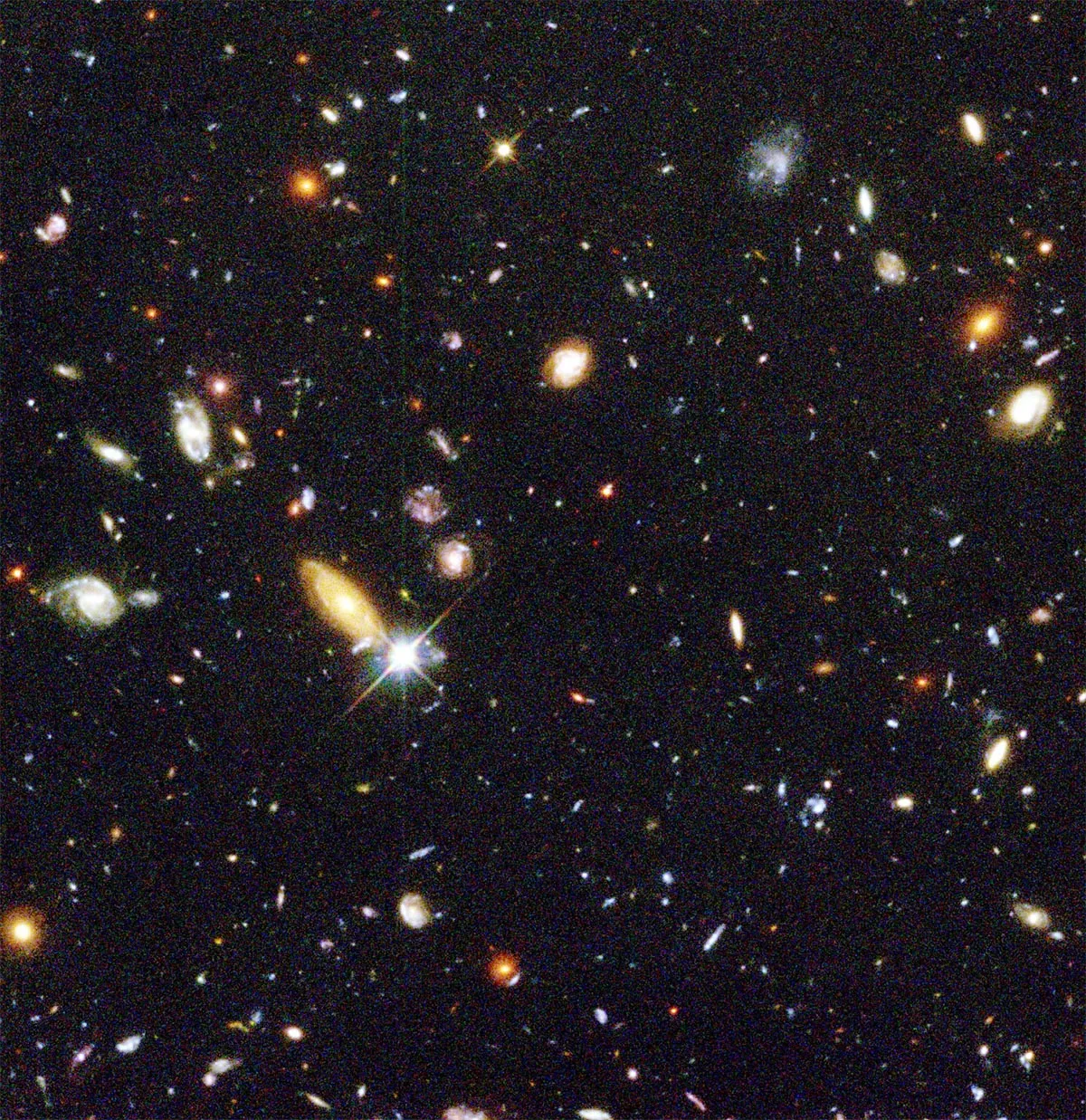
Given current data, the go-to option for the fate of the Universe is called the ‘Big Freeze’ or ‘Heat Death’ scenario.
It works on the proviso that our current laws of physics are correct and that the cosmos will behave as it has for a few billion years more.
In 1998 two independent teams of astronomers (led by Saul Perlmutter, Brian Schmidt and Adam Riess) studied light from distant supernovae and realised it was fainter than expected.
They proved that not only was the Universe expanding but this expansion was speeding up.
The driving force behind this acceleration was named ‘dark energy’ – a cosmologically constant, non-zero energy woven into the fabric of space itself.

However, we still have no idea what it is, what it is doing and what it will do in the future.
But as the Universe increasingly expands, matter will become less dense, diluting as the volume of the cosmos increases.
The dark energy density will remain constant, causing the expansion rate to take on a positive value.
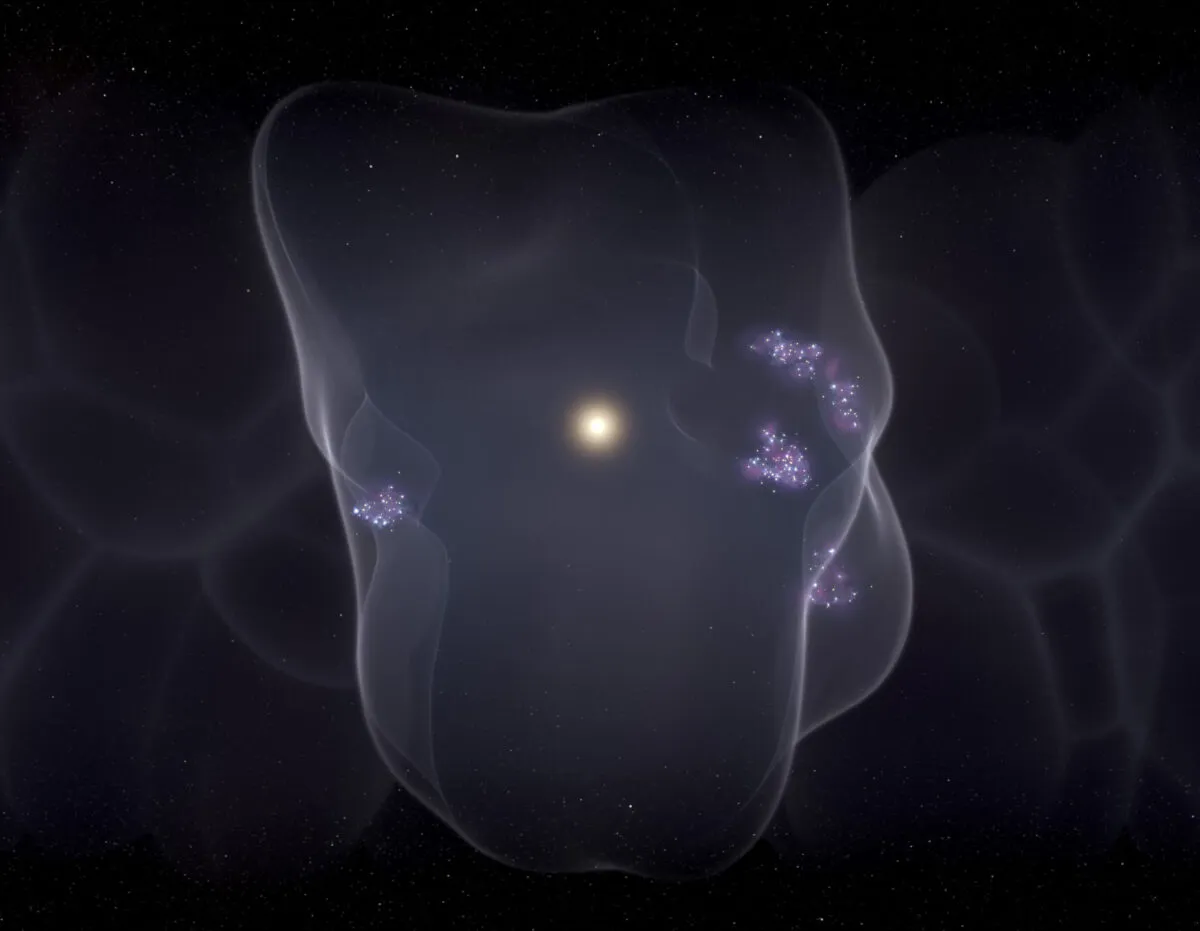
With insufficient matter and energy to gravitationally counteract the expansion, the Universe will exponentially expand, forcing apart all material that is not part of our Local Group – a bubble of space a few billion lightyears wide.
Already, 97% of the visible Universe is unreachable. Light from objects beyond the 13-billion lightyear observable boundary will diminish and redshift over eons until it completely disappears.
Even further into the future, large-scale objects could evaporate through quantum tunnelling, where particles of insufficient energy can still cross an energy barrier.
Behemoth black holes could shrivel due to Hawking radiation, theoretically emitted by quantum effects near the event horizon.
This is caused by the creation of virtual particle-antiparticle pairs in the vacuum of space; one falls into the black hole while the other escapes, the black hole loses mass-energy in a process known as evaporation, causing it to eventually shrink and disappear.
Ultimately, all that will be left of the Universe will be an expanding soup of subatomic particles, cooling en route to absolute zero – ‘heat death’.
In this thermodynamic shutdown there will be no temperature differences, no function and, therefore, no life. At this point, the Universe’s final temperature will hover just above absolute zero.
The Big Rip

Over the past two decades, measurements of the strength of dark energy have raised the possibility that it may not be ‘constant’ after all.
In the ‘Big Rip’ scenario, dark energy strengthens in magnitude, growing more powerful over time, becoming a ‘phantom dark energy’.
This new beast would cause the expansion rate to transition from a serene to an uncontrollable pace. Far-flung objects would hurtle away from us at a frenzied incremental rate.
As phantom dark energy builds, gravitationally bound galaxy clusters will disperse, individual galaxies will disband into stars and, like a game of cosmic billiards, planets will be flung into disarray.

Even atoms will become unbound until, allegedly, in the Universe’s death throes, subatomic particles – such as quarks – and the very fabric of spacetime itself will tear apart.
This ‘end beyond ends’ is the Big Rip.
Space effectively annihilates itself, becoming an almost reverse singularity where any understanding of ‘distance’ is demolished.
Thankfully, if this theory is correct, we still have a few hundreds of billions of years before it could happen.
The Big Crunch

In the 1920s, Edwin Hubble established that the Universe was expanding.
Later, when formulating his theory of General Relativity, Albert Einstein determined the cosmos was in perpetual motion and introduced a cosmological constant into his equations to counteract this, thereby endorsing the accepted thinking of a static Universe.
Russian physicist, Alexander Friedmann, decided that, after initial expansion, the fate of the Universe was determined by the mutual gravity of its content – its constituents and how much there is – altering that expansion.
Current observations affirm there is too little matter to slow down, or reverse expansion.
ut dark energy may be dynamical; it could change over time into another kind of energy, or even particles, not strengthening but weakening.

The current rate of expansion is consistent with a constant energy inherent in the fabric of space itself, but what if this energy density slackened?
As we have seen, if dark energy decayed to zero it could evoke a ‘Big Freeze’, but if it decayed to the point of becoming negative, it could bring about a ‘Big Crunch’, where space fills with a reverse intrinsic energy, leading to a total implosion of the Universe.
The cosmic web would contract, galaxies collide, matter would transition to plasma, atoms would smash together and subatomic particles would assume intense energy states – all on a timescale far longer than the epoch between the Big Bang and the present.
The Universe would end up as one large fireball with a near-infinite temperature, where neither time nor space would remain.
Vacuum decay

Our fourth possibility for the end of the Universe is based on the default settings of spacetime.
In the violent early years of the cosmos, ‘phase transitions’ – when a substance undergoes a rapid, radical transformation – led to the separation of the fundamental forces, crucially the weak nuclear force from the electromagnetic force, rendering, on the quantum level, our current, stable 13-billion-year-old Universe replete with particles and radiation.
But this ‘quantum vacuum’ Universe may not be in its lowest-energy, supremely steady state; it could be ‘metastable’ – awaiting change in another violent transition.
Random quantum oscillations could easily generate an entirely new ‘ground state’ with attendant lowest-energy particles, forces and fields.
Horrifically quicker than an instant, this unpredictable, revolutionary quantum bubble could spring from anywhere, hurtling outward at light speed, spawning a new Universe incongruous with anything we know and recognise today.
Fortunately, as far as we can tell, everything seems stable at the moment. And, on the plus side, if it did suddenly change, we wouldn’t have time to notice it happening.
The Big Bounce

But maybe all is not lost. There is a theory known as conformal cyclic cosmology (CCC), in effect a Big Bounce.
This idea draws on the Big Freeze mentioned earlier wherein a cold, vast, almost empty cosmos, with lone subatomic particles – neutrinos, electrons and dark matter – are incalculably distant from each other.
Incredibly, and it violates current laws of accepted physics, these particles could decay into photons, creating a spacetime of… emptiness, with no characteristics, no points of reference, no navigational markers… nothing.
But, on a more positive note, this Universal ‘end’ state could imprint itself on another, and perhaps bounce into another Big Bang trillions of years from now in a perpetual cycle of cosmic creation.
Of course, the fate of the Universe is a total unknown.
We can expand our minds by theorising and conjecturing, but scientists are certain that whatever befalls the cosmos as we know it, it will be a drama played out over a sweeping timescale – or ‘death scale’ – of tens of billions of years. So, for now and millennia to come we can sleep tight.